Easter 4: Held in his hand


This week’s contribution is offered by Clare Amos, Diocesan Director of lay discipleship and administrator of this blog. She focuses on the lectionary Gospel for this week, John 10.22-30.

As I write this reflection on next Sunday’s readings it has been an abnormally cold and changeable period, both in Switzerland and in several other parts of Europe. Last Saturday evening snow fell quite low on the Saleve – the mini-mountain which towers over Geneva, and a few spots of it still linger. Snow – in May! What is the weather coming to! So I was struck by the opening of this week’s Gospel reading, ‘It was winter’ (John 10.22). It certainly feels like winter here. John’s note about the season acts as a sort of interpretative frame for exploring the passage. Indeed it is fascinating to look at the link between the seasons and key episodes of the Gospel of John: spring/Passover (John 2; 6 and 12 – end); summer (John 4); autumn/Tabernacles (John 7-9) – and here winter. The reality of winter somehow affects the mood of the passage – there is a contentiousness and a seriousness about Jesus’ words. The passage looks towards the discussion about the close relationship between Jesus and his Father which will dominate the Farewell Discourses.

It is not only winter but, we are told, it is the Feast of Dedication. That is the Jewish festival – these days often known as Hannukah (which is basically a Hebrew word meaning ‘Dedication’) which commemorates the re-consecration of the Temple in Jerusalem during the time of Judas Maccabeus, (2nd century BC) after its desecration by the Seleucid (Greek) ruler Antiochus Epiphanes. Symbolic allusions to these events run through these verses, and the following section (till the end of chapter 10). In verse 36 Jesus’ self-description as the one who is ‘sanctified’ or ‘consecrated’ by the Father is intended once again as a reminder that he has replaced the Temple as the primary location where human beings can meet God. But more profoundly the passage teases out the question of Jesus’ personal identity. There were those who were wondering if Jesus was the Messiah (10.24) In the thinking of the time the military leader Judas Maccabeus was seen as a sort of proto-type of the Messiah, who was often understood as a military or political figure. That view was – as we know – something that Jesus’ himself sought to challenge. However the Messiah was seen as human – rather than divine. So the title did not say quite enough about who Jesus fully was. The passage therefore also highlights Jesus’ intimate identity with God the Father, ‘The Father and I are one’. (John 10.30) The Feast of Dedication gave added resonance to this claim – for two centuries earlier one thing that had scandalised the Jewish community was the claim by Antiochus Epiphanes to be ‘equal with God’ – which is in fact a claim linked to Jesus in John 5.18. Jesus’ words therefore would have been very difficult for at least some of his audience to hear.
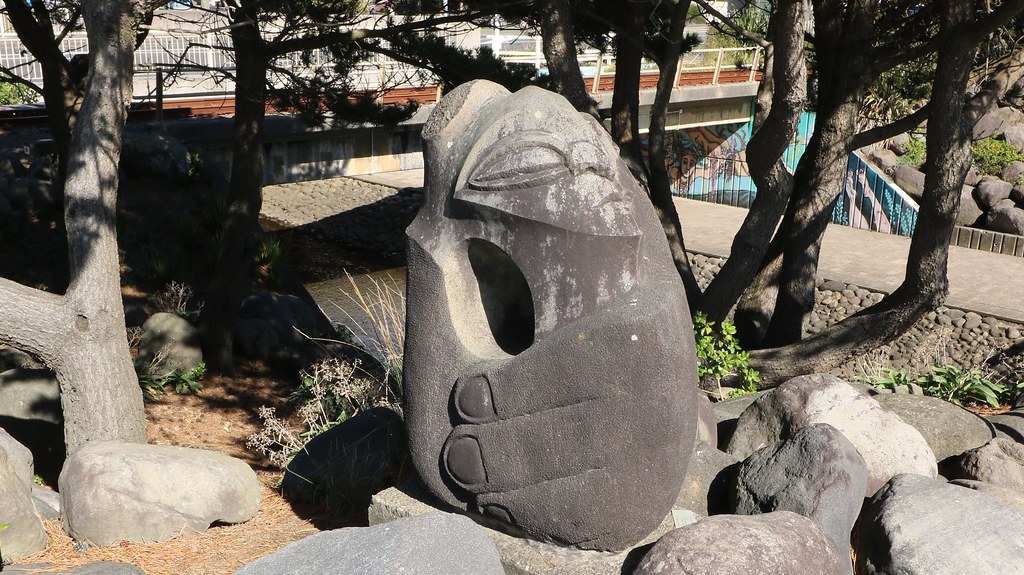
anchor stone

It is not an easy passage: it does feel ‘wintry’ in terms of human dynamics. Perhaps what we need to hold on to most of all however is the fact that we are ‘held’ by Jesus. The assertion that ‘No one will snatch them out of my hand’ (10.28) which has provided comfort for Jesus’ followers in many difficult places and times. The intriguing picture of a sculpture by the Tongan artist Filipe Tohi, on display in New Zealand links the hand of Christ to an anchor stone which holds a canoe safely.
Easter 3: The joy of resurrection

Keith Burrell, a Reader in Lyon, who has lived and ministered in the Diocese in Europe for many years, draws on this week’s lectionary readings (Zephaniah 3.14-end; John 21.1-19) for this post-Easter reflection.

‘The Lord will take great delight in you… will rejoice over you with singing.’ (Zephaniah 3.17). A much needed message of hope for today, particularly because I cannot remember a period when there has been so much bad news around. But hope there is, even as I start thinking about this verse on the train to Paris shortly after the terrible fire in Notre Dame, a fire which calls to mind the fire in York Minster when it was struck by lightening in 1984 and the one in Windsor Castle in 1992. And then on this Easter Sunday morning came the news of the murderous bomb attacks in Sri Lanka.

What is there to rejoice about? Zechariah’s message of hope takes on renewed meaning in the light of the resurrection, and Jesus’ proclamation of peace and love for a broken world. Despite Israel’s situation, Zechariah saw reason for hope in God’s joyous love for his creation, and there is hope for us in Jesus’ reinstatement of Peter – Peter the disciple who had denied him three times. Perhaps Jesus had that verse from Zechariah in mind when previously he had spoken of the joy in heaven over one sinner who repents (Luke 15). Be that as it may, Jesus has no words of recrimination for Peter. In fact, I think he rejoiced because Peter was still there among the disciples.

Jesus just has one simple question for Peter: ‘Do you love me?’ A question that every so often I feel he asks me. Do I love my Lord with all my heart, mind, soul and strength? Or do I hold little part of me back? Is he perhaps asking us all that same question today?

Both York Minster and Windsor Castle have been rebuilt – there is now scarcely any visible sign of those disasters – and already vast sums of money have been promised to restore Notre Dame.

Jesus calls us to offer the world around us something far more precious and valuable than money: love. Are we prepared to express our love for him by serving those around us and bringing joy, peace and love where there is none?

The little baby sitting opposite me in the train has an absolutely gorgeous wee smile. Will she still be smiling when she is grows up?

Are we bringing joy to our Lord, is he rejoicing over us because we are bringing joy and love to those around us by putting ourselves wholly at His service in every possible way and more?

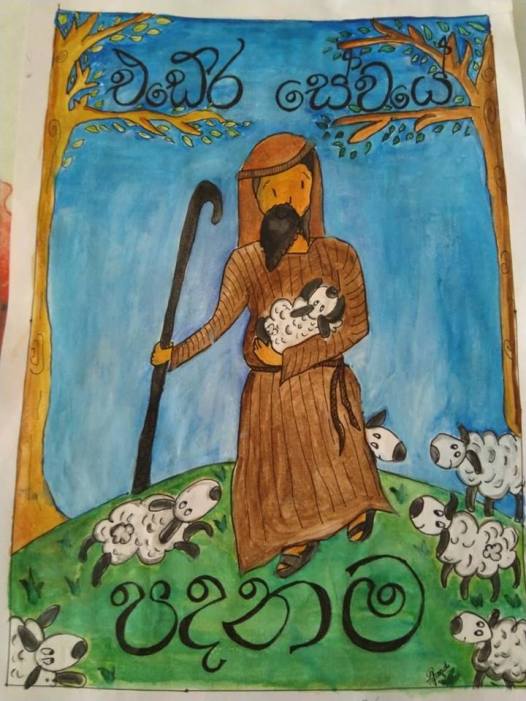
sri lanka good shepherd

This picture of the Good Shepherd – which comes from Sri Lanka and is available via the facebook page of the Anglican bishop of Kurunegala, Rt Revd Keerthi Fernando, reminds us of Jesus’ post-Easter invitation to Peter, ‘Tend my sheep’.

Easter 2: Beyond Doubt?

This week’s post-Easter reflection on John 20.19-31 is offered by Revd Viv Larkin. Viv is a retired Minister of the Uniting Church in Australia (an amalgamation of the Methodist, Presbyterian and Congregational churches), who is currently living in Mallorca, where she and her husband are ministers of the word in the Anglican chaplaincy on the island, under the Ecumenical Canons of the Church of England.

The experience of the resurrected Christ may not be as instantly transformative as we’ve often thought, but those who seek Christ’s self-revelation will grow into his mission.

Conventional wisdom says that the Resurrection and Pentecost experiences were so profound and overwhelming that they transformed a group of frightened and disillusioned disciples instantly into a fired-up bunch of fearless witnesses. The experience was so undeniable that their lives were instantly turned upside down. There is no doubt that their lives were turned upside down, but was it really as sudden as we have usually assumed, or does it just seem that way because we are reading an edited summary of the highlights?

There are some things in the gospel accounts that give cause for some doubts about this. And the doubts themselves may prove quite helpful and inspiring because they make the first experiences of the resurrected Christ sound a lot more like our experiences of the resurrected Christ.

On the evening of the day of resurrection, the disciples are locked away behind closed doors when suddenly Jesus appears among them. ‘Peace be with you,’ he says and then shows them his nail scarred hands.

Then he breathes on them and says, ‘Receive Holy Spirit.’ This is John’s account of Pentecost. It’s quite different from Luke’s because John doesn’t separate the experiences of Resurrection and Pentecost. In John when you encounter the risen Christ you receive his Holy Spirit. Jesus breathes Holy Spirit into them and commissions them as the continuers of his mission.

But what happens next? Jesus disappears for a week, and when he next appears, where are they? Locked in the same room again! The community that received the Holy Spirit and was commissioned to take on the world is still locked in the same room. And they’ve only grown by one – Thomas has turned up! And what’s more, their experience of the risen Christ and the Holy Spirit hasn’t even changed them enough to convince Thomas, so the mission of being witnesses to the world is looking to be in shaky hands.

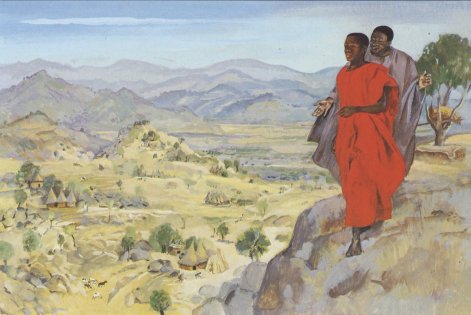
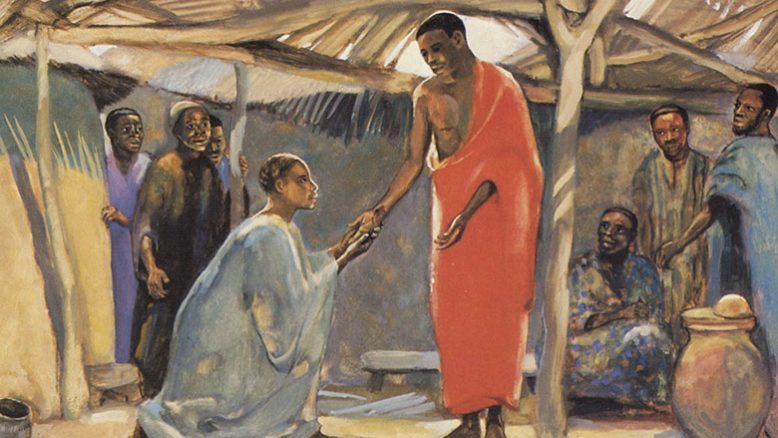
Jesus-MAFA-780-778x438 thomas
Thomas meets the resurrected Jesus: from La Vie de Jesus Mafa – a depiction of the life of Christ from the perspective of Christians in Cameroon.

If you are still unclear in your own mind about whether or not you have experienced the presence of the risen Christ, join the club. You’re in good company, for it seems that for most followers of Jesus, and even for these foundational few, the experience of Christ didn’t suddenly wipe out all the doubts and fears of their pasts and turn them into unstoppable world changers.

Even though quite a few of us could name the time and place when we were converted, others of us can’t, and none of us found that everything about our life was utterly transformed on the spot. It was the turning point, from which faith and hope and love began to take root and grow. Like the first disciples, we may well have still been huddled behind the locked doors of our fear and doubt a week later. But within a few years those few had carried the news to the ends of the known earth, and we are not the same people we were either.

As we continue to seek the risen Christ — in prayer, and in hearing the word and sharing around the table, and in serving the broken and needy among whom he was and is so often found — our faith and confidence continues to be nourished by the earth-shattering and yet strange and indefinable encounters with this one who lives and yet who remains both ever-present and ever-elusive.

As Thomas experienced, Jesus comes to us in our fears and responds to our doubts and touches us where we need to be touched so that we might have the faith and courage to take the next step. And just as happened for Thomas, the conversion of our lives leads us into the mission of transforming the world, for we too, with all the uncertainty and ambiguity of our experience of the risen Christ, are the ones to whom he gives his Holy Spirit and leads us into healing, reconciliation and mission.

In the name of Christ. Amen.

Easter Sunday: The same yet different


martin wharton pic.png

Bishop Martin Wharton, until his retirement Bishop of Newcastle in England, and now an Assistant Bishop in the Diocese in Europe, shares with us the life-changing news of Easter, drawing on the lectionary Gospel for Easter Day,  John 20.1-18.

Easter celebrates an earth shattering event. The most decisive, unique event in the history of the world. The raising of one dead, from the dead after he had been buried.

Look again at the story. The women come to the tomb early on the Sunday morning, but John’s Gospel only mentions Mary Magdalene because she was the first person to see the Risen Lord.

Why did the women come to the tomb? One answer is that they came to anoint the body. I find this improbable.

The tomb was secured by a very large stone. Those of you who have been to Jerusalem might have seen the huge stones used to secure tombs in 1st century Palestine. It was quite beyond the strength of a group of women to roll back the stone, enter the tomb and complete the anointing.

So why did they come? They came to mourn. Early on the Sunday morning there would be no one much about. Remember this was the man they had ministered to during his time in Galilee. This was he on whom they had pinned all their hopes.

Everything had been very rushed on that Friday evening. There was just time to wash the body, put on the grave clothes and seal the tomb before the Sabbath. So they wanted to mourn in quiet near the body and they went to the tomb just as dawn was breaking.

And what did they find?

The stone rolled back.

Now if you had been there and seen that, what would have been your first thoughts?

I think I would have had the same thoughts as Mary Magdalene. I would have said, “someone’s been at work here ……they’ve taken him away and we don’t know where they have laid him”.

John’s Gospel tells us that Mary rushed away to find Simon Peter and tell him. Peter got hold of the disciple who was Jesus’ special friend, John, and they both ran there.

It’s fascinating to see the differences in character between Peter and John. John got there first, but didn’t go in.

Peter always the impetuous one, full of good intentions, the leader, but not always good at carrying things through. John, not much of a leader perhaps, but the one with discernment and spiritual insight.

So we aren’t surprised that when they get to the tomb, John gets there first, but doesn’t go in. He just peers in and sees the linen cloths.

Peter, the impetuous one gets there second but goes straight in and finds the cloths lying there and the napkin which had been on the head of Jesus rolled up separately.

Peter, sometimes a bit slower on the uptake, doesn’t realise what this means. But John, seeing the shape of the grave clothes, realises.

Somehow or other, and it will always remain a mystery, the Lord had vanished! He had been raised.

That was what the strange arrangement of the grave clothes meant.

Peter saw what had happened. John had the insight to know what it meant.

There was nothing more to be done, so they returned home.

But Mary stayed there weeping. “They have taken away my Lord”. And that one word, “Mary”. She thought he was the gardener.

The Risen Lord was the same yet different. We find that again and again in the resurrection stories. The same yet different.

She couldn’t touch him because he had not yet ascended to the Father. The same, yet different. The first of his many resurrection appearances.

I am clear that Jesus’ body did disappear. He was raised from the dead. He is alive and he sits, as the creed says, on the right hand of the Father. This is the only explanation that I know of that fits the facts.

As for the claim that the story was merely made up – there was just no time for this to happen. Myths don’t appear overnight. People were still alive who knew what had happened.

As for the empty tomb, it is silly to think that the women went to the wrong tomb – they had only left it on Friday night.

The Romans had no reason to steal the body. Nor had the disciples. And if they had, where they laid him would have quickly become a place of pilgrimage – of which there is no sign at all. If the Jews had stolen the body, you can be quite sure they would have produced it. There is no other reasonable explanation. Jesus was raised from the dead. In any case, who would have made up such a story?

Furthermore, how could the disciples have been changed overnight from a group of beaten, depressed followers into a people vibrant and full of life and hope. How could the Christian faith possibly have got underway without a start like that?

Living, as we do, in a highly sceptical age, it’s important to deal with the historical evidence. Equally important is the way the risen Jesus – the same yet different – shows himself to the disciples in the coming weeks. They knew he was alive. We too, in our own way, have experience of him, know he is alive. We have received him as we shall at every Eucharist. We have experienced in our hearts what we call the grace of Our Lord Jesus Christ.

For the God who acted so decisively in raising Jesus to new life. In breathing new life into that disfigured and scarred body is, we believe, the same God who breathes new life into his people today.

The risen Lord is the same yet different. Our place in Europe at Easter 2019 is the same yet different. Britain has not left Europe. While economic, legal and institutional arrangements will be changed, our relationships with our partners and friends will continue. They will be the same yet different. And our task remains the same. The  task given to us by our Risen Lord to bring peace, wholeness and harmony throughout Europe and all creation.

Easter people. People made new by the Risen Christ. Filled with hope – for ourselves and for our world.

Palm Sunday: Paths of peace?

Dr Clare Amos, Diocesan Director of Lay Discipleship, reflects on Luke’s portrayal of Jesus’ entry into Jerusalem, based on the lectionary Gospel reading Luke 19.28-40.

Traditionally we call the Sunday coming up ‘Palm Sunday’ – but this year, the year when the Gospel of Luke provides the lectionary reading, perhaps it isn’t and perhaps we shouldn’t. Because if you look carefully at the appointed reading, Luke 19.28-40, you will find that – unlike Matthew, Mark and John – there are no palms mentioned in Luke’s story, not any other sort of greenery. In fact Luke’s account of Jesus’ arrival in Jerusalem is far less triumphalist than that of any of the other gospel writers. Although Jesus is proclaimed as a king (19.38) it is clear that he is a very different sort of king from people’s normal expectations.

One of the striking features of these verses in Luke is the use of the word ‘peace’ – it appears in 19.38, and then is repeated in verse 41 (technically beyond the lectionary reading – although it clearly links to it). The word ‘peace’ is not used at all in the story as it is told by the other Gospel writers. Yet it is fundamental to Luke’s understanding of the meaning of these events.

It is also, I suspect, no accident, that Luke more than any of the other Gospels emphasises that these events are taking place on the Mount of Olives (19.29, 37) since the olive itself is an ancient symbol for peace. Did those who celebrated Jesus’ entry into Jerusalem that day realise that they were welcoming a prince of peace? At first sight it looks as though they must have done, with their song of celebration, ‘Peace in Heaven’. Yet look carefully: for the song is an ironic counterpoint to that sung by the angels at Jesus’ birth. The angelic choir chanted, ‘Peace on earth’, while Jesus’ disciples now sing, ‘Peace in heaven’. Surely we should be on the side of the angels: it is peace on earth that we need and are called to struggle for! ‘Peace in heaven’ can become all too easily an escapist diversion. Peace-making has to happen on earth, and it is an activity that can be very costly indeed to those who are brave enough to engage with it. With Jesus’ lament over Jerusalem, Luke then goes on to explicitly remind us (19.41-44) of the tragic consequences of the lack of peace. Today is a moment of decision not only for Jesus but also for Jerusalem, and the shadow of the cross is already case firmly across his path. Instead of green foliage, Jesus’ path in this Gospel is strewn with rocks and stones.

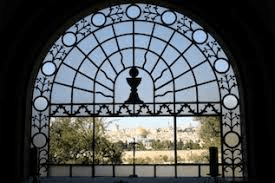
dominus flevit

The chapel of the church of the Dominus Flevit which commemorates Jesus weeping over Jerusalem

There are many clues within the Gospel of Luke that the writer took very seriously the political and historical context in which he wrote – the Roman rule in Palestine, which included the Roman claim that they brought to the land the ‘Pax Romana’ = ‘Roman peace.’ Immediately before his entry into Jerusalem Jesus has told a parable which clearly alludes to Archelaus, one of the sons of Herod the Great, initially installed by Rome as client king over Judaea and Samaria after his father’s death, but then exiled 10 years later because his incompetence and cruelty scandalised even his Roman overlords. This parable is recounted by Jesus, we are told, ‘Because he was near Jerusalem, and because they supposed that the kingdom of God was to appear immediately.’ (19.11). On the one hand Luke clearly believed that the incarnational nature of Jesus’ ministry meant that context was inescapable. Jesus spoke and speaks into specific human situations and needs. On the other hand, however, it seems also that Luke wants to make clear that Jesus’ ministry transcended the normal political answers. Indeed it could be said that Jesus was crucified partly because he refused to follow one of the ‘obvious’ paths taken by others, whether that be collusion with the Roman authorities, or armed revolt against them.

It is interesting to read and write about these New Testament events in this particular week. As I write I do not know whether the United Kingdom will leave the EU in two days’ time or not – which is certainly a political event weighing heavily upon many of us in the Diocese in Europe. Although we may have strong feelings one way or the other, perhaps the message I take from this weekend’s Gospel reading is that there is no easy, obvious, ‘Christian’ answer to the political challenges and turmoil we currently face. Certainly we are called to be peace-makers but we cannot just capture Jesus for our own political point of view. Yet at the same time I am sure to the inmost core of my being that my faith in the Jesus who journeyed to Jerusalem and wept over the city as he approached it demands that however wearying it may be I continue to care passionately about the political turmoil in which we currently find ourselves. For it is in that perplexity that I will find Jesus journeying to Jerusalem, to the cross and eventually to the resurrection.


Fifth Sunday in Lent : A new thing in an old city


Revd Dr Justin Lewis-Anthony draws particularly on the Old Testament lectionary reading, Isaiah 43.16-21, on this reflection for the approach of Passiontide.

Rome is the Caput Mundi, ‘head of the world’. Rome dates its foundation and its glory to 753 BC, and for much of the time since then it has dated its history ‘AUC’, Ab Urbe Condita, from the founding of the city. The Eternal City has a date; welcome to AUC 2772.

The age of Rome is a shock to someone who comes from a more recent culture, a less historic country. There are rocks by the side of the road in Rome which, if they were to be found in England, would justify their own museum exhibition. And the commonplace nature of old things (the ubiquity of antiquity?) applies to churches as well. As someone said to me when I arrived in here, ‘There are 900 churches in Rome: only 850 of them are significant.’

Which is why God’s promise to the people of Israel in Isaiah can be so shocking to hear in a place which prides itself on its age: ‘I am about to do a new thing; now it springs forth, do you not perceive it?’ And worse: ‘Do not remember the former things, or consider the things of old.’ How do we understand this, especially when we live in an old, venerable city?1200px-Colosseum_in_Rome,_Italy_-_April_2007

There are two dangers when we think about things old and new: one is to cling to the old things because they are old. The other is to embrace the new things because they are new. This is what C.S. Lewis called ‘chronological snobbery’, to think that the mere passage of time has anything to say about the worth or value of any given object or idea. We think ‘I am so much better than my ancestors because I live later than them’, or we think ‘I am so much worse than my ancestors, because I live later than them.’ But time is not the measure of goodness, in God’s eyes.

Instead we should seek to understand the ways in which God has acted in the lives of our brother and sister Christians in the past, the ways in which He acts in the lives of our fellow human beings today, and to perceive the ways in which He will bring new, wonderful, things into being in the future. Everything must be tested, not by its age or its novelty, but by the way it expresses or denies the kingdom of God. As Paul says, he finds his fulfilment not in the history of his people, or the dignity of his lineage, but in the ‘surpassing value of knowing Christ.’ We find that knowledge in the lives and faces of our brothers and sisters, made in the image of God, and for whom Christ died, whether they lived yesterday, today, or tomorrow.

A sense of history is a valuable thing to set against the short-term and short-sighted view of most humans: we have been here before, in grief, confusion and joy. Those who follow us will experience the same mix of emotions and uncertainties long after we are forgotten. But, in the love of Christ Jesus, we find the hope of eternity.

In the meantime, I must try the ‘Caput Mundi Pizzeria’ I saw near Termini station. I wonder if its pizzas are fresh?

Justin Lewis-Anthony is the Deputy Director of the Anglican Centre in Rome, having previously ministered in England, Canada and the United States.

anglican centre logo

The logo of the Anglican Centre: The dove on the tree in the centre, holding a piece of foliage is a sign of the Holy Spirit, as a bringer of good news, as was the dove which brought this sign of new beginnings to Noah. The dove is also a sign of the Kingdom of God of which Christ spoke, this kingdom being like a tree in whose branches many birds may come and roost. The mosaic style is typical of the northern Mediterranean in which Rome and Italy are set.

The cross is a sign to us of the triumph of God in Christ over the power of sin and death. The butterflies are a sign of the resurrection, the liberation and freedom that God’s new creation can mean for us and for all the world. The shell is a symbol of the common baptism of all members of the Body of Christ on earth.

The Anglican Centre in Rome is therefore a site of the good news of a new creation.

Fourth Sunday of Lent: The reckless love of God

Drawing on all the lectionary readings appointed for the Fourth Sunday of Lent (Joshua 5.9-12; Psalm 32; 2 Corinthians 5.16-end; Luke 15.1-3, 11b-end), Canon John Wilkinson, Associate Chaplain and Canon Pastor at the Pro-Cathedral of the Holy Trinity, Brussels, challenges us to model God’s own grace in our lives and links.

* Oh, the overwhelming, never-ending, reckless love of God
Oh, it chases me down, fights ‘til I’m found, leaves the ninety-nine
I couldn’t earn it, I don’t deserve it, still You give Yourself away
Oh, the overwhelming, never-ending, reckless love of God

It is good in the middle of Lent to be reminded that it is not all doom and gloom. Indeed Lent is not just about repentance; it is primarily about celebrating the boundless grace of God, in Christ, which both makes sense of penitence and makes it possible.

For the people of Israel, the purpose of the Exodus had been accomplished. The Prayer over the Water in our baptism liturgy speaks of God having ‘led his people through the waters of the Red Sea to freedom in the Promised Land’, but here at Gilgal, having experienced a similar crossing, this time over the Jordan, the people had now arrived in the Promised Land.  They were now in the right place, the place of restoration, of fulfilment, of restoration.  And in the context of this restoration, the sign of the covenant, circumcision, could be restored, and the sign of the rescue, the Passover, could be celebrated.

But they were able to do that because of the grace of God, who had said to Joshua, ‘Today I have rolled away the reproach of Egypt from you.’, upon which message the name Gilgal is a play on words.

Our psalm picks up the theme. The overarching theme is that despite our failure to confess our sins, and continuing propensity for disobedience, the grace of God continues to be active and powerful.

‘Blessed is the one whose transgression is forgiven, whose sin is covered,’

cried out the Psalmist, knowing who it was who forgave and covered his sin.

‘Blessed is the one against whom the Lord counts no iniquity, and in whose spirit there is no deceit.’

It is as ever, the Lord himself who restores and reconciles.

And Jesus too speaks of this in this parable.   Amongst all the other themes, there runs through it a golden thread of grace; the grace of a Father, patiently and lovingly waiting, inelegantly and inappropriately running, lavishly and selflessly welcoming; and all of this despite the grumpy jealousy of the older brother, with whose response the father’s grace stands in sharp contrast.

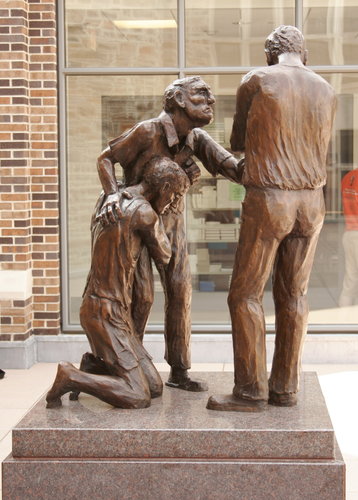
forgiving father

The Parable of the Prodigal Son: Statue by Margaret Adams Parker at Duke University, USA.

Paul’s teaching 2 Corinthians reflects upon the theology behind these stories and offers a salutatory application for us in Europe today.

For the people of Israel entering the Promised Land; for the Psalmist reflecting on the wonder of his restoration; and for the returned prodigal son, it must all have seemed like a new act of creation.

‘We are back where we were meant to be after years of wandering’;

‘I said, ‘I will confess my transgressions to the LORD’, and you forgave the iniquity of my sin’;

‘It was fitting to celebrate and be glad, for this your brother was dead, and is alive; he was lost, and is found.’

It all looks so new even if it looks familiar. God has done a new thing and has done it through grace.

Therefore, if anyone is in Christ, he is a new creation.
The old has passed away; behold, the new has come,’

But that is not where Paul stops.

If, through God, a new creation has been brought into being, surely as those who are made new in that new creation, we are also called to live reconciliation; to live restoration.

Grace is not cheap; grace is as costly as a ‘fatted calf’ on top of a whole inheritance.   It will not be cheap for us either to live restoration and reconciliation; to model God’s grace in a world where grace is counter-cultural and in a church where the world’s values so easily have greater influence than they should; to model God’s grace in Europe where divisions are becoming increasingly apparent and where populism is growing in strength; to model God’s grace, in the United Kingdom, where families, friendship groups and communities have been riven by disagreements over Brexit.

It will never be easy; it was not easy for the father to gird up his robes and run.   He did it because of his ‘Oh, the overwhelming, never-ending, reckless love’

It sometimes mean our backing down and always means our being prepared to back down; it will sometimes mean facing the rage of a world that doesn’t think it appropriate to reconcile, and it will always mean our being prepared from that.

But it will also always mean that a way is open to us and to others to stand with the people of Israel at Gilgal; to reflect with the Psalmist; and to hear of the reckless love of the father.

It’s good in the middle of Lent to be reminded that it’s not all doom and gloom. Indeed Lent isn’t just about repentance; it’s primarily about celebrating the boundless grace of God, in Christ.

…………………………..………………………………………………………………………………………………….

* written by Cory Asbury, Caleb Culver, Ran Jackson © 2017 Bethel Music Publishing (ASCAP) / Watershed Publishing Group (ASCAP) (adm. by Watershed Music Group) / Richmond Park Publishing (BMI).


Third Sunday in Lent: Fecundity of Repentance

Revd Dr Robert S. Kinney reflects on Luke 13.1-9, the challenging lectionary Gospel set for this week, drawing in the Old Testament reading, Isaiah 55.1-9.

Fecundity is an uncommon term. In human demography, it generally refers to the ability of a population to replenish itself and it is currently an important subject in Europe. For many years, according to Eurostat (the EU’s statistical office), the fecundity rate in each European nation has fallen below what is needed to keep the population even. This means that, apart from immigration, the population of each European nation is declining. Of course, that brings with it a multitude of sensitive topics, from the tragedy of infertility in individuals to national migration policies and the preservation of national culture.

In the Gospel reading for this coming Sunday (a tough passage!), Jesus tells a parable centred on the fecundity of a fig tree in order to explain a concept that is no less sensitive.

In Luke 13.1-5, Jesus is addressed by some unknown audience members. Having heard Jesus talk about the coming eschatological judgment—even chastising them for not seeing it coming—the audience introduces additional information to Jesus. They tell him that some Galilean Jews had been slaughtered by Pilate in the course of making sacrifices (a horrific act that is sadly consistent with what is known about Pilate). It is as if they are asking if these murdered Jews deserved the specific judgment that came upon them.

But Jesus quickly rejects the notion. He even cites another event (the tower of Siloam falling) to suggest that these people were not killed because they were worse sinners than anyone else. But then his logic takes a delicate turn. Like the lengthy discussion throughout the book of Job, Jesus challenges the notion that disaster comes only to those who deserve it. That is, disaster is not only for those who did something in particular. Instead, disaster – m judgment really – is universal. This universality is emphasised in the repeated use of all (in verses 2, 3, 4, and 5). Judgment is universal—except for those who repent: unless you repent, you will all perish as they did(v.3 and v.5).

In Luke 13.6-9, then, Jesus tells a parable about a fig tree. Like this apparently unrepentant audience, the fig tree is bearing no fruit. In an act of universal judgment, it is time to cut it down once and for all. But the gardener prevails upon the fig tree’s owner to let it have one more chance. And so, Jesus’s audience has one more chance to repent and begin bearing fruit—an echo of something John the Baptist had said earlier in the Gospel: “Bear fruits worthy of repentance” (Luke 3.8).

The final judgment of perishing that Jesus promises will be worse than the grave consequences of population decline in Europe. And so, the fecundity that matters foremost is not that of population stability, but of spiritual growth. We are in need of the spiritual fecundity that comes with repentance. The Isaiah reading paints a glorious picture of what abundant life in God looks like, and then similarly exhorts the reader to seek it:

‘Seek the Lord while he may be found, call upon him while he is near; let the wicked forsake their way, and the unrighteous their thoughts; let them return to the Lord, that he may have mercy on them, and to our God, for he will abundantly pardon.’ (Isaiah 55.6-7)

Abundant life comes through repentance and God’s mercy. If we hope to come into that life and be spared the judgment that is to come, we must repent. Jesus, just like the gardener in the parable, intercedes for those who do so. Indeed, he gave his life in order that we might have time to bear fruit. And so, in this season of Lent, we do well to consider the examples Paul gives in the 1 Corinthians reading—the example of the Israelites in the wilderness and the sins from which to repent. We do well to consider the invitation of the Isaiah reading, so that we may “eat what is good” (55.2). We do well to consider the warning of Jesus, for the time to bear fruit is short.

Robert S. Kinney serves as a priest (with PTO) at Christ Church in Vienna, Austria. He is the Director of Ministries for the Charles Simeon Trust. He acts as an educational mentor for the Diocese in Europe Ministry Experience Scheme.

Second Sunday in Lent: True Identity

Archdeacon Meurig Williams, archdeacon of France and Monaco, draws on all three of this week’s lectionary readings (Genesis 15.1-12, 17-18; Philippians 3.17-4.1; Luke 13.31-35) to explore the nature of our true identity – especially at this time of turmoil in Europe.

meurig

Europe is currently awash with confusion about identity and belonging. As many people fleeing danger arrive on our shores, we glimpse a mirror-image of their insecurity in those who are championing so-called ‘identity politics.’ An ever-widening chasm is creating distance – and conflict – between those who have more than they need and those who have nothing. The Gilets Jaunes protests in France have shown us that what people are being told does not match what they see and experience. Our capacity to understand the needs of those from different cultures, who speak different languages, and who see life differently, is becoming more shallow and superficial. In the minds of many, home and a sense of belonging is not so much a gift to be cherished, celebrated and shared but a silo to be defended against others with different identities.

Our readings from Scripture, today, invite us to think and act differently.

Abraham and Sarah had every right to feel insecure (Genesis 15.1-12, 17-18). The obedient pilgrims, who left the security of their settled home in an act of reckless trust, believing the promises of God about giving them many descendants, are still childless. Abraham also makes no secret of his uncertainty about God’s promise of a new home in a new location. There are worse trials and torments to come. We are catching a glimpse of the Israel of God in the long process of becoming a settled nation, so crucial to Jewish self-understanding. At one level, the Jewish scriptures tell a juxtaposing story of what it means to be a nation under God, living in a land that confirms their unique identity, on the one hand; and the unbearable strain of defeat and deportation, and of long years of exile far from home, on the other.

Perhaps the sense of doubt in our reading, (which took its final form during an extended period of exile, long after the events it records) is an all-too-faithful reflection of the Jewish experience over many millennia. It is also a theme that speaks to the basic human longing for a place on this earth where we most truly belong. As the French philosopher, Michel Foucault, acknowledged, ‘the anxiety of our era has fundamentally to do with place.’

However, this is only one side of the coin, and our Gospel today (Luke 13.31-35) reveals the disenchantment that surfaces when we sense that a particular place is not what it once was – or was meant to be; when we feel hemmed-in and smothered by being at home. The poetry of Dylan Thomas, for example, rejoices in his Welsh roots; but also voices the urge to ‘explode out of a frustrated sense of belonging.’ We can hear that expressed in Jesus’s lament over Jerusalem. He is feeling the rejection which the prophets before him had known.

The city whose name means ‘peace’ has become a danger zone (amplified by the sinister warning that Herod is out to get Jesus). The place where God had promised to dwell among his people has become the arena of injustice and self-interest. Roman occupation of the city, which accentuates a sense of tension and insecurity, is not the cause of the Temple’s God-forsakenness. Rather, what the prophets had once described as the gathering place of all nations has become a self-serving ghetto of exclusion and exploitation. There is no salvation in pursuing ethnic purity at a time of national crisis.

From inside this conflict-ridden melting pot, we need to hear the unequivocal affirmation from the Epistle (Philippians 3. 17-4.1) that our true identity is found in the crucified and risen body of Christ. Whatever human and earthly solidarities we may cherish will be transfigured by the promise that our true home is in heaven, where God gathers all identities and allegiances, to enable us to become a new humanity in Christ. This is both a promise for the future and a challenge for the way we live today. The priest and poet, R.S. Thomas, pondering the cross in the light of our longing for security, once wrote:

You have answered us

with the image of yourself

on a hewn tree, suffering

injustice, pardoning it.

Pointing as though in either

direction, horrifying us

with the possibility of dislocation.

Might it be that, at that moment of horrific recognition, finding ourselves dislocated from the uncertain and anxious solidarities of this world, we find ourselves at home where the crucified Christ is at home? Then we are truly liberated to see how all races, languages and cultures have a home deep within the heart of the God.

Archdeacon Meurig’s reflection is brilliantly illustrated by ‘The Crucified Tree Form’ by Theyre Lee-Elliott, in the Methodist Modern Art Collection. For copyright reasons it is not included here, but it can be found at https://www.methodist.org.uk/our-faith/reflecting-on-faith/the-methodist-modern-art-collection/index-of-works/crucified-tree-form-the-agony-theyre-lee-elliott/


First Sunday in Lent: An opportune time

Dr Clare Amos explores the particular insights into the temptation of Jesus that are offered by this week’s lectionary Gospel, Luke 4.1-13. She also wants to draw attention to a series of paintings on ‘the wilderness’ created by Revd Adam Boulter, chaplain in Poitou-Charentes – more details at the end of Clare’s reflection.

Jesus is tempted - Matthew 4:1-11

The picture comes from a set of paintings called ‘The life of Jesus Mafa’ which depicts episodes in the life of Christ from an African, Cameroonian, perspective. The very ordinariness of the tempter in this picture makes him particularly insidious – and powerful.

Once again (as with the Gospel for Transfiguration Sunday) it is the small differences between the gospel writers, that can help make the narrative so interesting – and so telling.

Of course in this case it is Matthew with which we need to compare Luke’s account of the temptation of Jesus. Mark is quite different – and much shorter. But the accounts of Jesus’ temptation in Luke and Matthew are very similar – so what do the small differences tell us about the particular concerns of Luke?

It is of course symptomatic that Luke begins his account by reminding us that Jesus returned from his baptism and went out into the wilderness ‘full of the Holy Spirit’ (4.1) As his inaugural speech at the synagogue in Nazareth will make clear, ‘The Spirit of the Lord is upon me’ (4.18), his ministry will be lived in the life of the Spirit from this moment, its very beginning, until his death in 23.46 when he commits his/the Spirit back to the Father.

It is also interesting to note that typically – and I must confess that I had not spotted this until writing these reflections – Luke’s words, ‘he ate nothing at all during those days’ (4.2) seem to be more emphatic than Matthew’s bare ‘he fasted’ (Matthew 4.2). Meals and food are very important in Luke: Robert Karris deliciously comments, ‘In Luke’s Gospel Jesus is either going to a meal, at a meal or coming from a meal’. Though this may be a slight exaggeration it does express an intrinsic reality about the Gospel of Luke. Perhaps the most powerful biblical image for the Kingdom is that of a feast – so Jesus’ feasting with his disciples and others is intended as a visible sign of the Kingdom of God coming into reality. Somehow these days of fasting before feasting is an appropriate time and way of preparation.

Yet the most significant special feature of the temptation in this Gospel comes at its end, ‘When the devil had finished every test, he departed from him until an opportune time’ (4.13). For Luke, Jesus’ defeat of the devil’s wiles during these initial 40 days is not going to be the end of the time of trial. Jesus will be ‘tested’ again at several points later in the Gospel, up to and including Gethsemane. It is notable how Luke seems to emphasise – even more than the other evangelists – Jesus’ agony in the garden. One other, possibly linked, feature of Luke’s account of the temptation is the different order of the trials, when compared with Matthew. There may be several reasons for this, but one result of Luke’s ordering is that the word ‘test’ appears in the final temptation, immediately before being repeated in the brooding final remark that this time in the wilderness was not the testing’s end.

It is interesting to ‘translate’ the specific elements of Jesus’ temptations and ask what they might mean for us today. One of the best reflections on the temptations that I have ever heard was preached to a group of ordinands. The preacher suggested that in some ways Jesus’ temptations were those experienced most acutely by people in ministry: the temptation to believe that everything depends on us – that we should and can meet all the physical needs of everyone; the desire to be put up on an infallible pedestal by the Christian community; the irresponsible belief that God will protect us from our own risky behaviour. I can indeed see these as being real challenges for those who exercise ordained Anglican ministry, and indeed for others such as myself, who, though not ordained, have a public role in the life of the church.

But there is one other key point – that links to Luke’s stress on the ongoing nature of Jesus’ trials. Perhaps the most insidious temptation of all is to believe that temptation is a one off. Been there, done that! Once we have ‘sorted’ a particular issue or concern we won’t have anything similar to worry about in the future! Indeed I can see elements of this attitude in the current view in some British circles that the UK’s basic problems are linked to being in the EU, and that once the UK has left that body we will move seamlessly into a blissful future. The temptation that temptation and difficulties are temporary or finite is a challenge on both the macro-scale, and for individuals. Certainly we may hope to grow in wisdom and the spirit of Christ, but Luke reminds us to stay watchful; that the time of trial has not yet come to an end. Yet Luke also tells us of a resource we have been given in order to respond: for it is no accident that it is also Luke who emphasises how at key moments in his ministry Jesus spent so much time in prayer.

In 2015 Revd Adam Boulter created a series of paintings entitled ‘The Wilderness’ which depicts significant biblical stories (including the account of the temptation of Christ) which are set in the wilderness. The paintings accompany sonnets composed by the Anglican priest-poet Revd Malcolm Guite. The set can be viewed at https://www.cantab.net/users/adamboulter/adamboulter/15_02.html