And Peter remember, ‘Follow me’

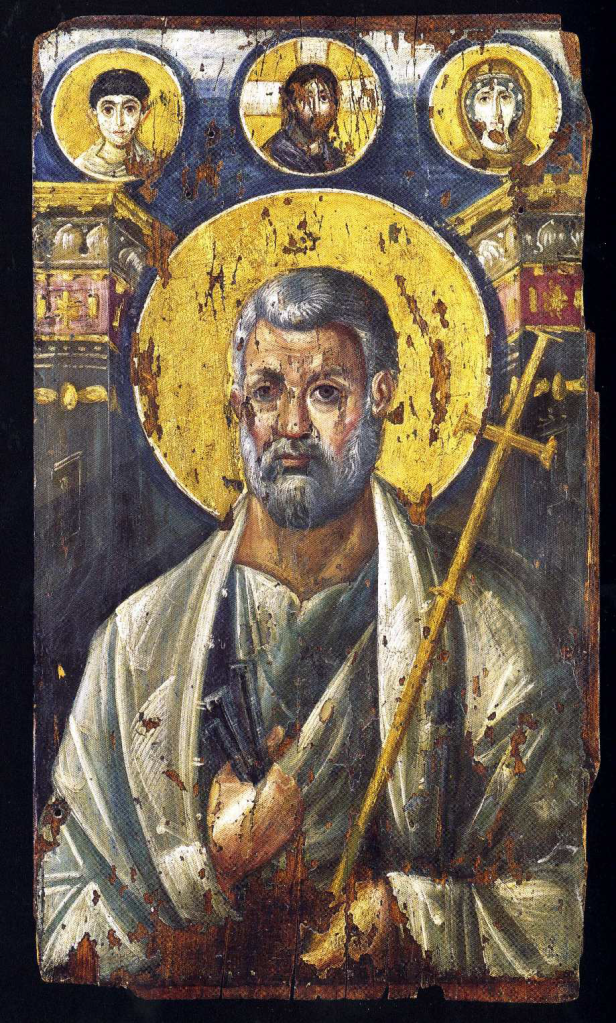
The image above is a beautiful icon of St Peter, part of the icon collection of St Katherine’s monastery in Sinai. It is one of the oldest Christian icons in existence, dating back to possibly to the 5th Christian century. I cherish the humanity that is so evident in the face of Peter. It feels an appropriate accompaniment to this reflection on John 21.1-19, the lectionary Gospel for Easter 3 in 2025. The reflection is drawn from a sermon I preached on this text a number of years ago, initially at the opening service of the General Synod of the Anglican Church in Australia.

Clare Amos, Director of Lay Discipleship, Diocese in Europe

‘And after this he said to him, ‘Follow me’.  Have you ever realised that these words, spoken by Jesus to Peter near the end of the last chapter of the Gospel,  are the very  first occasion in John’s Gospel that Jesus has issued Peter the command – or invitation – to ‘Follow me?’ If you look at the beginning of the Gospel – to the time when Jesus is calling a range of disciples you find that the words are indeed said to others such as Philip – but not to Peter himself.  To Peter Jesus rather offers a new name, saying to him, ‘You are Simon son of John – You are to be called Cephas which means Peter.’ But there is no ‘Follow me’. That this omission is quite intentional is reinforced by a puzzling little conversation Jesus has with Peter on the night of the Last Supper, the night before Jesus’ death which runs as follows: ‘Simon Peter said to him, ‘Lord where are you going? Jesus answered, ‘Where I am going you cannot follow me now, you cannot follow me now; but you will follow afterwards.’ Now at the very end of the Gospel it seems is the moment for that ‘afterwards’.  

It is all very different  in Mark or Matthew.  In these Gospels it is at  the very beginning of his ministry – as soon as he catches sight of Peter and his brother by the shore of the Sea of Galilee that Jesus calls out ‘Follow me’.  They are the very first words Jesus utters to him. And immediately the nets are left and Peter has breathlessly set off on his journey of a life-time. 

What a world of difference between those two different moments of  ‘Follow me!’ – and Peter’s response to them. The first one is the occasion when Peter impetuously sets off, fired up with excitement – perhaps fishing had been frustrating or fruitless  that day or perhaps he was flattered by this sudden attention – so he sets off on a journey with Jesus not really having the faintest clue about where it will lead him. The second ‘Follow me’ is so different.  Now he does not know too little. If anything he knows and remembers too much. He remembers that slow, painful process of coming to realise just who Jesus was; and then the even more painful discovery of a Jesus who confounded traditional expectations of how a Messiah should behave. He remembers the running away in the Garden and the shame of that threefold denial.  And just in case Peter might have forgotten we have the memory of them etched into the biblical passage from John’s Gospel which we have just heard read. For Jesus’ celebration of breakfast on the beach with his disciples is only possible through a charcoal fire – a charcoal fire that surely recalls a similar one which had been lit that night in the high priest’s house when Peter had said three times ‘I do not know the man.’  And then there is the three-fold question ‘Simon son of John, do you love me?’, reminiscent surely of that same three fold denial. ‘Simon, son of John’, not with the addition of the name which Jesus had once given him, ‘You shall be called Peter’ for in truth so far he has not been a Rock to depend upon. Yet the encounter between Jesus and Peter on the sea-shore looks forward as well as back. So those words, ‘Feed my sheep, tend my lambs’ offer Peter not merely forgiveness, or even a personal relationship with the Risen Lord but an invitation (commission) to a wider ministry and mission. Peter’s future role in the life of the Christian community is being written in to the restoration of his relationship with Jesus. Of course we have read elsewhere in this Gospel just what it means to be a good shepherd, tending to the needs of the flock. We have heard that a good shepherd is prepared to lay down his life for the sheep. And this hint of Peter’s future is then made more explicit, with what seems like a direct prediction of the death Peter will one day meet, caring for the flock that has been entrusted to him in Rome.  

And it is only after all this has been said that Jesus can finally offer Peter the challenge ‘Follow me’.  

I often think that one way of describing the life all of us have as Christians is that , like Peter, we live between those two moments of ‘follow me. ‘ We stand here having answered the challenge offered by the first, but we are still being made ready to respond fully to the deeper challenge of the second, the one that can only come ‘afterwards’, after we have learned not only to accompany Jesus in his life, but also through his death.  How precisely this works out may differ for each of us individually depending on our own personal Christian story – but we are all in some way travelling with Jesus on a journey that began with our response to his first grace-filled invitation, may have taken us through some mistaken twists and turns, but gradually enables us to come to understand  more about the nature of our travelling companion on the road, and eventually begin to discern  all that it might mean for us, preparing us to begin  to make our fuller response.  And I think it is important  that in John’s account this latter ‘Follow me’ is accompanied by a task, a commission, so that following Jesus does not lead merely to our own salvation but to an engagement in ministry and  mission with and for others.  

I wonder too whether we can suggest that those two moments of ‘follow me’ may apply not only in the lives of individuals, but also in the life of the Church itself; that here as Church today we are living out our initial commitment to the one we follow – yet it is a journey on which there will be mistakes and much to learn. As Church we cannot properly hear the second ‘follow me’ until we have come to understand what it really means to have the courage to accompany Jesus through his passion and death, and until we have also learned that to follow Jesus may involve us in a sacrificial ministry and mission which will be wider than we might have dreamt of and which may take us down paths we do not know and which, in the words of the Gospel reading,  are even places where, humanly speaking,  we do not  wish to go.  

Yet of course it is not only in Jesus’ death that we accompany him – but also in his resurrection, a resurrection which has led to the beginning of a new world, a new creation. Here in John 21 there are echoes of that new creation. Once again God has proclaimed ‘Let there be light’, the sun has risen, the darkness of the night is being dispelled, and the seas are teeming with life. The motif of Jesus offering us a new creation, a new Genesis, which John teases us with throughout this Gospel, beginning with his opening words ‘In the beginning’, comes  now to its final fulfilment.  Significantly this new creation both recalls of the old – yet also transforms it. For the disciples this means that they have gone back to Galilee, to their old occupation as fishermen, and it is in familiar Galilee that this new creation will dawn, but only when they at last start to see reality through new eyes. Like them we too are summoned ‘to let the morning sun rise on our perceptions of God’s world, to stop looking at things the old way, blundering along in the dark, wondering why we aren’t catching any fish to speak of.’ (Tom Wright) 

Do some of you know CS Lewis ‘Voyage of the Dawn Treader’?  It is my favourite of the Narnia books.  Near the end of the story the children begin to wade through the seas of the uttermost east towards a shore on which they meet a lamb standing by a fire who offers them breakfast. The resonances with John 21 are obvious – and deliberate. But as they are wading through the waters the children  look towards the horizon,  the place where sea meets the sky.  We know that normally this is an optical illusion which will disappear as we get nearer.

But, as Lewis puts it in his story, ‘as they went on they got the strangest impression that here at last the sky really did come down and join the earth – a blue wall, very bright, but real and solid: more like glass than anything else.  And that’s what John’s Gospel wants to say to us too:  in this new creation inaugurated by Jesus heaven and earth have met together and touched each other, for the Son of Man has been raised up to be in his own body the ladder that has joined them together. This is indeed creation with a difference!  The old creation was marked out by separations and divisions: taken to extremes in the Gnostic reworking of the story. But the new creation is marked out by the removal of the middle wall of partition.  And it is this new creation that has become the location where we tentatively, fearfully, hopefully, are being called to discover what it might mean to respond to Jesus’’ follow me’ in our own time and place.  In the incarnation of God in Christ the word became flesh, and through Christ’s crucifixion and resurrection God promises that the gateway and bridge between earth and heaven will never be shut. So the word continues to become flesh but it now becomes our mission, through and in the power of the Spirit,  to become the pathway through which this truth is made real in our world.

In a few minutes time through our celebration of Communion, or Eucharist, we are going to remember and join with Jesus and his friends in sharing that breakfast on the beach, that sacrament of new creation. In our speaking of words and eating and drinking of bread and wine, we will be living out what it means to proclaim the word become flesh. And what will we, must we, do when we leave this act of worship  to be disciples of Christ’s  mission in our world?  Listen to Bishop Tom Wright as he gives us his answer:

The word became flesh, said St John, and the Church has turned the flesh back into words: words of good advice, words of comfort, words of wisdom and encouragement, yes, but what changes the world is flesh, words with skin on them, words that hug you and cry with you and play with you and love you and rebuke you and build houses with you and teach your children in school.

…So Peter there is work for you to do. You are going to leave the fish business, which you know so much about; you’re going to leave it for good, and you’re going into the sheep business instead, which at the moment you know precious little about. I want you to feed my lambs. I want you to look after my sheep. I want you to be you, because I love you and have redeemed you; and I want you to work for me, because out there, there are other people that I love, and I want you to be my word-become-flesh, my love sitting with them, praying with them, crying with them, celebrating with them. And how can you do it?… Peter, don’t just tell them in words. Turn the words into flesh once more. Tell them by the marks of the nails in your hands. Tell them by your silent sharing of their grief, by your powerful and risky advocacy of them when they have nobody else to speak up for them. Tell them by giving up your life for them, so that when they find you they will find me. And Peter, remember: follow me.’ (© Tom Wright)

Heart in pilgrimage: Jesus at prayer in the Gospel of Luke

In this year in which the Gospel of Luke is the key lectionary Gospel I have found myself revisiting ideas and thoughts I first explored a decade or so ago. I am increasingly interested in how the Lord’s Prayer is not simply prayer taught by Jesus to his disciples but is deeply foundational for our understanding of who Jesus is, and the nature of his ministry. In particular I think that Luke wants us to discover how Jesus exemplifies the prayer he has taught his disciples in his own ongoing life – and eventually in his Passion. The reflection below was initially written by me about 15 years ago for publication in the journal ‘The Reader’.

Clare Amos, Director of Lay Discipleship, Diocese in Europe

clare.amos@europe.anglican.org

Travelling the road to freedom

This is a sermon that I will preach/have preached on 9 April 2025, at the online Eucharist of Holy Trinity Church Geneva, at which my husband, Alan Amos, is presiding. The Eucharist will commemorate the 20th century martyr, Dietrich Bonhoeffer. Given the clearly ‘European’ focus of the address and its subject it seems appropriate to share it also on this blog.

Clare Amos, Director of Lay Discipleship, Diocese in Europe.

Today, April 9, marks the 80th anniversary of the execution, perhaps better described as a judicial murder, of the German pastor and theologian Dietrich Bonhoeffer. He was put to death less than a month before the Second World War came to an end in Europe, when it was obvious that Germany was going to lose the conflict. His killing was a deliberate act of pure revenge on the part of the Nazi leadership – his name was on a list of those whom Hitler was utterly determined would not survive to see any post-war freedom.

As it happens in 1945, April 9 fell 8 days after Easter Sunday. This year the commemoration comes about the same amount of time before the Easter weekend. It seems appropriate as the story of Bonhoeffer speaks even today of both cross and resurrection and how neither can be fully understood without the other.

As I think you all know I am deeply committed to the ecumenical movement, of which the World Council of Churches is one of the formal fruits. Many of those who, in the first half of the last century, worked for Christian unity did so because they were deeply marked by their experience of the two world wars which scarred landscape and people in Europe and beyond. In their struggle for Christian unity they wanted to bear witness and live out the reality that their – our – common identity as Christians was more fundamental than their national or ethnic identity as Germans, French, British, American, Japanese, Italian or whatever. Bonhoeffer was close to the circle of those such as the Church of England bishop George Bell, who in the early post-war period, were instrumental in bringing the World Council of Churches to birth. Both as a Christian pastor and as a patriotic German Bonhoeffer deeply wrestled with the choices he felt compelled to make in his opposition to Hitler and the Nazis. He knew that his opposition to Hitler would certainly require of him very difficult moral challenges. There was no possibility of the luxury of keeping his hands clean in the midst of the muck and morass that he had to live through. Bonhoeffer certainly believed that his Christian identity was more fundamental than his German one, yet that cost of discipleship was very great indeed – in so many ways.

One of Bonhoeffer most remarkable writings is a poem written during his prison years entitled ‘Stations on the road to freedom’. There are four stanzas, marking the four ‘stations’ of discipline, action, suffering and death – all are important and build on each other. The final stanza reads (in translation):

Comenow, highest feast on the road to eternal freedom,
Death, lay down the burdensome chains and walls
of our temporal body and our blinded soul,
that we may finally view what we have been unable to see here.
Freedom, long we sought you in discipline, in action, and in suffering.
Dying, now we recognize you yourself in the face of God.

I find it a fortunate coincidence that both in relation to Bonhoeffer – and in relation to current events in our world today – our lectionary Gospel this current year is the Gospel of Luke. Because the Gospel of Luke is the text among our four canonical Gospels in which the Christ we meet is presented as a intensely ‘worldly’ figure. By that I mean that Jesus’ life, ministry and death were played out in the awareness and context of the political world of his day. One of the significant features of Luke’s passion narrative is the way it overtly takes account of the political tensions of Jesus’ day between Jews and Romans which would about 30 years after Jesus’ crucifixion break out into open war.

Luke does not provide us with any easy answers: he refuses to allow Jesus to be identified as either an anti-Roman Zealot or Jewish collaborator – but equally he insists that Christ’s freedom struggle cannot be understood apart from such a political context. The Christ we meet in this Gospel will not withdraw into a holy and pietistic quietism, although he will weep over Jerusalem and the pain that the city will know over the centuries because it has been and will continue to be loved so hatefully. This Christ will travel to the Cross seeing it as the ultimate station on the road to that freedom that he had proclaimed in his inaugural speech in the synagogue in Nazareth, ‘The Spirit of the Lord is upon me … he has anointed me to proclaim release to the captives and to let the oppressed go free.’ 

At his transfiguration on the mountain Jesus had conversed with Moses and Elijah about the ‘exodos which he was to accomplish in Jerusalem’ (Luke 9.31). As Luke then suggests this would be both an intensely political and worldly event (as indeed was the original biblical Exodus from Egypt), yet at the same time constituting a refusal to play by the normal political rules of his day. Such a ‘freedom struggle’ is immensely costly to those who engage in it. It crucified Christ. It killed Bonhoeffer. What is the Exodus that we need to accomplish in our place and our time? What road to freedom do we, as followers of Jesus, have to travel today? And what will it cost us?

A final comment. One of Bonhoeffer’s most often quoted remarks is, ‘Only a suffering God can help’. Bonhoeffer’s vision was of a God who, in Jesus Christ, did not allow himself to be separated from human suffering, but was willing to share in it. When Bonhoeffer’s life and theology first became known in the English speaking world in the early 1960s, it was an idea that was seen as unbelievably radical. In the decades since perhaps we have come to realise that there are indeed times when, ‘only a suffering God can help’. So I find it intriguing that just at the moment we are celebrating the 1700th anniversary of the Council on Nicaea and the Nicene Creed which eventually resulted from it. The idea of a ‘suffering God’ was anathema in the world and religious thinking of Nicaea.

Intriguingly however another – though linked – aspect of Nicaea was that this was also the moment when the state in the form of the Emperor Constantine decided to control the life and thinking of the Church. That ‘Constantinian captivity of the church’ had an immense effect on Christian life for many centuries – even today I would suggest that the view of the relationship between state, religion and church shared by both President Putin and President Trump is one that owes a great deal to Constantine’s vision. Bonhoeffer’s challenge 80 and more years ago to his fellow ‘German Christians’ who colluded with the injustices being wrought by the German state sometimes even in the name of Christianity, is a challenge we still need to listen to in our world of today.

Epiphany is a jewel… multi-faceted

This week’s blog draws on the Gospel readings for the 6 January (Matthew 2.1-12) and for 7 January, the Feast of the Baptism of Christ (Mark 1.4-11).

Clare Amos

Director of Lay Discipleship; Clare.amos@europe.anglican.org

I have never been ‘efficient’ at taking down Christmas lights and decorations by Twelfth Night. I was relieved when some years ago I discovered that an alternative ‘tradition’ allowed them to remain up till February 2 and Candlemas. I do generally manage it by then!

So I have felt cheered (and justified!) by the fact that liturgical revisions over the last 30 years or so have encouraged us to see the whole period between 6 January and February 2 as an ‘Christmas/Epiphany season’, rather than considering Epiphany as a ‘pin-point moment’ concluding on January 6.

This also enables us to have a wider understanding of ‘Epiphany’, a word whose basic meaning is something like revelation/manifestation/shewing.

In Western Christianity traditionally Epiphany or Twelfth Night commemorates the arrival of the three wise men (later often described as ‘kings’) at Jesus’ crib. In parts of western Europe the day is at least as significant as Christmas Day itself – not least as a time for gift giving. As the chaplaincies in our diocese who are based in lands like Spain and France well know, the arrival of the ‘Three Kings’ is often accompanied by colourful street parades – during which sweets are thrown into the crowd which children have the excitement of gathering. 

Parade of the Magi in Madrid

Cologne Cathedral, known to some of us, not least because our Diocesan Synod takes place in this city, traditionally contains the bones of the Three Kings. The relics have been located there since the early Middle Ages. A book written by Johannes of Hildesheim in the 14th century to mark the bicentenary of the relics’ translation to Cologne, includes the tradition that the first time the three wise men meet each other before the city of Jerusalem is on the hill of Calvary, where Christ would later be crucified. It is said that although they had never met before and did not speak the same language, they recognised and understood each other and their shared common goal.

The Shrine of the Magi in Cologne Cathedral.

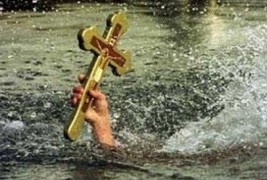
It is however very different in the eastern lands encompassed by our diocese. In Orthodox countries, such as Greece or Russia, the focus of Epiphany is on the baptism of Christ. The day is marked by the blessing of the waters, which can take various forms – often a cross is thrown into the sea, or lake or river, and young men and boys are encouraged to dive in to retrieve it. The ritual not only remembers our own baptisms and the revelation of the Holy Trinity at Christ’s baptism  but also expresses the belief that the whole of creation is made holy through Christ.

The blessing of the waters in Greece

The Anglican Common Worship liturgies for the Epiphany season now mark both biblical links – the arrival of the wise men and the baptism of Christ – but they also recall a third ‘manifestation’ of Epiphany – the turning of the water into wine at the wedding feast of Cana.

So,  for example, the Eucharistic preface for this season celebrates this ‘glorious’ season in the following words:

All honour and praise be yours always and everywhere
mighty creator, ever-living God,
through Jesus Christ your only Son our Lord:
for at this time we celebrate your glory
made present in our midst.
In the coming of the magi
the King of all the world was revealed to the nations.
In the waters of baptism
Jesus was revealed as the Christ,
the Saviour sent to redeem us.
In the water made wine
the new creation was revealed at the wedding feast.
Poverty was turned to riches, sorrow into joy.
Therefore with all the angels of heaven

we lift our voices to proclaim the glory of your name
and sing our joyful hymn of praise…

I have used the word ‘glorious’ above deliberately. ‘Glory’ is of course explicitly referred to in the telling of that first sign at Cana, ‘Jesus did this, the beginning of his signs, in Cana in Galilee, and revealed his glory’. (John 2.11) ‘Glory’ in ‘bible speak’ is a way of talking about ‘the visible presence of God’. God is visibly present in all three manifestations of Epiphany: as the wise men ‘worship’ the baby Jesus (Matthew 2.11), as the boundaries between heaven and earth are torn apart at Jesus’ baptism in the presence of Father, Son and Spirit, as Jesus inaugurates God’s long-promised and joyful wedding feast with humanity. As the image in the lovely prayer-poem by Kate McIhagga below picks up, Epiphany is like a multi-faceted jewel, which ‘sparkles’ with God’s light shining towards us from different angles.

But there is something else. I have increasingly come to understand that it is important to see the Christian ‘mystery’ as a whole. Often, partly due to their personal or corporate theology and spirituality particular Christians focus on ‘incarnation’, or ‘cross’ or ‘resurrection’. It is sometimes said that Anglicans tend to concentrate particularly on ‘incarnation’, and that is probably true of some of us, but possibly not all.

The ‘jewel’ that is Epiphany certainly takes seriously the glory of the incarnation, of God being revealed through the human flesh and form of Jesus. But there are also hints in the three facets of Epiphany of what is come later in the story, through the wise men’s gift of myrrh, the traditional ointment used to honour the dead, and through the wedding gift of wine, the symbol of Jesus’ blood that will one day be shed and spilt and shared. Incarnation leads us towards passion and resurrection.

The traditional site of Jesus’ baptism: the lowest point on earth

And the baptism of Christ – which for me takes us to the very heart of what ‘Epiphany’ represents. Latin American theologians have referred to this moment as Jesus’ ‘solidarity dip’ with humanity. The heavens are split open and God comes down to meet with humanity … down… down  even into the waters. It is intriguing to realise that the traditional site of Jesus’ baptism in the Jordan near Jericho is actually the lowest point on the surface of the earth (approximately 400 metres below the level of the Mediterranean Sea). But the movement of baptism is one in which submersion is followed by rising up, and it is clear that this down/up movement of baptism has been understood by Christians  as reflecting the submersion of Jesus’ passion, followed by the rising of his resurrection. (See for example Romans 6.4).

It is however clear also – not least from Romans 6.3-4 – that we as human beings who are disciples of Christ are also being invited to participate through our own baptisms in the ‘meaning’ of Jesus’ own: we are called to make God present even in the depths, and to share in the movement of passion and resurrection through which Jesus invites us to participate with him in renewing the life of the waters. I enjoy the tradition found in Orthodox iconography of Jesus’ baptism which shows a number of small figures at Jesus’ feet. They represent the ‘demons’ of the unruly waters, now being ‘cleansed’ through Jesus’ actions, to participate positively in their own enjoyment of this new creation.

Byzantine style Fresco of Jesus’ baptism at Rochester Cathedral

Epiphany is indeed a ‘jewel’ out of which the whole of the Christian mystery can sparkle its light, and invite us to share in its radiant spectrum.

Epiphany is a jewel.
Multi-faceted
Flashing colour and light.
Epiphany embraces
The nations of the world
Kneeling on a bare floor
Before a child.

Epiphany shows
a man
kneeling in the waters of baptism.
Epiphany reveals
The best is kept for last,
As water becomes wine
At the wedding feast.

O Holy One
To whom was given
The gifts of power and prayer,
The gift of suffering;
Help us to use
These same gifts
In your way
And in your name (Kate McIlhagga)

Is it far to Bethlehem?

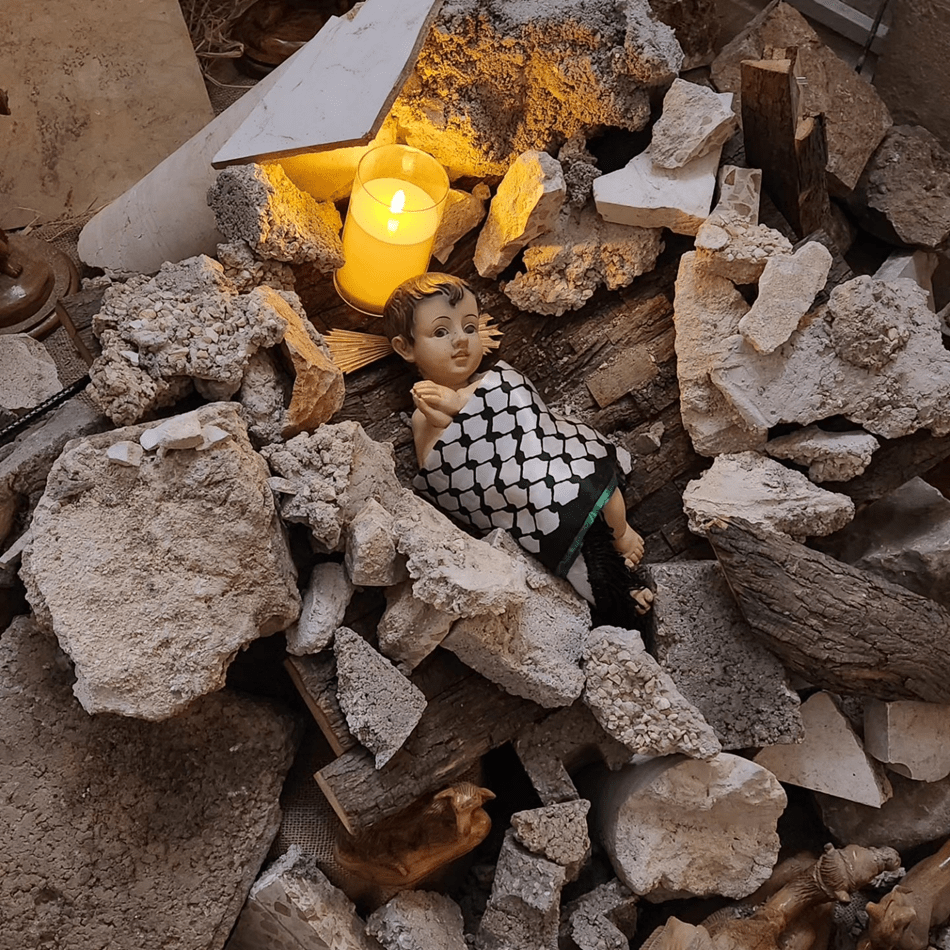
A contemporary Christmas crib in the Lutheran Church, Bethlehem, Photo: Munther Isaac

I am writing this week’s blog while in Malta, a country in which the tradition of nativity cribs is very much publicly  alive and flourishing – as indeed in other parts of southern Europe. It is one of the factors that has encouraged me to focus on Bethlehem. So this blog does not relate to a specific lectionary reading, but to a place – which will certainly feature in our worship over the coming days. The next blog will be written for Sunday 7 January and will appear a few days beforehand.

Clare Amos

Director of Lay Discipleship, Diocese in Europe

Clare.amos@europe.anglican.org

We are well into the season of Christmas carol services in which each year we are traditionally exhorted ‘in heart and mind to go even unto Bethlehem and see this thing which is come to pass, and the Babe lying in a manger’. This year, the situation in Gaza, Israel and Palestine makes this invitation – and challenge – to ‘go even unto Bethlehem’ particularly bitter-sweet, not least for the town’s Christian inhabitants, whose livelihoods have been devastated due to the war in Gaza Birthplace of Jesus empty for Christmas due to impact of war – The Jerusalem Post (jpost.com)

What does it mean in such circumstances ‘in heart and mind to go even unto Bethlehem’?

One way of looking at the season of Advent is to think of it as a sort of pilgrimage, a journey being taken by both God and ourselves until the moment when we find ‘God with us, Emmanuel’.  

Macrina Wiederkehr defined pilgrimage as follows: A pilgrimage is a ritual journey with a hallowed purpose. Every step along the way has meaning. The pilgrim knows that life giving challenges will emerge. A pilgrimage is not a vacation; it is a transformational journey during which significant change takes place. New insights are given. Deeper understanding is attained. New and old places in the heart are visited. Blessings are received and healing takes place. On return from the pilgrimage, life is seen with different eyes. Nothing will ever be quite the same again.

One of the key aspects of ‘pilgrimage’ is the importance of place. Rowan Williams once said: ‘Place works on the pilgrim . . . that’s what pilgrimage is for.’

Some years ago I designed a series of services for Advent, with the overall title ‘How far is it to Bethlehem?’ Picking up on the idea of pilgrimage, each week we focused on a particular ‘place’ that we needed to ‘journey through’ before – on Christmas Day we were able finally to ‘arrive’ at Bethlehem. The places we visited ‘on the way’ were all mentioned the weekly Advent Gospel readings:

  • Advent Sunday: Jerusalem
  • Advent 2 and 3: Wilderness and Jordan
  • Advent 4: Nazareth

Why was it important that we visited each of these places on our journey to Bethlehem? And what did that mean for how does Bethlehem itself could ‘work on’ us?

Briefly, the focus on ‘Jerusalem’ on Advent Sunday, which each year draws for its Gospel on Christ’s speech on the Mount of Olives (Matthew 24; Mark 13; Luke 21) acts as a reminder to us that Christ is born not in the ‘expected places’ nor in the centre, but ‘on the edge’. Jerusalem has been throughout so much of its history a place where human beings have tried to ‘capture’ and control God: those ‘apocalyptic’ Gospel passages make it clear that the God who comes in Advent has his own timescale, and can appear when and where he is least expected.

Wilderness and Jordan were referred to in my previous blog. They are places ‘on the edge’, places of stripping, of letting go, of being submerged – which we need to do before we can enter the land of promise.

Nazareth speaks to me of God being present in the ‘ordinary’, of God coming in the every-day-ness of our human lives, of an angel who comes to a young woman as she is undertaking her regular task of drawing water from the well. (I think there is something very true about the Christian Orthodox tradition of locating the annunciation at a well!)

And Bethlehem? When I have the privilege of taking groups to this not-so-little-town I ask people if they know which is the first point in the Bible that Bethlehem gets a mention. This generally offers quite a challenge. People certainly move back from the New Testament into the Old – and come up with responses like, ‘the story of David’, or ‘the Book of Ruth’. But actually the first mention of Bethlehem in our Bibles (as they are now set out) occurs much earlier still. You can find it in Genesis 35.19. When Jacob returns from his 20 years of ‘exile’, bringing with him his two wives, Leah and Rachel, Rachel goes into labour and gives birth to her second son, Benjamin, ‘when they were still some distance from Ephrath’. Though Benjamin is born safely Rachel herself, dies in childbirth. And the text then reads, ‘So Rachel died, and she was buried on the way to Ephrath (that is, Bethlehem), and Jacob set up a pillar at her grave.’

When I first realised this, I found it an extraordinarily powerful ‘coincidence’ (if that is an appropriate word), that the first biblical mention of Bethlehem, a town that Christians so much associate with birth, should actually be in relation to a story about death – or rather a story about birth and death.  Indeed other mentions of Bethlehem in scripture, such as the story of Ruth or the achingly beautiful oracle of Jeremiah in 31.15 which tells of Rachel weeping for her children, refusing to be comforted ‘because they are no more’, remind us of how close birth and death were – and perhaps still are in many parts of our world. TS Eliot of course caught this in his poem ‘Journey of the Magi’…’Were we led all that way for Birth or Death’?

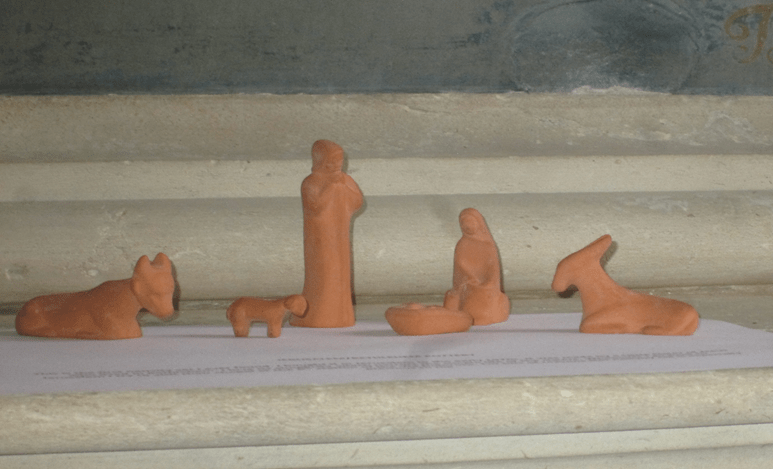
My own cherished pottery nativity set, made in Bethlehem c. 1975

I was powerfully reminded of Eliot’s words years ago, when I was living in Jerusalem and visited Bethlehem on a bitterly cold February day, to find a funeral going on inside the church, with the coffin placed directly above the Cave of the Nativity. Birth or death? A birth which foreshadows later suffering and death – yet it is only through such a death that new birth is made possible. Bethlehem is a place of paradox, a paradox wonderfully encapsulated in the door to the Church of the Nativity, which is an entrance so low that everyone needs to stoop down to pass through it. It was built in that way to stop people trying to ride into the church on the back of their horses. It expresses in stone the paradoxical truth of the incarnation – sung about more than 1500 years ago by St Ephrem in his Hymns on the Nativity:

‘Blessed be the Child who today delights Bethlehem…

Glory to the Living One whose Son became a mortal;

Glory to the Great One whose Son descended and became small.’

Many of the Christmas carols we sing which refer to Bethlehem I find too sweet – almost sickly – given the realities of today. But there is a lilting Christmas song by Elizabeth Poston which has always expressed for me the intermingling of glory and the tragedy of Bethlehem. It includes the lines, ‘O Bethlehem! Ancient of days, within thy story, heaven was laid. O Bethlehem! Anguish must be the price of glory, for us he paid.’

One of the ironies about Bethlehem is encapsulated in its very name. In semitic languages the word ‘Beth’ means ‘House.’ But the letters ‘Lehem’ can either be linked to a word which means ‘Bread/Food’ or another word which means ‘War’. So the name Bethlehem can mean either ‘House of Bread’ or ‘House of War’. The choice is for us, and for our world today:  do we come to Bethlehem to be fed, receiving the bread of life – or do we turn our backs on the ‘one of peace’ (see Micah 5.5) and follow the dangerous path which leads to war? That is a question too relevant to present days.

Is it far to Bethlehem? It is closer than our innermost being – and yet unless we have prepared ourselves to stoop low enough to allow the one who became ‘small’ to ‘enter in’, unless we can learn to cherish Bethlehem’s strange mixture of birth and death, weeping and joy, divinity and humanity, God with us – it is a pilgrimage that we will never finally make our own.

Thank you

Scandalous God,

For giving yourself to the world

Not in the powerful and the extraordinary

But in weakness and the familiar;

In a baby; in bread and wine.

Thank you for offering, at journey’s end, a new beginning;

The richest jewel of your love;

For revealing, in a particular place,

Your light for all nations…

Thank you

For bringing us to Bethlehem, House of Bread,

Where the empty are filled,

And the filled are emptied;

Where the poor find riches,

And the rich recognise their poverty;

Where all who kneel and hold out their hands

Are unstintingly fed. (©Kate Compston)

*****

Malcolm Guite’s beautiful sonnet, ‘Christmas sets the centre on the edge’ resonates with several of the thoughts expressed above and is well worth discovering. https://malcolmguite.wordpress.com/2011/12/23/christmas-on-the-edge/

On the edge

An aerial photograph of the River Jordan taken in 1938 (wikimedia commons)

This week’s lectionary blog focuses on the lectionary Gospel reading Mark 1.1-8, and draws attention to one of the Bible studies offered at the recent Diocesan Racial Justice Conference.

Clare Amos, Director of Lay Discipleship

clare.amos@europe.anglican.org

One of the disturbing chants that has frequently been heard, both in the Middle East and in western cities, in the two months, since the events of October 7 is, ’From the river to the sea…’ How the sentence then ends depends on who is doing the chanting. If it is fairly radical pro-Palestinian voices it continues, ‘Palestine shall be free’. Increasingly though, ultra-right-wing Jewish voices are ‘echoing’ the chant with versions that speak of complete Israeli Jewish control of the land ‘between the river and the sea’.  In my view, if either side ever seriously decided to try and bring into reality their competing aspirations, the conflagration that would result, probably throughout the Middle East and beyond, could make the violence that we have seen to date feel mild by comparison.

‘The river’ being referred to of course is the River Jordan, from ancient times a ‘traditional’ boundary marker for the ‘land’. In the Book of Joshua (chapters 3-5) the crossing of the Jordan marks the end of the period in the wilderness and a new beginning. It is interesting how Joshua 4.21-24; 5.10-11 draws a parallel between the Exodus experience of crossing the Red Sea, and this experience of crossing the river. In one we are moving out into the wilderness, and in the other, a sort of ‘renewed Exodus’, we are moving in from it. The link between the two events is echoed in other parts of the Old Testament, most notably Psalm 114.  

The river Jordan also features in this week’s lectionary Gospel. It is no accident that the place where John the Baptist is exercising his ministry of change and repentance is at this boundary-marker. The choice of this location implicitly suggests that those who come to him for baptism in the waters of the Jordan are presenting themselves as willing to be part of a ‘New Exodus’ community.

Over the past couple of years as I have been working with colleagues on the diocesan lay learning course one thing that I have been fascinated to explore is the importance of the idea of a ‘new Exodus’ for the self understanding of Jesus and his earliest disciples. In particular as Anthony Bloom initially noted, and then Tom Wright picked up upon, one key way of looking at the Lord’s Prayer is to think of it as the ‘foundation prayer of the new Exodus community’.  There are links between each of the petitions in this prayer and the events described in the Book of Exodus: the link between ‘daily bread’ and the wilderness manna may be the most obvious, but it is not the only one.

One of the key markers of this ‘New Exodus’ community is the important place it gives to those ‘on the edge’ or in the wilderness – including of course John the Baptist himself. He is an ‘edgy’ person, as was Elijah – who he reflects in his clothing and location. His ministry at the Jordan river clearly located him as someone on the frontier.

At the recent diocesan Racial Justice conference held in Freiburg, Dr Sathianathan Clarke, the presenter of the Bible Studies, devoted his first study to John the Baptist, who he named as ‘the uncivilised outsider’ a person challenging ‘the system’. Sathi told a story against himself of a time when in Washington, USA, where he lives, he had been preaching on John the Baptist in a church many of whose members were themselves homeless. Afterwards one of the congregation came up to him and commented that he had not mentioned that John the Baptist is perhaps the biblical figure that himself can be most easily identified as ‘homeless’ – and that it was a pity that Dr Clarke had not referred to this as he was someone that Sathi’s homeless congregation could relate to. In your particular context who are the ‘outsiders’, the people who might find themselves identifying with John?  There is a powerful song of the hymn writer Brian Wren, ‘Welcome the wild one’, which focuses on John the Baptist. The words are available here Welcome the Wild One – Hope Publishing Company

Also worth drawing attention to is the illustration offered by the St John’s Bible for the beginning of the Gospel of Mark: note how, with the scene of Jesus’ baptism happening behind him, the brown clad figure of John is already striding out of the picture. Baptism of Jesus – The Saint John’s Bible: Virtual Tour – University Library at The University of Notre Dame Australia (nd.edu.au) 

Quite a few years ago now I designed a series of Sunday services around the theme ‘Is it far to Bethlehem?’. Over the weeks of Advent and running into Christmas Day and beyond, each week we focused on a particular ‘place’ which acted as a ‘station’ on the way to Bethlehem. Among the ‘stations’ were the River Jordan and the wilderness. We cannot arrive at Bethlehem too soon, if we are to be able to hear the message that the birth of Christ has to offer us,  it is vital that we ‘stop’ first in these ‘edgy’ places and discover what they have to say to us. Perhaps particularly this year above all years. This is brilliantly expressed in this prayer by Francis Brienen:

Wilderness is the place of Moses, 

a place no longer captive and not yet free, 

of letting go and learning new living. 

Wilderness is the place of Elijah, 

a place of silence and loneliness, 

of awaiting the voice of God and finding clarity. 

Wilderness is the place of John, 

a place of repenting, 

of taking first steps on the path of peace. 

Wilderness is the place of Jesus, 

a place of preparation, 

of getting ready for the reckless life of faith. 

We thank you, God, for the wilderness. 

Wilderness is our place. 

As we wait for the land of promise, 

teach us the ways of new living, 

lead us to where we hear your word most clearly, 

renew us and clear out the wastelands of our lives, 

prepare us for life in the awareness of Christ’s coming 

where the desert will sing 

and the wilderness will blossom as the rose. 

(© Francis Brienen, ‘A Restless Hope’, URC Prayer Handbook 1995) 

Keep Awake!

This week’s blog focuses on the Gospel reading Mark 13.24-37 to reflect on the ‘Advent time’.

Clare Amos

Director of Lay Discipleship, Diocese in Europe

Clare.amos@europe.anglican.org

Christ Pantocrator, Toledo Cathedral, accessed via wikimedia commons

What exactly is the season of Advent? J Neil Alexander, a liturgical theologian from the United States poses the question, ‘Is Advent a preparatory fast in preparation for the liturgical commemoration of the historical birth of Jesus in Bethlehem, or is Advent a season unto itself, a sacrament of the end of time begun in the incarnation and still waiting on its final consummation at the close of the present age?’

Traditional ‘Advent calendars’ with their doors opened one-by-one leading us gradually nearer to the stable in Bethlehem and the birth of a baby on December 25 provide one answer to this question.

The usual readings selected for Advent Sunday in the lectionaries of most Christian Churches suggest the other possibility – linking Advent to the end of time. In the Common Worship lectionary the suggested Gospel reading for Advent 1 is a section of the ‘apocalyptic’ chapter from whichever of the synoptic Gospels will be the ‘lead’ lectionary Gospel for the coming church year – which begins of course on Advent Sunday. Over the next 12 months that lead role is given over to the Gospel of Mark, and so it is Mark 13.24-37 which is chosen as the reading for this coming Sunday.

Apocalyptic is a kind of biblical writing in which themes like cosmic confusion and fear and judgement are prominent. Why do we begin the church’s new year – for that is what Advent Sunday is – with such a focus on the end? Why do we have to hear about stars falling from heaven (Mark 13.25);  why cannot we simply read about the friendly star that kindly stood over the manger to point the way for the wise men?

One of the fascinating features of Mark’s ‘apocalyptic’ chapter is the way that it concludes, with the words ‘Keep awake’ (Mark 13.37). The identical phrase ‘Keep awake’ appears in the following chapter, in Jesus’ instructions to his sleeping disciples in Gethsemane. Although Matthew and Luke also use similar phrases in their ‘apocalyptic chapters (Matthew 24; Luke 21) and accounts of Gethsemane the verbal link is not as close as it is with Mark.

So what is Mark’s Gospel seeking to say to us through this repeated ‘Keep awake’?

What I find in the Gospel of Mark to a greater degree than in either Matthew or Luke,  is that as Mark retells the story of Jesus’ ministry and passion, he is inviting his readers to share with the earliest disciples of all – Peter and the original followers of Jesus – in following the ‘way’ and joining the journey that Jesus and those first followers had made first in Galilee, and then in Jerusalem, We are not an ‘audience’: rather we are invited to become ‘participants’ in this journey. And though I am reading Mark’s story almost 2000 years after it was first written down, and though my own current context is not one of persecution, I too still find myself treading ‘in heart and mind’ that journey of Jesus which Mark sketched out so vividly for his very first readers – perhaps 35 years or so after Jesus’ earthly ministry .

But, I think, there is one point where Mark seems to break off briefly from telling the story of the ‘original’ ministry of Jesus, and somehow addresses his readers directly, in their own time and context. It is in this ‘apocalyptic’ chapter. Without necessarily denying that ideas expressed in this chapter may well go back to the earthly Jesus, I also ‘hear’ clearly expressed in this chapter the anxieties of Mark’s own contemporaries, his readers who may have found themselves standing ‘before governors and kings,’ and have been brought to trial because of their faithfulness to Jesus (Mark 13.9-11). The tension over the fate of the Temple – its destruction by the Roman army of Titus – whether this was still to happen at the time Mark wrote, or whether it had recently occurred also seems to be alluded to (Mark 13.1. 14).

The repeated ‘Keep Awake’  – uttered to Mark’s own contemporaries at the end of 13, and to Jesus’ first disciples in the following chapter has the effect of ‘bridging’ the thirty or so years between the experience of Jesus and his disciples in Gethsemane, and the experience of Mark’s contemporary readers.  Their suffering becomes in a sense a ‘new Gethsemane’.  The fact that Jesus’ own Gethsemane experience ultimately leads to life through death can in turn offer hope for Mark’s own contemporaries – and perhaps us too, readers of the Gospel two millennia later.

In turn that surely invites us to reflect on how we – or the New Testament writers think about ‘time’. ‘Time’ is certainly a key concept for Mark; he introduces the public ministry of Jesus with the words, ‘The time is fulfilled, and the kingdom of God is at hand’ (Mark 1.15) . The Greek word used here is Kairos = ‘a point in time’. It does not mean the same as the other Greek word for time, ‘Chronos’, which is used to refer to a period of time. JAT Robinson wrote an excellent little book ‘In the End God’, which deserves not to be forgotten, which explored the difference between these two different understandings of ‘time’ and their implications for us. Advent is certainly a ‘time’ to which time is central. Karl Barth once commented, ‘Whatever other time or season can or will the Church ever have but that of Advent?’

Time: sharp as a knife

In April there is going to be conference to mark the 60th anniversary of the great Toronto Anglican Congress. I am hoping to prepare a paper for it, and so have been reading some of the contributions offered at the original Congress. In the opening sermon offered by Michael Ramsey, then Archbishop of Canterbury, spoke powerfully about ‘time’. ‘Time: we remember that in the New Testament “time” is a terrible word, sharp as a knife. It is Kairos: time urgent in opportunity and in judgment. It is less often the year or the day than the hour or the minute, each hour, each minute being a time of visitation: evening, midnight, cockcrow, morning, the Lord may come. We may be leisurely studying an era, when the divine hour or moment passes and finds us asleep and does not come back again. Yes, it is in places and times that our love of God is tested. “O God, thou art my God: early will I seek thee”.’

Mark’s ‘Keep Awake’ breaks down the ‘normal’ barriers of time and links together as one the past, the present and the future, the experience of the first disciples of Jesus, of Mark’s original readers, and those who read his Gospel today and in the future. We find ourselves joined together in the one time, ‘urgent in opportunity and in judgement’.

As a friend of mine has recently commented, the word ‘Woke’ – which has gained a bad press in some circles – is actually a form of the word ‘Wake’ and is an injunction to stay awake enough to read ‘the signs of the times’ in which we are living!

One key aspect of that apocalyptic language such as we have in Mark 13 is that it offers us a vital reminder that our Christian faith is not just a private or individual affair. Our beliefs and actions can and do have consequences in the social realm, and even at the global dimension. We are not allowed the luxury of believing that the birth of Christ is simply a pretty tale to be celebrated in children’s nativity plays, for the cosmic language of apocalyptic insists that it can and should make a difference to our nations and our world. There is a profound interconnectedness of all things: expressed in part by the frequent use in apocalyptic of the idiom of the world groaning in travail with the birth-pangs of the new creation. Mary’s birth-pangs, Mary’s labour and that of our world (Mark 13.17; Romans 8.22) impinge upon each other.

Hope for a tree?

One of those ‘cosmic’ areas in which the language of apocalyptic can speak to us is that of the wellbeing of creation. This weekend, as I am sure you know, the international climate change conference is happening in Dubai. Increasingly we are becoming aware that this global concern cannot be separated from spiritual decision. Do we really believe that love and self-sacrifice are written into the fabric of the universe? Because that is what, I believe, is necessary if as Christians and as human beings we are going to make a real difference to the story of climate change.    The language of seas roaring and earth shifting – characteristic of apocalyptic – somehow constitutes a vital resource that can help us take this concern with appropriate seriousness.  And it is telling that in our Gospel passage we also hear about the flourishing of a fig tree (Mark 13.28ff). The tree is a biblical metaphor for hope and possibility in spite of unpropitious present circumstances. There is hope for a tree. The cutting down of trees, as in the world’s rainforests, has become a marker for human despoilment of our world, conversely the planting of trees acts as a sign of human commitment for the future. Do you know the tale from the Talmud?  A rabbi was walking down a road when he saw a man planting a tree. The rabbi asked him, ‘How many years will it take for this tree to bear fruit?  The man answered that it would take seventy years. The rabbi asked, ‘Are you so fit and strong that you expect to live that long and eat of its fruit?’ The man answered, ‘I found a fruitful world because my forefathers planted for me. So I will do the same for my children.’

On Advent Sunday we are called to wake, and wait, and watch, and wonder that the baby so shortly to come to us is not simply part of our world’s past but also of its future. We are called to make ready his way, but will his way find us ready? Will we find within the rhythms of nature at this time of the year, with its dying and hope of new life, and its radiant but sometimes hidden beauty, God’s word to us? Rowan Williams stunning poem ‘Advent Calendar’ accessible here https://www.youtube.com/watch?v=IQBPBhQCsxE offers us both hope and challenge.

A surprising king

I apologise for this rather long reflection for the Feast of Christ the King, drawing on Matthew 25.31-46 and the appointed Psalm, 95, but I found myself wanting to wrestle seriously this particular year with the biblical motif of kingship, which I believe is an important key to engaging with this feast.

Canon Dr Clare Amos

Director of Lay Discipleship, Diocese in Europe

Clare.amos@europe.anglican.org

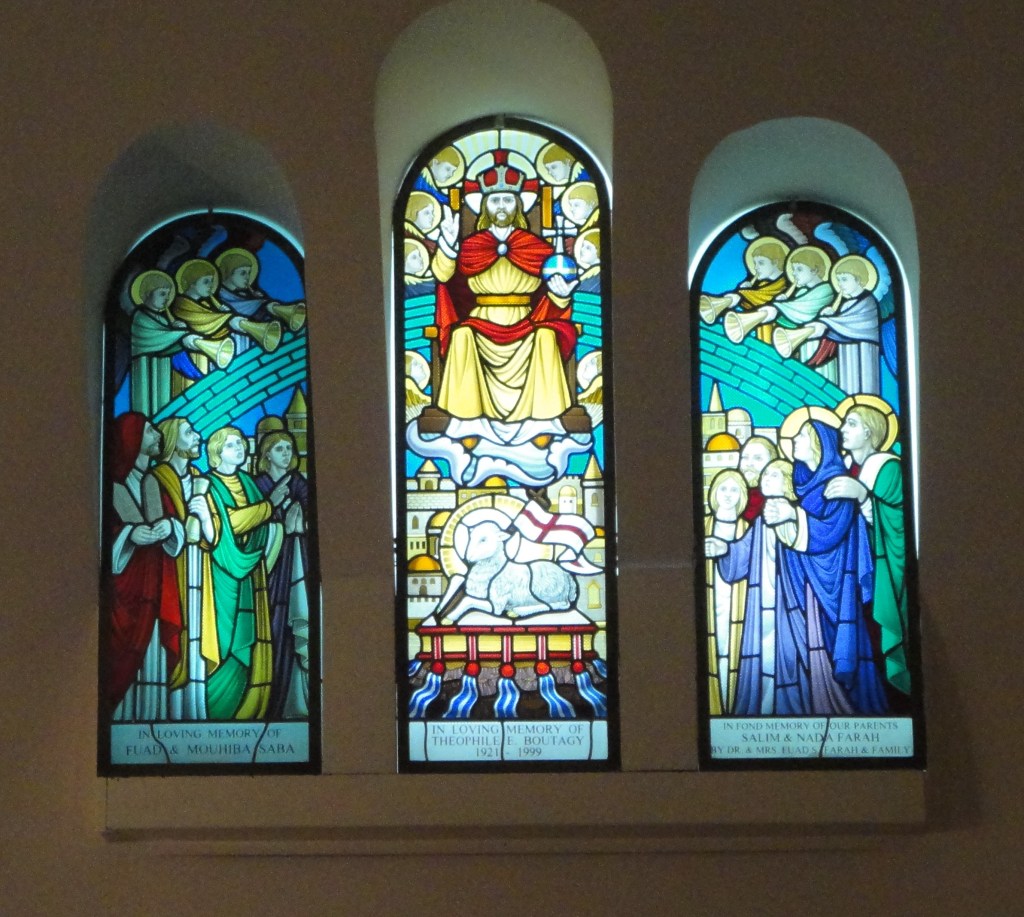
The west window of Holy Trinity Church, Geneva, depicting a ‘royal’ Christ holding the orb of the world in his hand. Used with permission.

It must have been almost exactly three years, during COVID times, when services were on line, the locum priest at the church my husband and I were ‘attending’ preached on ‘the Parable of the Sheep and the Goats’ (Matthew 25.31-46) at what was described as All Age worship for Christ the King Sunday. Well I say that he preached on the Parable of the Sheep and the Goats’, but actually it might have been called ‘the Parable of the Sheep’, because the priest in fact only read the Gospel as far as Matthew 25.40 – omitting the last six verses which focus on ‘the Goats’. And the goats and their fate didn’t get a mention in his sermon either. We got on well with our preacher, so afterwards we teased him about his choice to leave out ‘the nasty bits’. He justified his decision by saying that it was an All Age worship service – and that the fate of the goats was not an appropriate or helpful topic for those of tender years. I sort of understood his point of view, but it has still left me with some question-marks.

It is interesting that in their choice of the Psalm this week the lectionary compilers have opted for Psalm 95, for those of us old enough to remember Matins on a regular basis, the ‘classic’ opening psalm of the service referred to as the ‘Venite’. But they have not given us all of the psalm, verses 7b-11 are not included. It is of course precisely these verses in which a note of ‘judgement’ is sounded, ending with the sombre line, ‘Therefore in my anger I swore, “They shall not enter my rest” which are omitted. It feels rather on a par with that leaving of ‘the goats’ out of the Gospel reading! I will return to the psalm in a moment.

I have commented in my previous blogs for Christ the King Sunday, ‘Kingship – not of this world (November 18, 2021) and ‘Stirring it Up: the challenging Kingship of Christ’ (November 19 2020) that I find ‘Christ the King Sunday’ which has come into our liturgical calendar largely as a result of developments that took place in the Roman Catholic Church in the 1920s and 1930s, quite problematic. I ‘purred’ when I discovered a couple of years ago that Bishop Tom Wright did so too! In his case it is partly because he feels that it usurps the traditional place of the Feast of the Ascension.  I personally would add my intrinsic unease about all the huge ‘Christ-Roi’ statues erected in parts of Roman Catholic Europe and in Latin America in the 1920s and 1930s, which, whether they are intended to or not, subliminally remind me of ‘fascism’. However I have promised myself that this is not going to turn into another ‘anti-Christ-the-King-festival’ piece!

One of the areas of biblical study that I have found increasingly fascinating in recent years is the development and ordering of the Book of Psalms – why certain psalms have been grouped together – and why one comes after another. A particular point of interest comes at the end of Book Three (of the Psalms, Psalms 73-89) and the beginning of Book Four (90-106). I think that these two books are wrestling with the immense challenges of faith that the exile offered to ‘Israel’, in particular Judah and Jerusalem. Psalm 89 begins by setting out the ‘traditional’ understanding of ‘kingship’ in the period of the pre-exilic monarchy, in which the king, as descendant of David, was lauded as ‘son of the Lord’ and all manner of extravagant promises and expectations were laid upon him, with his role seen as to ensure the destiny and prosperity of his people. The first half of Psalm 89 (up to verse 37) expresses such ideas powerfully. But then there is a dramatic shift. Verses 38-51 seem to be written in the consciousness of the dreadful fate that had befallen the last of Jerusalem’s kings at the time of the Babylonian conquest and the exile of the people. All those hopes, all that theology, just dead in the dust. What future could there be for this people in exile once ruled by those kings of David’s line?

The answer is offered us in the next psalm – 90 – and psalms 91-100 which follow it, which include this week’s psalm, 95. As a group this collection of Psalms are often referred to as ‘the Psalms of God’s Kingship’. In several of them the phrase ‘the Lord is King’ appears in a prominent place in the psalm. But even in those, such as Psalm 95, in which the phrase is not explicitly used the motif of God’s kingship over the world and over humanity is surely present.

These psalms are telling us that even if human kingship ‘fails’, – as those kings of David’s line seemed to have done, God’s kingship will endure, ‘from everlasting to everlasting you are God’ (Psalm 90.2). It is interesting that Psalm 90 is the one psalm in the whole psalter that has a link to Moses in its title, ‘A prayer of Moses, the main of God’. There were two covenant traditions in the history and story of the Old Testament, the Mosaic (Sinai) covenant tradition, and the Davidic covenant tradition. They seem to have existed in a sort of tension with each other, and one of their differences, was their contrasting attitude to the role of human kings. The placing of the reference to ‘Moses’ at precisely this point, when the traditions linked to ‘David’ seemed to have failed is surely significant. The Mosaic/Sinai tradition was frequently hostile to human kingship – seeing it as attempt by humanity to usurp God’s rightful role as king. The Davidic covenant tradition however (at its best!) viewed the king as acting as a mediator between God and the people. The king’s closeness to God, and his own human status, combined so that he could ‘represent’ God to the people, and he could also represent the people before God. And – the tradition also suggested – at times this representational and mediatorial role might involve the king in suffering on behalf of his people. We do seem to catch glimpses of this in some of the psalms, and perhaps the servant songs of Isaiah 40-55, which themselves may have been composed partly as a response to the ‘failure’ of human kingship at the time of the Babylonian exile.

Some of these insights into the nature of Old Testament kingship, have come to the fore during this last year, especially around the time of the coronation of King Charles III. The coronation rite draws considerably from the Old Testament understanding of kingship. This is the first time that we have celebrated the Feast of ‘Christ the King’ since the coronation, so it is interesting to make such cross-references.

My ‘argument’ is that to understand the fullness of what it means to call ‘Christ the King’, we need to think of him holding together in his person these two competing Old Testament understandings of kingship: the one in which a human king of the Davidic line has a representative and mediatorial role, and the one in which the absolute supremacy of God as king is affirmed.  I believe that the New Testament writers make precisely that link. I would also suggest that the ‘Davidic’ perception of the king’s special relationship to God played a substantial part in the development of New Testament thinking about the incarnation of God in Jesus Christ. For me, that is expressed not least by the way that the Gospel of Matthew calls Jesus, ‘Emmanuel’ (God with us) both directly and indirectly.

If we look at the word ‘E/Immanuel’ in its original context (Isaiah 7.14; 8.8) it seems to have been a title given initially to a child born to the Davidic house of kings in Judah. Indeed the suggestion is often made that it was referring to the birth of Hezekiah, the son of King Ahaz and Ahaz’s successor. ‘Emmanuel’ was an appropriate title to give to such a royal child, given God’s ‘withness’ vis-à-vis the king. But even Hezekiah, ‘good’ king though he may have been, did not live up to the hopes placed in him, and  so people looked towards the day that a child would be born who would truly reflect such a name and description!

And so to the Gospel of Matthew once again. In Matthew 1, immediately after a genealogy which has clearly linked Jesus to the family of David, as the  birth of Jesus is announced we are told ‘And his name will be called Emmanuel, God with us.’ (Matthew 1.23)  Then this assurance of God’s presence with human beings runs  like a gentle heartbeat through the pages of the Gospel until it rings out once again in Jesus’ final words ‘I am with you till the end of the age.’ (Matthew 28.20) ‘I am with you’, that deliberate recapitulation of the ‘Emmanuel of Matthew 1, is Jesus’ claim to fulfil all those expectations of kingship, human and divine, of which our Old Testament scriptures have sung the prelude.

And yet there is another surprise for us.  One final radical twist in Matthew’s tale – which leads us back to our Gospel reading for this coming Sunday:

Jesus, ‘Emmanuel’, promises to be with his disciples throughout all time. But where can we find and see him today? Matthew himself directly and explicitly provides the startling – and shocking? – answer. For in this Parable of the Sheep and the Goats we discover that we are being offered the opportunity to see Jesus with us in some very unlikely places – in the faces of the sick, the strangers, the hungry and thirsty, the imprisoned, whom the disciples of Jesus may choose – or refuse – to honour or minister to.  ‘Lord , when did we see you hungry, or naked or a stranger or in prison? ‘Truly I tell you, just as you did to the least of my brothers and sisters – so you did it to me.’

So back to the Feast of Christ the King. Where do we find ‘Christ the King’ in today’s Gospel reading? Perhaps the answer is both in the figure of the almighty judge who doles out reward and punishment and in the figures of those – poor, sick, hungry, homeless – in whom Jesus invites us to discover his presence?

And one last thing. I had never spotted it previously. I mentioned above that one of the roles of Old Testament kings might well be to suffer as a representative on behalf of his people. I do not think it an accident that our Gospel reading for ‘Christ the King’ – telling of the figure coming ‘in glory and all the angels with him’ (Matthew 25.31) – is then immediately followed by the final prediction of Jesus’ passion, and the machinations of the religious leaders to achieve his death. “When Jesus had finished saying all these things, he said to his disciples, ‘You know that after two days the Passover is coming, and the Son of Man will be handed over to be crucified.’(Matthew 26.1)

Blessed are the peacemakers

Window in All Saints Church, Beirut, Lebanon

Given that many churches in the Diocese in Europe, including the one with which I (Clare Amos) am most closely linked, will be marking All Saints and All Souls Day this coming weekend I felt it made sense to have a primary focus this week on the readings selected for All Saints Day.  (Revelation 7.9–17; 1 John 3.1–3; Matthew 5.1–12)

As it happens, though, the readings for the Fourth Sunday before Advent – the alternative liturgical possibly suggested by the Common Worship calendar – which are Micah 3.5–12; 1 Thessalonians 2.9–13; Matthew 24.1–14 enter into an intriguing dialogue with the themes and scripture readings for All Saints Day, so I have found myself drawing in this Gospel as well.

I would be remarkably surprised if any of our chaplaincies which celebrates All Saints on Sunday doesn’t find itself singing ‘For all the saints’ at some point in the service. Sung to Vaughan Williams wonderful tune ‘Sine Nomine’ (‘Nameless’ – referring to the multitude of saints without number or name!) it is as much a part of the celebration of All Saints Day as Hark the Herald Angels Sing is of Christmas. It is interesting though that the words of the hymn were written at least 40 years before ‘Sine Nomine’ was composed: I wonder what it felt like to sing the hymn to the tune that was originally used for it?

But ‘For all the saints’ is not totally unproblematic! In fact it is quite militaristic in its language. Indeed a couple of the verses of the hymn are sometimes omitted for that reason. The Anglican priest-poet Jim Cotter, who died in 2014, is well-known for his alternative versions of a number of hymns, and he did the same for ‘For All the Saints’.  You can find Cotter’s version in a number of places, including his book ‘Prayer in the Morning’. For copyright reasons I won’t include Cotter’s entire text in this blog… but to give you an idea of how he transposes the original words into a slightly different ‘key’, here is Cotter’s version of one of the latter verses:

And there will dawn a yet more glorious day,

The saints with laughter sing and dance and play

The Clown of glory tumbles in the Way: Alleluia!

I cherish the vivid images that spring to mind as I read or sing this!

‘For all the saints’ is not actually one of the ‘worst’ offenders when it comes to militaristic language in Christian songs and hymns. For me that particular accolade probably goes to either ‘Stand up, stand up for Jesus, ye soldiers of the Cross’, or ‘Onward Christian soldiers, marching as to war’.  Inevitably I have been personally affected by living in Lebanon during its civil war in which I encountered considerable numbers of ‘Christian soldiers’ or ‘soldiers of the Cross’ whose faith was expressed too readily via their sub-machine guns.  Since then I find it very difficult to sing either of the two hymns I have mentioned above, though I found it interesting that when, while working for the World Council of Churches, and travelling internationally, those songs were very popular choices in many parts of the world which I visited.

So it is interesting to set alongside this that one of the key ‘Beatitudes’ in the text from the Sermon on the Mount which is the lectionary Gospel for All Saints is the blessing offered to peace-makers. The pledge that is offered to them is that they ‘will be called children of God’. (Matthew 5.12). The promise of being named as ‘children of God’ is picked up in the Epistle for this day, ‘See what love the Father has given us, that we should be called children of God, and that we what we are…Beloved we are God’s children now ‘ (I John 3.1-2)

What is interesting however is that this reading from I John also includes a reference to ‘pure’ –  a word which appears in the Beatitude which comes just before that associated with the peace-makers, ‘Blessed are the pure in heart, for they shall see God’.

I John hints to me that we are supposed to see these four concepts peace-makers/pure in heart/seeing God/children of God as closely linked to each other. And in the process says something that feels only too relevant about peace-making. Namely that it is not simply an external process but requires of us – if we are to be ‘saints’ who follow the vocation of peace-makers – an inner transformation and purification.  

In my interreligious work at the World Council of Churches and since, one of the issues that I was (and am) working on is the question of religiously motivated violence. It is not simply an ‘interreligious’ question – religiously motivated violence can certainly be ‘intra-religious’ as well. But it is certainly a question that often does arise in interreligious contexts.

Over the years I have got rather ‘allergic’ to being told in the various ‘high-level’ dialogue meetings I have participated in, that ‘our’ religion (whatever particular religion the speaker may profess!) is an engine of peace – certainly not of violence. It is a shallow statement and often to a considerable degree not reflective of reality..

Back in 2002, I remember listening to a speaker who brought his wisdom from Northern Ireland and who said starkly, ‘Unless religion is willing to acknowledge that it is part of the problem (when it comes to violence) then it cannot also be part of the solution. That has been a guiding principle for me ever since, and it is the focus of a current writing project of mine.

In the context of these readings for All Saints Day, perhaps my linked ‘take-away’ – drawing together the readings from the Beatitudes and from I John – is that if we who are called to be ‘saints’ are indeed to be peace-makers that will entail a willingness to be changed (‘purified’) ourselves. One cannot help make a full or enduring peace without being willing to undergo a personal and perhaps even painful process of transformation.

I will leave you, the readers, to draw out the implications of my comments for our difficult contemporary contexts.  I do however note that the alternative lectionary Gospel for the Fourth Sunday before Advent (Matthew 24.1-14) also, by implication, offers a reminder of the way that the preciousness of the city of Jerusalem to peoples of several different faiths (‘competitively loved’ as Bishop Kenneth Cragg put it) has, throughout history, been itself a major cause.of war. One day, we must hope and pray, as the prayer below puts it, the city will live up to ‘the peace embedded in its name’.

Jerusalem, ‘perfection of beauty’,

City cherished and squabbled over,

Where hopes have been crucified

And the colours of resurrection still await the dawn.

We pray for all who love,

That as well as passion they may learn patience,

That their longings may lead to life,

That their faith in you may bring forth fruit,

For the healing of the nations.

Though your stones still cry aloud with the pain of centuries,

Drenched with the tears of the one who wept over you,

May the God who called this place his home

Give all people wisdom and courage

To discover in you the peace embedded in your name,

So that you may truly become, ‘The joy of all the earth’. Amen.

clare.amos@europe.anglican.org

Loving God, loving neighbour

Part of a manuscript of the Book of Leviticus from the Dead Sea Scrolls

This week’s ‘Faith in Europe’ blog focuses on the Gospel reading Matthew 22.34-46, the lectionary Gospel for Sunday 29 October. Current events in the Middle East, as well as the history of religion in Europe, are in my mind as I write it.

Clare Amos

Director of Lay Discipleship, Diocese in Europe

*****

There are two halves to this coming Sunday’s lectionary (Matthew 22.34-46) Gospel reading – each with a question in them.  I expect most congregations will concentrate on the first half, and the first question. So will this blog – although I will also draw out towards the end a possible implication of the second question.

The challenge that Jesus is posed with ‘Which is the great commandment in the Law?’ appears in all three Synoptic Gospels although there are minor differences between them. It is however only Matthew who after listing the two commandments – demanding first love of God and then love of neighbour,  suggests that Jesus went on to affirm ‘On these two commandments hang all the law and the prophets’ – drawing a connection with the reference to ‘the law and the prophets’ in the Sermon on the Mount (Matthew 5.17).

I appreciate the tradition of classical Anglican liturgy of reciting these two commandments in the Communion service – as a kind of preparation for the act of confession. It is perhaps a pity that the practice is not quite as widespread as it used to be. Mind you – in the church I attended as a teenager the vicar considered that merely using these ‘two’ commandments was a concession to human weakness: whenever he had the opportunity he would replace them with the whole Ten Commandments as per the book of Exodus! On reflection I am not sure that he was right – properly observed it is arguable that these two commandments are far more demanding than the Ten. 

Over the last 25 years or so I have had the privilege of working in the field of inter faith dialogue and engagement. It is a field which I find fascinating, challenging, vital – and sometimes totally exasperating. Perhaps surprisingly, one of the results of working in this field is that I have discovered new insights into Christian scripture. And that is true in relation to this week’s Gospel reading.

One of the criticisms that is sometimes made of inter faith dialogue, is that it is largely Christians who make the running, and take the initiative in this area, rather than ‘other faiths’. That might have been true 25 years or so ago, but I think that in the last 20 years the picture has shifted. One of the inter faith initiatives that caught wide public imagination is A Common Word. Published in October 2007 A Common Word was an initiative of Prince Ghazi bin Muhammad of Jordan working with a group of Muslim scholars from the Middle East and elsewhere. I have had the privilege of participating in several significant inter faith meetings in which A Common Word provided the basis for our discussion. The document was produced as a response to the critique of Islam that had been made a year earlier by Pope Benedict in a talk in Regensburg in Germany.  It takes the form of a letter addressed to Pope Benedict and other high profile Christian leaders. You can find a copy of it here. The ACW Letter | A Common Word Between Us and You The central thesis of A Common Word is that both Muslims and Christians hold in common two important guiding principles: that we are both called to the Love of God, and the Love of our Neighbour. In turn this can provide a basis for Muslims and Christians to work together for harmony in our world. A Common Word then seeks to illustrate this point from both Muslim scriptures (the Qur’an) and Christian scriptures (the New Testament). Not surprisingly, the primary Christian scriptural reference offered is this week’s lectionary Gospel about the two great commandments (and its parallel in the Gospel of Mark).

And the use of this passage in A Common Word led me to reflect more deeply on it, both in terms of our Christian self-understanding, and also what we bring to the table of dialogue with Muslims.

Briefly, I think there are two key points that I would want to make.

The first is that when Christians use the phrase ‘Love of God’ – our fundamental understanding is that love starts with God, not with us. Human beings are called to love God primarily because he first loved us. It may not be directly apparent from Matthew 22.34-46, but it is a profound underlying principle for Christian theology, spirituality and ethics.

Such a trajectory is clearly apparent in the Gospel of John and the letters of Paul. Take for example the Gospel of John, in which the word ‘love’ appears a great number of times, more than in the other three Gospels put together. The first time the word occurs is in the iconic passage, John 3.16, ‘God so loved the world that he gave his only Son’… Then beginning with chapter 11 (the story of Lazarus, Mary and Martha), the word ‘love’ splurges all over the pages of the Gospel. But it is made clear that the question Jesus ultimately addresses to Peter – and to the rest of us – ‘Do you love me?’ is posed on the basis that God has clearly demonstrated the sacrificial and costly nature of love in the life, ministry and death of Jesus Christ.  Gratitude therefore is the primary driver which must underly the demand ‘you shall love the Lord your God with all your heart, and with all your soul, and with all your mind’ (Matthew 22.37). I believe that in turn this will affect how we express such love.

The second point is that for Christians, the two commandments, ‘Love God’ and ‘Love our neighbour’ cannot ultimately be separated: the dialogue between them enriches both our understanding of God and of human beings. It is a framework linked to the Christian understanding of the importance of incarnation, of God ‘dwelling’ with humanity: we are required to see the face of God in our brother and sister and even our neighbour. The clearest expression of this comes in the First Letter of John, ‘Those who do not love a brother or sister whom they have seen, cannot love God whom they have not seen’ (I John 4.20). The love of God and the love of neighbour are not two separate and potentially competitive commandments, but complementary aspects of the one reality.

Why is this important? For several reasons, but certainly this, which feels all too relevant at the present time. Namely that so often those who commit acts of religiously based violence do so on the basis of their understanding of the ‘love of God’. They believe that the justification for their carrying out sometimes horrific acts lies in the fact that they are thereby demonstrating their love and obedience towards God.  All religions – including Christianity – have been guilty of this at various times in their history. It is a factor in current developments in the Middle East.  In such contexts it becomes even more vital to see Love of God and Love of neighbour as two parts of the one reality.

A brief note (as promised above!) about the second question in this week’s lectionary Gospel, a somewhat puzzling challenge offered by Jesus to those he was engaging with. ‘Whose son is the Messiah?’ – challenging as he does so the conventional understanding that the Messiah was ‘Son of David’. Though I am sure that there is more that could be said, perhaps one implication of Jesus’ question is that in Jesus’ understanding of messiahship the traditional ‘boundaries’ dividing God and humanity were being challenged and overcome. That, it would seem to me, has possible implications for any model of messiahship which is military or hierarchical in character.

Loving Father in heaven

Emmanuel, God with us,

Of your goodness

you have given us yourself,

The richest gift of all.

You invite us to seek for you,

In the face of your Son,

Where you have imprinted your likeness,

Made glorious with the wounds

Of suffering and passion. .

Grant us a spirit of generosity,

So that we may be enabled also to discern your features

In the changing kaleidoscope of this world’s need. Amen.