Peace in Heaven?

Jesus entering Jerusalem, fresco by John Corbidge at All Saints Church, Pissouri, Cyprus

The lectionary blog for this coming Sunday focuses on the ‘Gospel of the Palms’, Luke 19.28-40. But the liturgy of Palm Sunday moves quickly from this moment of apparent triumph to Jesus’ suffering and death only a few days later, events which are of course also our focus on Good Friday. Next week’s blog will reflect on the meaning of the crucifixion and will take as its starting-point the challenge of ‘Peace in heaven?’ that is presented by Luke’s Gospel of the Palms.

Clare Amos, Director of Lay Discipleship, clare.amos@europe.anglican.org

Luke’s account of Jesus’ entry into Jerusalem has got the capacity to bring out the pedant in me! Because if you read the biblical text carefully,  Luke 19.28-40, you will see that Luke’s Gospel, unlike the other three, nowhere mentions ‘palms’ – or any other kind of greenery. So, in the years when Luke is the lectionary gospel, should we in fact be referring to ‘Palm Sunday’? In truth, I am perfectly well aware that there are more important things to worry about – especially at the present time! But it is an indication perhaps that Luke’s account of this crucial episode in the life and ministry of Jesus has some significant difference of emphases, when compared with the other three Gospels. Luke’s account somehow feels slightly less ‘triumphal’. For example, the word ‘Hosanna’ also doesn’t actually appear in his narrative – though the word is prominent in Matthew, Mark and John.

Conversely Luke’s is the only account of the episode in which the word ‘Peace’ appears (Luke 19.38). It’s not there in the other Gospels. In Luke’s account the name ‘the Mount of Olives’ is also more prominent at the heart of the story, ‘As he was now approaching the path down from the Mount of Olives’ (Luke 19.37). Given the age-old association between olives and peace I think this may too be significant. It also of course builds a connection with the agony in the garden that Jesus is shortly to endure – since the name of this garden, at the foot of the Mount of Olives actually means, ‘Olive press’ (Gethsemane).

Luke 19.41-44 are not part of the lectionary Gospel. There may be good reasons for this, but in some ways it is a pity, since these verses, which speak of Jesus weeping over Jerusalem, continue the theme of ‘peace’ which has been introduced just above. ‘If you, even you, had only recognised on this day the things that make for peace! But now they are hidden from your eyes’ (Luke 19.41-42). Jesus’ words include a deliberate ‘pun’ on the name ‘Jerusalem’, the city which has ‘peace’ (shalom) in its very name, but which has patently often not experienced ‘peace’ throughout the millennia of its existence.

The continuing use of the motif of ‘peace’ in Luke 19.41-44, encourages us to go back and look more closely at the first time it appears in the story, in Luke 19.38. It is part of the cry of ‘the whole multitude of the disciples’ as Jesus begins to descend the mountain towards the gates of Jerusalem:

‘Blessed is the king, who comes in the name of the Lord!

Peace in heaven, and glory in the highest heaven!’

What is fascinating (but rarely noticed) is that this is the counter-point of the message sung by the angels at Jesus’ birth,

‘Glory to God in the highest heaven,

And on earth peace, goodwill among people’. (Luke 2.14)

So the angels of the nativity sing of peace on earth, while on ‘Palm Sunday’ the disciples sing of ‘Peace in heaven.’

Who got it right, the angels or the disciples? I owe the following thought to a reflection originally offered by Fred Kaan in Wisdom is Calling. Kaan comments:

[The song of the disciples] ‘is a completely crazy and total misrepresentation of what God had in mind from the beginning. The angels sang, ‘peace on earth’. The followers of Jesus sang, ‘peace in heaven’ – many of them still do, whereas we should be on the side of the angels. Peace in heaven is none of our business. As earthly disciples we should not waste our imagination and emotions on envisaging peace in heaven, because we are human beings inhabiting ….[the earth] which we are called to fill with the Father’s glory’.

Given the lack of peace at the present time in our world, and especially in our continent of Europe, this is a salutary observation. To focus on ‘peace in heaven’ is certainly diversionary, but it can also be potentially dangerous. In my experience of working in interreligious relations for the Anglican Communion and the World Council of Churches, a theme that I have frequently found myself focusing on is that of religiously motivated violence.  I think it is not too much to say that there can be a connection between wanting everything to be right ‘in heaven’, and taking violent steps ‘on earth’ to enforce our religious ideals. And it is not just an ‘issue’ for non-Christian religions. Certainly there is increasing (and I think justified) reflection at the moment about the ‘religious’ component of the Russian motivation for the attack on Ukraine. For some at least of the Russian leadership, both religious and political, their actions may, in a distorted sort of way, be an attempt to enforce ‘peace in heaven and glory in the highest heaven’.

And if the ‘multitude of the disciples’ on that first Palm Sunday got it wrong when they sang ‘peace in heaven’, then that perhaps helps to explain the otherwise puzzling comment of Jesus at the end those verses which have described his weeping over the city. Jesus suggests the pain that Jerusalem and her people would suffer was due to the fact that ‘[you] did not recognize the time of your visitation from God.’ (Luke 19.44) On the surface at least those who sang with a loud voice to welcome Jesus to Jerusalem, did ‘recognize’ their visitation. But was it perhaps that their singing of ‘peace in heaven and glory in the highest heaven’ presented a challenge to ‘peace on earth and goodwill among people’, and did not really comprehend the vocation of the one who came to be ‘Prince of Peace’? Is this why the pain of Jerusalem, that beautiful, and ‘competitively loved’* city, has  cried aloud in its stones for the last two thousand years and we can still hear its sound of suffering even today?

* ‘competitively loved’ was a phrase often used of Jerusalem and the Holy Land by Bishop Kenneth Cragg, Anglican bishop, poet, specialist in Christian-Muslim relations and friend.

(The blog for the coming week will continue to explore the theme of ‘peace’, linked to Jesus’ crucifixion, and reflect on how this event at the heart of our faith may indeed link peace in heaven and on earth.)
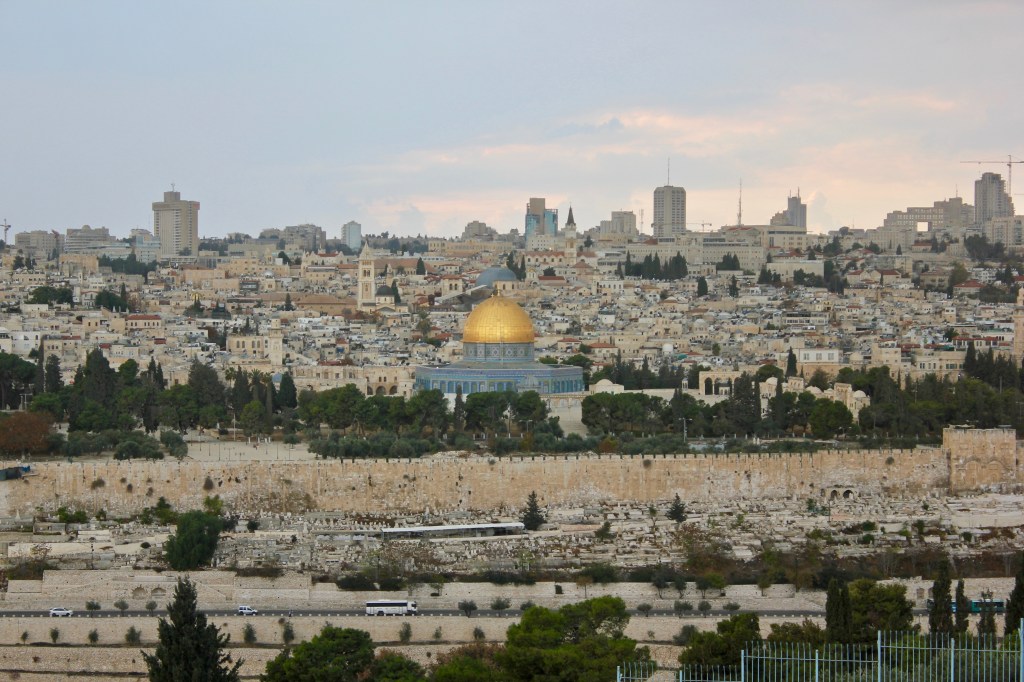
Jerusalem from the Mount of Olives, photographed by Edoardo Fanfani during the Ministry Experience Scheme pilgrimage to Jerusalem 2017.

The house was filled with the fragrance

A Roman perfume flask

This week’s lectionary blog focuses on the Gospel reading, John 12.1-8, which tells of the anointing of Jesus by Mary of Bethany. It also draws on the Old Testament reading Isaiah 43.16-21 and the appointed psalm, Psalm 126. Apologies for the delay in posting this week – due to various exceptional factors.

Clare Amos, Director of Lay Discipleship, clare.amos@europe.anglican.org

All the four Gospels tell of an incident in which Jesus is anointed (or washed) by a woman, but there are intriguing differences between them. In Mark and Matthew it is Jesus’ head that is anointed, in Luke and John it is his feet. In Matthew, Mark and John the incident is clearly related to Jesus’ forthcoming passion and acts as a pre-emptive anointing for his burial; in Luke the incident is placed earlier in Jesus’ ministry and the woman’s actions are linked to her own past as a ‘sinner’.

During the history of the church the passages have often been conflated: with the unfortunate (but telling!) result that the unnamed woman of Matthew and Mark, and the woman named as Mary of Bethany in this Sunday’s Gospel, John 12.1-8, tend also to have been viewed as ‘repentant sinners’, and their actions seen primarily in that light. There are far far more visual examples of Luke’s account of the tale certainly than the story as told by Mark and Matthew, when the pouring of the oil actually over the head of Jesus, recalls the actions of prophets of the Old Testament and their role in the anointing of kings.

Equally the story as related here in the Gospel of John, once we look at it closely, has some particular and distinctive insights to share, which are fundamental to John’s understanding of who Jesus was and what he had come to do.

Even a cursory reading of John 12.1-8 brings out the emphasis on the perfume, and in particular its scent., ‘The house was filled with the fragrance of the perfume’ (John 12.3). That note does not appear in the story as told in the other Gospels. However it is intriguing that in the previous chapter of John’s Gospel there had also been another reference to smell – of a rather less pleasant kind. For as Jesus instructs the stone to be taken away from in front of Lazarus’ grave the ever-practical Martha (for whom I feel a great deal of sympathy and fellow-feeling!) comments, ‘Lord, already there is a stench for he has been dead for four days.’ (John 11.39). It suggests that the two incidents, the raising of Lazarus, and the anointing of Jesus, are to be read and interpreted alongside each other. If we failed to spot that through the reference to smell, then it is made crystal clear for us by the way that the Gospel introduces this incident at the supper, ‘Jesus came to Bethany, the home of Lazarus, whom he had raised from the dead’ (John 12.1).

The raising of Lazarus, and the anointing of Jesus at Lazarus’ own home in Bethany belong together, and between them they take us to the very heart of the Gospel of John. There is a very strong hint offered in the Gospel that it was precisely because of the ‘excitement’ generated by Jesus’ raising of Lazarus, that the high-priestly leadership felt that Jesus had become a danger to their accommodation with the Roman authorities and therefore needed to be ‘sacrificed’ himself in order to ensure the safety of ‘the nation’.  (John 11.47-53).  

But that connection between the two moments of smell, one of beauty and the other linked to death, provides a powerful reminder of that biblical pattern reflected in this week’s psalm (Psalm 126) , which suggests that weeping leads to joy, and that life is drawn out of death.

John 11 and John 12 are the core central chapters of John’s Gospel, which is a Gospel whose goal is life (see John 20.31). They tell us of how life and death are intertwined, of how Jesus brought life out of death, not merely by his actions (in terms of what he did for Lazarus), but ultimately through his own dying which is provoked precisely by those actions.  They take us deep into the mystery of the cross. But they also take us deep into another mystery that John’s Gospel explores for us – that of Jesus’ incarnation.  There is a powerful physicality about these chapters – both in the story they tell and how they describe Jesus himself as actor and recipient.

It is interesting to note that in our short lectionary Gospel John 12.1-8 we have all five of the human senses directly referred to or implied in the story: smell, touch, taste, hearing, sight. And of course in chapter 11 we have that infamous shortest verse of the New Testament, ‘Jesus began to weep’ (John 11.35), which is surely a powerful expression of Jesus’ humanity. To return to John 12, we often fail to realise how physically ‘shocking’ the story is – especially in the context of its time and place. Presumably in order to wipe Jesus’ feet with her hair Mary would have needed to remove her headcovering, which to this day women in many Middle Eastern countries would wear, except in front of their closest family.  As many commentators acknowledge her profoundly personal physical actions have an erotic edge. They are daring and potentially dangerous, but they are also part of what it means to be a human being relating to another human being.

‘I am about to do a new thing’, is a line from this week’s Old Testament reading, Isaiah 43.16-21. In John’s Gospel the one who became incarnate as a human being is bringing to birth a new creation, a new Genesis (you only have to read John 1.1 to realise that!) This Gospel is indeed the story  of a new creation, including a new humanity. And a key aspect of this new humanity is that it re-sets the relationship between men and women – which after the events of Genesis 3 had been marked primarily by fear, caution, imbalance and violence. John 12.1-8 is a risky story: it is risky because it both hints at the risks Jesus needed to undertake to bring about the new humanity, but it also suggests that if we want to be part of this new humanity it can sometimes be a risky business. In honouring Mary’s loving gestures towards him, as indeed in weeping for Lazarus (‘See how he loved him’, John 11.36) Jesus shows himself willing to accept the risk of love.

And one other thing. John 12 is followed by John 13. This is a chapter which focuses on Jesus washing the feet of his disciples. Is it just possible that part of the ‘risk’ Jesus was to take in inaugurating this new creation was to allow himself to be influenced by the gesture of Mary, that woman, who only a few days earlier had washed his own?

When we were still far off: a story and a prayer

The Parable of the Prodigal Son, Duke University, Margaret Adams Parker

This week’s lectionary blog takes as its focus the story of the Prodigal Son, Luke 15.1-32, which is the Gospel reading selected for Lent 4.

Clare Amos, Director of Lay Discipleship

clare.amos@europe.anglican.org

Much though I appreciate the desire to celebrate ‘Mothering Sunday’ it has its problems. It can be a very painful day for people who are involuntarily childless, or who are or have been caught up in painful family hostility. It also somehow disrupts the ‘flow’ of Lent: though in fact both of the alternative Gospel readings suggested by the lectionary do directly or indirectly provide a link to Jesus’ passion, that is rarely picked up in the festivities linked to Mothering Sunday.

The date of course was originally selected because in the BCP the Epistle for the Fourth Sunday of Lent from Galatians 4, includes a reference to ‘mother’, ’the other woman [Sarah] corresponds to the Jerusalem above; she is free, and she is our mother’ (Galatians 4.26). In fact I think the reading from Galatians probably intends to prioritise ‘Jerusalem’ over our earthly mothers, but that has been rather forgotten in the usual focus of Mothering Sunday.

It is a peculiarly English and Church of England custom to celebrate mothers in March: and I am not sure how well it works liturgically, with the possible exception of years (such as in fact this one) in which Mothering Sunday falls close enough to March 25 to be linked in some way to the Annunciation. In many of the countries in which our Diocese ministers, ‘Mothers’ are celebrated at some point in May, and on the whole I think that may work better.

One of my gripes however is that a focus on Mothering Sunday can displace biblical texts and themes that are important not to lose. One such reading is the Gospel offered this year for Lent 4 in the Common Worship lectionary, though it is intriguing that this reading, as well as the other Gospels suggested for Lent 4 in Years A and B, all do contain an oblique reference to parents (so in theory the link could be made).

However I certainly think it is a pity to forget about the Gospel for Lent 4 in this particular lectionary year, as it is Luke 15.10-32 the story of the Prodigal Son, which is one of the most beloved parables of Jesus – and which, if it is displaced by Mothering Sunday, does not get much of a look in the Sunday lectionary.

If you asked a cross section of people who self-identify as Christian which of Jesus’ parables they knew and cherished the most, there is a fair likelihood that a considerable majority of them would point to this one, generally known as the Parable of the Prodigal Son – though it equally could be called the Parable of the Forgiving Father (which allows for the oblique link to Mothering Sunday!)

It is cherished partly because it speaks so profoundly about God’s acceptance – as in fact does George Herbert’s wonderful poem ‘Love bade me welcome’ which often springs to my mind when I am reflecting on this parable. Years ago, when I lectured in Old Testament at the Near East School of Theology in Beirut, my colleague who taught New Testament in the N.E.S.T. was Kenneth Bailey who wrote a classic and still much loved book called The Cross and the Prodigal (well worth reading!). Ken’s book observed how, if one looked at the parable through Middle Eastern eyes, we can gain new insights that are not as obvious to western readers. 

One such insight was the scandalous behaviour of the father in running to welcome back his errant son. In the Middle East one still shows one’s dignity and importance by walking in a slow and measured fashion. That tradition used to get me into trouble in those years when Alan and I lived in Beirut. In those days I frequently ran – not necessarily because I was in a hurry, but as part of my personality and the joy of life. My running was noticed and disapproved of: first because I was supposed to behave like a learned professor at the theological seminary, and secondly because I was also a khouriye (priest’s wife) – married to the Anglican chaplain in the city. A ‘word’ was spoken to Alan about the need for him to ensure that his wife comported herself with more decorum than she was wont to do. There was even a salutary tale told of a minister in the local Lebanese Protestant church who had had a significant appointment rescinded because he too turned out to be a ‘runner’.  

A mark of how much this Gospel parable is loved is surely the way that it is alluded to in the post-Communion prayer, originally written by David Frost for Series 3, but which has continued to be used in Common Worship because of its beauty and the way that it ‘speaks’ to us. ‘Father of all, we give you thanks and praise, that when we were still far off, you met us in your Son and brought us home…’  I do not think that I am wrong to see in the words, ‘… we were still far off, you met us…’ a deliberate allusion to the meeting in the parable of the Father with his recalcitrant son.

It is interesting to reflect briefly on the three protagonists in the story: the father, and his two sons, the younger and the elder. I appreciate the portrayal of the three in the statue created by the Episcopalian artist Margaret Adams Parker at Duke University, USA which is used (with permission) as an illustration this week. I am ‘grabbed’ by the sense of vulnerability of the father it offers us. And what of the sons?

When I first undertook academic biblical studies in the 1970s, the views of Joachim Jeremias were all the rage. Jeremias’ key tenet was that the parables of Jesus were not allegorical, and that each had one key central point that was really all we should focus on. I have to say that as regards Jeremias I have been there, done that and rather come out the other side. For I do believe that without necessarily being full blown allegories, many of the parables of Jesus contain allusions and links that it is intended that we pick up and that unless we do our reading of the parable is impoverished. I particularly think that about the parables that are special to the Gospel of Luke, which of course includes the Parable of the Prodigal Son. So who is represented by the father, and who by each of the two sons?

I find David Frost’s prayer a helpful interpretive tool for this exploration. The link between the words of the prayer, ‘when we were still far off’  and the Gospel phrases, ‘but while he was still far off, his father saw him… ran and put his arms around him and kissed him’, encourages us to identify ourselves as the Prodigal, greeted by the heavenly Father and welcomed to a home-coming banquet (which of course we have just shared in through the Eucharist).

Yet that is not the whole of the story, nor even of the prayer. For after the words, ‘When we were still far off’ the next line of the prayer goes, ‘you met us in your Son and brought us home.’ The words slip off the tongue so easily that we forget just how daring they might be. For what are we saying about ‘your Son’? Where is the prayer positioning him? Perhaps like many powerful prayers there is a hint of mystery and ambiguity around. Is the Son accompanying his Father to this meeting with us, or is he travelling with us as we journey in to meet the Father? Linguistically the phrasing of the prayer allows for either possibility.

I suspect that many who say the prayer implicitly assume that the Son is standing alongside his Father ready to greet us, for that is theologically perhaps the more orthodox or safer option. It is probably what I myself originally thought when I first came across this prayer. But if you take seriously the way that the prayer is resonating with a biblical story which is telling of a meeting between a father and a son, then logically perhaps the Son needs to be seen alongside us, on our side of this crucial meeting, accompanying us as we make our prodigal return to our Father’s house. And if that is the case then the breath-taking conclusion is that in and through this prayer we are identifying Jesus the Son with the prodigal son of the parable. This is not a totally original interpretation: in his well known book, The Return of the Prodigal Son, the spiritual writer Henri Nouwen reflects, ‘the mystery [is] that Jesus himself became the prodigal son for our sake… the young man being embraced by the Father is no longer just one repentant sinner, but the whole of humanity returning to God.’i It is a stunning thought to bear in mind whenever we pray this prayer. It is probably the interpretation I myself would ultimately hold to.  

Rembrandt, The Return of the Prodigal

There is however perhaps one further possibility which I would like at least to tease out. For the biblical parable speaks of two sons – an elder and a younger. The pictures (the statue at Duke University and the famous painting by Rembrandt) that accompany this reflection incorporate this elder son within the story – though they also make clear his unreconciled distance. One of the reasons that the lack of reconciliation in the parable between the two brothers feels so very painful is that Luke seems to have intended us to ‘read’ the story bearing in mind a number of Old Testament tales of brothers, most of all the story of Jacob and Esau. By contrast with the parable of Luke, Jacob and Esau are eventually reconciled: indeed the words which speak of their encounter, ‘Esau kissed him and they wept’ (Genesis 33.4) are curiously similar to the description of the reconciliation of the father and the son in Luke. Is it not possible then that when we say the words, ‘Father… you met us in your Son and brought us home’, we could also identify Jesus with the elder son? And if so he has in this prayer taken a leap beyond the pain, hostility, envy and separation of the parable and has chosen to stand at his Father’s side, welcoming us, his younger prodigal siblings, back home to his Father’s house where there are so many dwelling places that he has even helped to prepare for us. (John 14.2) 

For the love of God is broader…

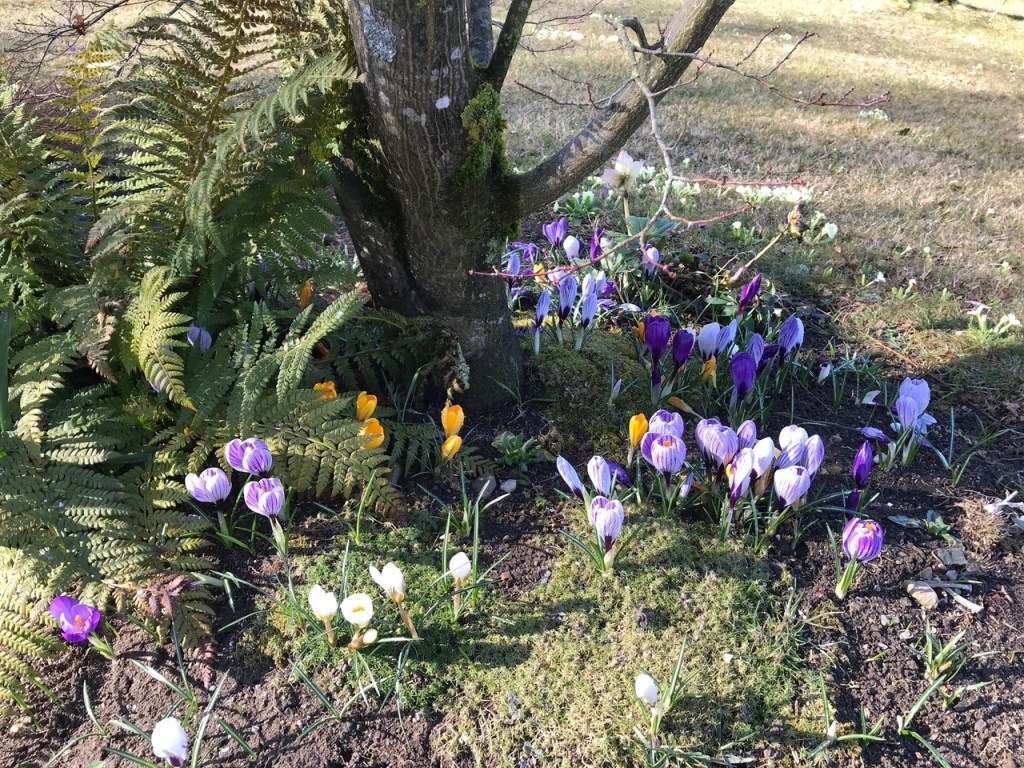
Life and love will find a way: the coming of spring near Lake Leman (photo by Nick and Simone Meyer)

This week’s blog focuses on the three Common Worship lectionary readings for Lent 3: Isaiah 55.1-9; I Corinthians 10.1-13; Luke 13.19

Clare Amos, Director of Lay Discipleship, Diocese in Europe

clare.amos@europe.anglican.org

What we are offered this week as our lectionary Gospel, Luke 13.1-9 feels quite problematic. My initial thought was to focus on this week’s Old Testament reading, Isaiah 55.1-9, which has long been a favourite passage of mine. But I resisted the temptation (well it is Lent!) and have determined to do my best with the Gospel, though as you will see I do draw in the Epistle and Old Testament reading later on.

After all, the key issue with which the passage is dealing is the problem of apparently unmerited human suffering – or it might be more accurate to say comparatively unmerited human suffering. And that is a topic that over the last two years that has been on the agenda of many people: first due to the pandemic and now in a different form because of the war in Ukraine.  Its actually a topic that has been around at least as long as Christianity and in fact much earlier. It is wrestled with in the pages of the Old Testament (par excellence in Job) and it was certainly explored in the religious and philosophical traditions of other Mediterranean peoples. One of the books that I have most appreciated reading in the last year or so (‘enjoy’ would not be quite the right word) engages with several aspects of this topic. The book is called Honest Sadness: Lament in a Pandemic Age by John Holdsworth and published by Sacristy Press.  John Holdsworth is an Old Testament scholar and teacher who was also Archdeacon in Cyprus 2010-19. The book ‘marries’ his biblical scholarship, his theological reflections on the suffering caused by the pandemic, and his experience of working with people in several parts of the Middle East. It also encompasses the deep sadness he had to experience during much of this period as his wife Sue suffered from and eventually died of Lewy body dementia. The book is considered, thoughtful and moving.

If we look at the Gospel passage we discover that two different kinds of human suffering are being referred to. The first, the killing by Pilate, of a number of Galileans (presumably in Jerusalem). That suffering is caused directly by the evil actions of human beings. The second example refers to a form of natural calamity, the fall of a tower in the area of Siloam (in Jerusalem). There may have been an element of shoddy workmanship that caused the collapse, but it is also possible that it was caused by something like a minor earthquake (frequent in the region). In terms of how most people think about the problem of suffering/evil – I suspect that the first kind (evil human action) is in some ways  easier to ‘accept’ than the second.

But in relation to both these kinds of suffering Jesus’ comments, as presented by Luke in these verses, feel harsh. Many of us associate the Jesus we meet with in the Gospel of Luke with ‘compassion’ (which is a word Luke uses more than the other Gospel writers). But initially at least there doesn’t seem to be much compassion in evidence in Jesus’ remarks to his disciples (or the crowd). Jesus seems to suggest that all are guilty – and have deservedly been punished. The only question around seems to be whether others will repent in time to avoid a similar fate. Such a viewpoint echoes certain strands of Old Testament spirituality which considers suffering as a punishment for sin, although this idea is profoundly challenged by other strands such as are found in the Book of Job.

And yet… that is not quite the end of the story. Because Jesus then goes on to tell the parable of the fig tree. As Luke shares it with us, it is the tale of a barren tree being offered one last chance to prove itself by bearing fruit – that last chance being offered due to the plea of the gardener (Luke 13.8). It is of course intriguing that when Mary encounters Jesus in the garden (John 20.11-18) she assumes that Jesus is the gardener; a mistake which contains within it a deep truth.

The harsh logic of being cut down due to ‘unfruitfulness’ is thus overturned – or at least deferred.

I will return to the Gospel passage in a moment but to turn briefly to the Epistle (1 Corinthians 10.1-13) and the Old Testament reading (Isaiah 55.1-9). I find it interesting to compare and contrast the two passages. Paul’s letter to the Corinthians presents the ‘traditional’ view that the death of many in the Exodus wilderness was due to sin. The passage draws on language associated with Exodus and Sinai. Which means that I think it is reasonable to see it linked in some way to the Sinai covenant tradition – as set out for example in Exodus 19-20. Now I realise I am oversimplifying here, but the basic premise of the Sinai covenant tradition is that it is a ‘conditional’ covenant: so there is a correlation made between the obligation on the people to keep the covenant ‘laws’ and the ongoing continuation of this covenant. And the implication of the Exile to Babylon might then well be that those essential laws have been so thoroughly infringed that God has drawn that covenant to an end.

However…  the Sinai covenant  is not the only covenant tradition in the Old Testament. There are also covenants made by God both with Abraham and David. And both these covenants seem to be ‘unconditional’. In other words God makes promises that he will keep – no matter what the response and behaviour of the people will be. Both these covenants become increasingly important for people at the time of the exile – due to the ‘failure’ of the Sinai covenant. And here in Isaiah 55.1-9, which I, like many others, believe to be a part of the Book of Isaiah composed during the Exile in Babylon, we have an affirmation of God’s enduring love for the people, linked to God’s covenant with David:

‘I will make with you an everlasting covenant,
My steadfast sure love for David’ (Isaiah 55.3).

In other words God’s love ultimately triumphs over the logic of the Sinai covenant which seemed to suggest God should disown the people.

What is more, the ‘original’ Davidic covenant was primarily with the king and the royal family. They of course had effectively come to an end due to the Exile. So the writer of Isaiah 55 creatively ‘extends’ the Davidic covenant to incorporate the whole people of God, who are now therefore seen as ‘royal people’ with the responsibilities of royalty towards others. (Remember Elizabeth II’s letter of last month, signed ‘Your servant Elizabeth’?).

The lectionary extract from Isaiah 55 concludes with the affirmation by God that, ‘my ways [are] higher than your ways, and my thoughts than your thoughts’ (Isaiah 55.9).

I would want therefore to suggest that this is hinting that God ultimately refuses to be bound by any narrow logic that correlates ‘sin’ and ‘disaster’ and ‘punishment’. Love will ultimately ‘find a way’.  And that we need to read this insight from the Book of Isaiah back into our interpretation of this passage in Luke. It is of course echoed in the wonderful hymn by  FW Faber, ‘There’s a wideness in God’s mercy’:

“For the love of God is broader
Than the measures of the mind
And the heart of the Eternal
Is most wonderfully kind.”

Perhaps ‘life’ will also find a way? One of the intriguing things about Luke 13 is that all three New Testament occurrences of the number 18 occur in this chapter – the first one referring to the number of people killed when the tower of Siloam fell upon them, and the latter two referring to the number of years the bent woman healed by Jesus had lived with her debilitating condition (Luke 13.11, 16).

I owe to Revd Ian Paul whose regular and helpful blog you can read at Psephizo.com part of the following insight. Ian is very interested in how and why numbers are used in the New Testament. Certainly I accept his view that in the Book of Revelation they form a sort of code.

In the first and second centuries AD when the early Christians wrote the name of Jesus they often did so by using the first two letters of his name in Greek viz IOTA and ETA and there are early manuscripts of Luke 13 written in just such a way.  Now in Greek letters also have a numerical value. And the numerical value of Iota in New Testament Greek is 10 and that of Eta is 8. Put them together and we come up with 18.  So these references to 18 in Luke 13 might be intended first as a hint that it is Jesus himself who overcomes the long period of the woman’s suffering, and also by linking our earlier passage of judgement (Luke 13.1-5) with the later story of healing (Luke 13.10-17) help to remind us that healing rather than punishment is Jesus’ ultimate goal.

I don’t know, and of course it can’t be proved, but it is an intriguing thought. As is the other one I had. Throughout much of Jewish history the number 18 has also been important. This is because Hebrew, like Greek, also assigns numerical value to letters. And the numerical value of the Hebrew word CHAI (two letters in Hebrew) which means ‘life’ is actually 18! A lot of young Jewish women wear a Chai symbol round their necks (see below).  So, is it just possible that in repeating the number 18 three times in this chapter Luke is suggesting to us that Jesus is Life and that Life will find a way?

O Jerusalem, Jerusalem

This iconic view through the window of the ‘Dominus Flevit’ (the Lord wept) Church on the Mount of Olives, reflects both the beauty and the pain of the city of Jerusalem

This week’s lectionary blog largely focuses on the Gospel reading Luke 13.31-35, which speaks powerfully into contemporary situations. It also briefly draws attention to similar questions raised by the Old Testament reading Genesis 15.1-12,17-18.

Clare Amos, Director of Lay Discipleship, Diocese in Europe

Clare.amos@europe.anglican.org

‘I have learned that it is possible to love something without having to possess it’. I have not forgotten these powerful words which an Israeli Jewish woman speaker offered at a conference a few years ago at Trinity College Dublin. The conference was exploring issues related to Israel and Palestine. The author of these words, who lives in Jerusalem, and with whom who I have worked on a number of occasions, would I think still self-describe as a Zionist, and would certainly want to affirm the right of Israeli Jews to live in peace and security within Israel’s 1948 borders. But she works closely with Palestinian colleagues, both Christian and Muslim, in the search for common ground between peoples of different faiths. I think her words were an explanation of how she had come to feel that peace and justice were more important than Israeli ‘control’ of the lands won in later wars.

I admire her for her words, and for her willingness to share the evident pain that this ‘learning’ had cost her. She has the right to love Jerusalem and the lands around in the way that I know she does. In a different way – for I am Christian rather than Jewish – I love Jerusalem too. It has been a thread running through my life since I first visited the city at the age of 18, and then a few years later lived there for five years. I have written about Jerusalem, and its perhaps ambiguous place in Christian theology on a number of occasions. In one of my earliest published reflections I offered the comment ‘Jerusalem is the place where God is crucified by the desires and aspirations and passionately held beliefs of men.’ I wrote that sentence a few years before I got inducted to the importance of gender inclusive language – but I leave it in that form as, in truth, Jerusalem seems to be a city in which men (male) do call the shots!  The crucifixion of Christ was I believe a visible manifestation of the human propensity to ‘love’ in a way that seeks to possess, and this is still painfully echoed in the contemporary life of Jerusalem.

There is an ancient rabbinic proverb about Jerusalem that sums up the interconnection between the beauty and the tragedy of the city,

‘Ten parts of beauty gave God to mankind
Nine to Jerusalem and one to the remainder
Ten parts of sorrow gave God to mankind
Nine to Jerusalem and one to the reminder.’

As is obvious from this week’s lectionary Gospel reading Jesus himself loved Jerusalem too. There are few more passionate words of Jesus recorded in the Gospels than those he speaks at this moment: ‘Jerusalem, Jerusalem, the city that kills the prophets and stones those who are sent to it! How often have I desired to gather your children together as a hen gathers her brood under her wings, and you were not willing!’ (Luke 13.34) The Roman Catholic nun, Maria Boulding, summed it up as follows: that for Jesus, ‘Jerusalem was the beloved city, and he resonated with all that it meant for a Jew, all the memories, all the vividly remembered thousand years of Israel’s holiest place. [It] was bound up with his love and reverence for the God of Israel who had chosen this city; he loved Jerusalem and he ached for it.’ (Maria Boulding, The Coming of God)

Of all the three synoptic Gospels it is clearly that of Luke which shares with us most deeply the glory and tragedy of Jerusalem. Unlike Mark or Matthew, Luke’s Gospel begins and ends in the city. And Jesus’ sentiments of Luke 13.31-35 are echoed in Luke 19.41-44 as Jesus approaches the city and weeps over it. It is telling that these four verses from chapter 19 never appear in the Sunday eucharistic lectionary. In some ways they are indeed deeply problematic and have become weaponised in the fraught narrative of the long enduring historical Christian hostility to Judaism. But the pun that is written in to them – on Jerusalem’s very name (yeru-shalem), ‘If only you had known on this day the things that make for peace’ (shalom) (Luke 19.42) – both sorrows over the strife that has been so associated with Jerusalem, yet hints also at Jerusalem’s place within the story of salvation.  

In summary I believe that Jerusalem visibly symbolises the profound danger that is inherent in our human condition. We are people made for love. But one of the most dangerous ways that we can reject love is by claiming to demonstrate its substitute: that sense of fierce possession of which Jerusalem itself has so often been the recipient so that war rather than peace is the end result. Our passion for Jerusalem compels human beings, with resonances of the divine ‘must’ which Jesus alludes to in Luke 13.33, to surrender themselves to a vulnerable intimacy before God in which we can no longer avoid the examination of ourselves and our motives.

I draw again on some words that I included in the blog last week taken my 2014 book Peace-ing Together Jerusalem,” ‘Jerusalem is a sacrament of what it means to be human. By that I mean that Jerusalem shows up visibly and physically the best and the worst of the human condition. On the one hand, it is a visible symbol of our longing, our highest and best desires, our love of beauty and our desire to worship God. But it is also a reminder of how this best can go so tragically wrong – precisely because we find it so difficult to love without also seeking to possess. Jerusalem is the place where this conundrum is squeezed into a sort of prism, so that it can be viewed in sharp focus.’ 

But let us now go further, ‘There is a mysterious way in which Jerusalem does not simply unveil these realities about the human condition but also… challenges us… to address them – to truly become the human beings God created us to be, in God’s image and likeness, as God’s partners in the creation and repairing of our world… That is what I mean by calling Jerusalem a sacrament.’

My colleague who spoke at that conference in Dublin would not have used the Christian language of sacrament but I believe that she understood quite profoundly the ‘mystery’ of Jerusalem: the way that our passion for the city forces us to address the challenge it presents. How can human beings love without also seeking to possess and control? In the answer to that question may hang life and death. As a Christian, I believe that the question draws us near to the passion and cross of Christ. Is it not also surely telling that in Russian Orthodox tradition the city of Kyiv is often understood to bear resonances of Jerusalem?

Jerusalem, ‘perfection of beauty’,
City cherished and squabbled over,
Where hopes have been crucified,
And the colours of resurrection still await the dawn.
We pray for all who love you,
That as well as passion they may learn patience,
That their longings may lead to life,
That their faith in you may bring forth fruit
For the healing of the nations.
Though your stones still cry aloud with the pain of centuries,
Drenched with the tears of the one who wept over you,
May the God who called this place his home
Give all people wisdom and courage
to discover in you the peace embedded in your name,
so that you may truly become ‘the joy of all the earth’.

*****

I note that the Old Testament lectionary reading for Sunday is Genesis 15.1-12,17-18 which tells of God’s covenant with Abram/Abraham. Once again the omission of some verses – in this case 15.13-16 – is fascinating and telling. The story of the covenant with Abraham is deeply entwined with the biblical wrestling over universality and particularity, and it too, like the city of Jerusalem, has played its part in the ongoing painful history of the Middle East. Another personal story – this time featuring a Palestinian friend. I draw on the story as I retold it in my commentary on Genesis, which seeks to ‘read’ Genesis taking account of the modern context of the Middle East. The commentary has been recently published in a revised and updated edition by Sacristy Press with the title Birthpangs and Blessings: A Commentary on the Book of Genesis:

In the Middle East today real people really get killed in part because of beliefs some human beings may hold about the book of Genesis. I will never forget my incredulity at being told [in 1977] by a Palestinian friend of mine, an educated Christian woman from Ramallah, a town on the West Bank, how on a visit to Jerusalem she had had a conversation with a Western tourist [today this person would be described as a ‘Christian Zionist’ though the term was not widely used in 1977] . On discovering that she was a Christian living on the West Bank, this person had informed my friend, quite categorically, that “she couldn’t be a real Christian, because if she were a real Christian, she would of course have been willing to leave her home town, since she would know that God had given the land to the descendants of Abraham, Isaac and Jacob”. One of the features of Genesis is the way in which it seeks to draw together universality and particularity: and the Middle East today is a region where the “scandal of particularity” can feel truly scandalous. ‘

The time of trial

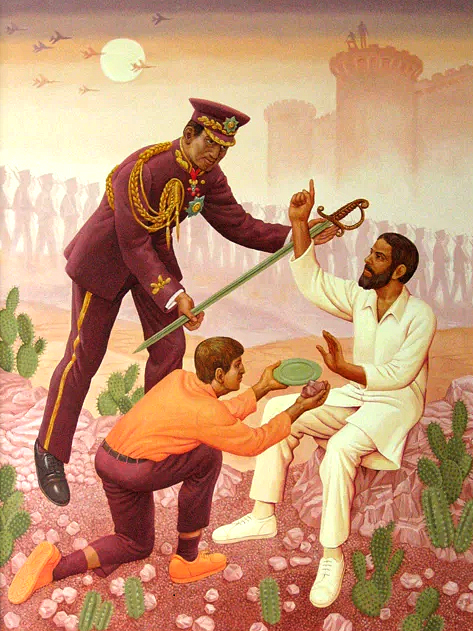
Peter Koenig, ‘Jesus’ Temptations’, used with permission

This week’s lectionary blog reflects on the account of the temptations of Christ given in Luke 4.1-13. Below it also draws attention to some interesting examples of art which depict Jesus’ temptations. And finally it offers links to three articles which I can recommend as helpful in seeking to ‘explain’ some of the religious complexities of the current conflict in Ukraine.

Clare Amos, Director of Lay Discipleship clare.amos@europe.anglican.org

*****

I have been proud to be part of the Diocese in Europe this last week when key people in the Diocese worked so quickly to pull together an online service initially on the first evening of the invasion of Ukraine (February 24) and then again on Tuesday 1 March. At both services we were privileged to listen to Christina, churchwarden in Kyiv, and Malcolm, chaplain in Moscow, speaking to us live in spite of the terrors that they had suddenly become caught up in. The services had a raw beauty and simplicity; they helped us confront the new horrors we are all facing, and I hope that they gave our fellow Anglicans in Ukraine and Russia a sense of how we cared for them.

There is, I suppose, an awful appropriateness that the current horrible events have been happening as both Western and Eastern Christians approach the beginning of Lent, that season when we reflect on Jesus’ own testing and call on him to be with us as we are tested too.

As is usual the Common Worship lectionary offers us as the Gospel reading for the first Sunday in Lent one of the accounts of Jesus’ own temptations in the wilderness: this year from the Gospel of Luke, Luke 4.1-13. Luke’s account is very similar to that offered by Matthew (though both differ substantially from that of Mark). But it is interesting – and quite telling – to note the subtle differences between Luke and Matthew, which actually seem to make Luke’s account especially relevant during this our present ‘time of trial’. I want to explore two of these differences.

The first is the different order that Luke and Matthew place the temptations in. Both begin by placing first the devil’s encouragement to Jesus to make bread out of stones. But then the order changes: Matthew next tells of the moment when the devil takes Jesus to ‘the holy city’ (Matthew 4.5) and sets him on the pinnacle of the Temple, encouraging him to cast himself from its height to ‘test’ God’s protection of him, and then concludes with the journey to the ‘very high mountain’ (Matthew 4.8) from which the devil shows Jesus ‘all the kingdoms of the world and their splendour’. Luke switches these latter two around, so that the pinnacle of the temple becomes the final temptation. Tellingly he names the place where this happens explicitly as ‘Jerusalem’, not simply as ‘the holy city’ (Luke 4.9). The role of Jerusalem within Jesus’ life, ministry and passion is a vital theme in Luke’s Gospel – which is probably why this is set as the final temptation, and also why ‘Jerusalem’ is clearly referred to. (Conversely in Matthew mountains are an important connecting thread that runs through his Gospel – so in his Gospel the mountain-top temptation becomes the finale.)

To grapple with the meaning and significance of these trials of Jesus we need to realise that they are different from – as well as with similarities to – the temptations that we ourselves may encounter. For they are intended to represent the temptations of Messiahship. What kind of Messiah would Jesus choose to be? The kind who would win over to his side the many hungry people of the New Testament world by offering them physical prosperity (‘bread and circuses’ as the Roman proverb put it)? The kind who would enforce a new order that enabled him to rule the world (from above) benignly – at least until having such absolute power had corrupted him absolutely? The kind whose spiritual vision was so focused on himself and what he loved that he expected God to alter the laws of nature to preserve him? Was Jesus’ Messiahship to be of this kind – or not?

We know the answer Jesus chose. However, inevitably I find myself drawing links with the current crisis. The picture above by the Roman Catholic artist Peter Koenig which depicts Jesus being tempted in the light of contemporary realities is so powerful in our current context that it is painful.

On the other hand Jesus, in overcoming these temptations, is not simply acting a model for us in resisting temptation but his victory actually helps to bring about our salvation. In the Litany we pray, ‘By your baptism, fasting and temptation, good Lord, deliver us.’ It is through his refusal to be trapped into evil which may pretend to be good that Jesus shows himself to be our ‘true Christ’.

Adam Boulter, watercolour draft sketch for painting which formed part of an exhibition of paintings by Boulter linked to poems by Malcolm Guite. See also https://www.cantab.net/users/adamboulter/index.html

In Luke’s Gospel the final temptation is linked to the pinnacle of the Temple in Jerusalem. Jerusalem is a very dangerous place and Luke knows that only too well. Having myself lived in Jerusalem for five years, and loved it for many years since, I am only too aware of the spiritual danger it can present to us. I once described it in these terms, ‘Jerusalem is a sacrament of what it means to be human. By that I mean that Jerusalem shows up visibly and physically the best and the worst of the human condition. On the one hand, it is a visible symbol of our longing, our highest and best desires, our love of beauty and our desire to worship God. But it is also a reminder of how this best can go so tragically wrong – precisely because we find it so difficult to love without also seeking to possess. Jerusalem is the place where this conundrum is squeezed into a sort of prism, so that it can be viewed in sharp focus.’ (Peace-ing Together Jerusalem)

It is telling that in 2019 Kirill, the Patriarch of Moscow, spoke of the city of Kyiv in the following terms, ‘For us Kiev is what Jerusalem is for many’. That temptation of standing on the pinnacle of the Temple believing that one is invulnerable, fired up with the sort of ‘love’ for ‘Jerusalem’ which needs to possess, is not unconnected with the current conflict – and part of its tragedy.

And the other, the second difference that Luke offers us in his account of Jesus’ temptations, comes at the end of the story, ‘When the devil had finished every test, he departed from him until an opportune time.’ (Luke 4.13) The impression that we gain from Mark’s account, and perhaps Matthew’s as well, is that by refusing the temptations offered to him at the beginning of his ministry, Jesus had defeated the devil (Satan) once and for all.  Luke makes it very clear that this is not the case. Jesus would need to challenge the forces of evil again – and again. The devil would be looking for every opportunity to gain the upper hand. Luke’s description of Jesus at prayer in Gethsemane conveys powerfully the sense of struggle and anguish that Jesus experienced, that time when, for one last moment, he had the opportunity to choose other – and easier – paths, and refused to do so. The devil was finally defeated.

It is however significant that as well as telling us that the devil continued to stalk Jesus as potential prey, Luke is the Gospel which tells us the most about Jesus as a person of prayer. We explicitly learn that at key moments in his ministry Jesus prayed. Jesus’ prayer and his struggle and ultimate victory against Satan belong together. Prayer is this Messiah’s most important instrument.

One of the features of the Gospel of Luke that I find most powerful is the way that from chapter 11 onwards (which is the moment that Jesus teaches his disciples what we call ‘the Lord’s Prayer’, Luke 11.2-4) there seem to be echoes of this Prayer, both in the teaching of Jesus and in his own prayers.  Such a link comes of course comes in Jesus’ words to his disciples in Gethsemane, ‘Pray that you may not come into the time of trial’ (Luke 22.46) – the time of testing, or temptation. As we enter into Lent this year we do indeed seem to be in a time of trial. May we continue as a diocese, in our chaplaincies and as individuals, to draw upon this gift and resource of prayer which Jesus modelled for us.

‘The Choice’,
Lauren Wright Pittman,
Creative Commons

The temptation of Christ in art

As those of you who read this blog regularly will know I am fascinated by art which can give us a new, and sometimes challenging perspective on biblical stories.  The picture at the top of the blog by Peter Koenig, the original of which hangs St Edward’s Roman Catholic Church in Kettering, is a good example which can encourage us to look at Jesus’ temptations in a new light.  So too is the picture of the ‘High Place at Petra’ by the priest-painter Adam Boulter (who has significant connections with our Diocese) which is set in the middle of the meditation above. I am also intrigued by the painting ‘The Choice’ by Lauren Wright Pittman which appears immediately above this note. In the current context it is interesting to note that the temptation of Christ is a theme that several significant Russian artists have explored: often conveying the sense that the temptations are linked as much  to the internal pressures that Jesus experienced or to his ‘shadow’ as to any external ‘Satan’. See for example Ivan Nikolaevich Kramskoĭ,, 1837-1887, below.  One website that I often visit to discover examples of biblical art from different (non-European) contexts is Global Christian Worship (tumblr.com) which contains some intriguing portrayals of Jesus’ temptation (and currently features an exquisite ‘Prayer for Ukraine’ played by a cello consort).

Ivan Kramskoi, ‘Christ in the desert

The ‘religious’ element of the conflict in Ukraine.

One of the aspects of the current conflict in Ukraine that many of us find very difficult or perplexing is the ambiguous element religion and the Russian Orthodox Church seems to be playing. There is a close relationship between the current leadership of the Russian Orthodox Church and certain forms of Russian nationalism. Linked to that there has been considerable hostility towards the recently established independent Ukrainian Orthodox Patriarchate. I have found the following sources helpful in giving an informed analysis/reflection on such aspects:

The art of transfiguration

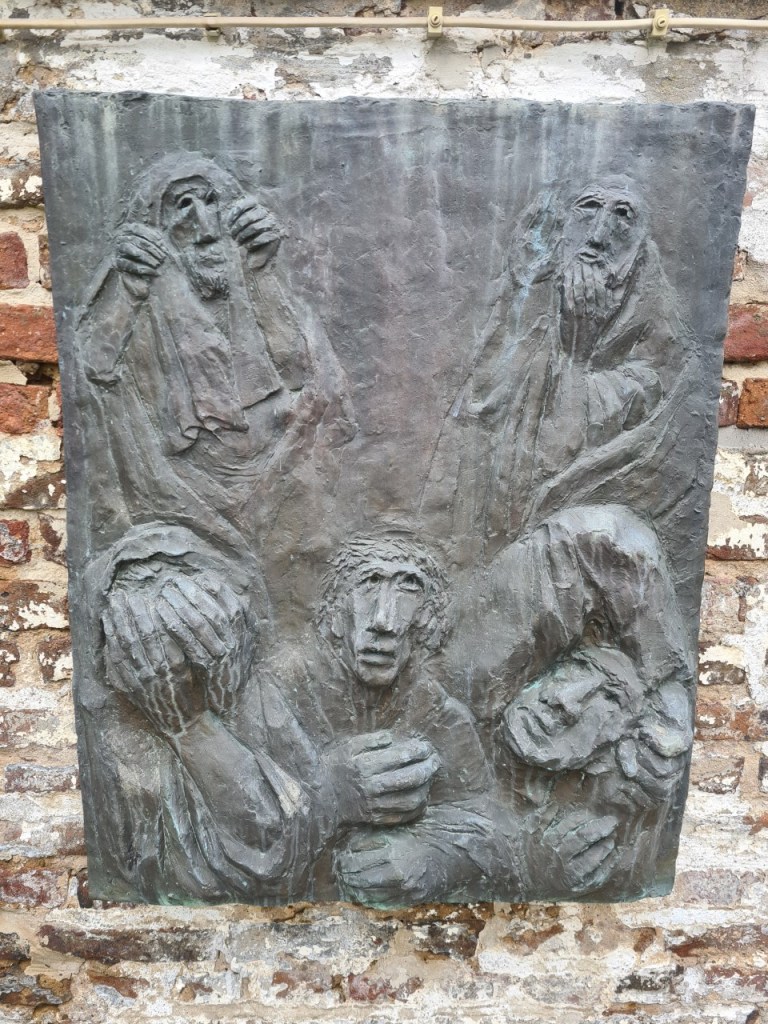
Carving of ‘The transfiguration of Christ’, Sieger Köder.

I am very grateful to Revd Julia Lacey who, as you will read below, prompted many of the thoughts in this week’s blog, which definitely has a ‘European’ flavour. This coming Sunday, the Sunday before Lent, is now kept in the Common Worship calendar with a focus on the transfiguration of Christ. This year the selected lectionary Gospel passage comes from the account in the Gospel of Luke, Luke 9.28-36.

Clare Amos, Director of Lay Discipleship, Diocese in Europe

Clare.amos@europe.anglican.org

The sculpture illustrating this week’s blog is in the garden in Germany of the mother of Revd Julia Lacey. Julia, who was an ordinand of the Diocese in Europe, sponsored by Holy Trinity Geneva, is now serving her curacy in Chelmsford Diocese. The bronze was carved by the German Roman Catholic priest and artist Sieger Köder who was a personal friend of Julia’s family. Julia tells me that Fr Köder created a very similar image for the tombstone which marks his own grave (he died in 2015).

This carving – and that on the tombstone – depicts the transfiguration of Christ, which is the focus of this week’s lectionary Gospel. But although you can see clearly the figures of Moses and Elijah, and of the three disciples who witnessed the event, you can barely see the figure of Christ himself at all. He appears to be there almost insubstantially,  ‘shadowing’ the upper figure on the right, whom I take to be Elijah. Julia mentions that in the version of the scene on his own tombstone, Fr Köder did not include the figure of Christ at all. As Julia herself described it to me, ‘Jesus is not visible at all – it’s like he has “given way”, literally opening up that connection between glory and glory. ’

Köder these days is probably better known as a painter than a sculptor, and he draws on the theme of the transfiguration in several of his paintings. Probably his best known example is this one which can be viewed via the website of Holy Trinity Anglican Church in Utrecht.. https://www.holytrinityutrecht.nl/sermons/transfiguration-2/transfiguration-seiger-koder/

What immediately strikes me is the sharp division between the upper and lower halves of the picture, marked out by the very different colours of each part. In the upper part the light emanating from Christ draws Moses and Elijah into a circle, which feels reminiscent of the shape created by the angelic figures in Rublev’s Icon of the Trinity (Hospitality of Abraham). The light however barely reaches down to the lower and lesser part of the picture where the disciples are located. Their eyes remain closed, perhaps this is intended to draw attention to a feature of Luke’s transfiguration narrative (Luke 9.28-36). Luke, unlike Mark and Matthew, specifically mentions that the disciples had been ‘weighed down with sleep.’ (Luke 9.32). What is also notable in this painting, and is reminiscent of his sculptures of the scene, is the way that the light emanating from Christ has almost absorbed him. He is so caught up in this light that the outline of his own body merges into it.

In some ways though I am even more fascinated by another Köder painting of the transfiguration, which forms part of a triptych altarpiece at St. Stephen’s Church, Wasseralfingen, Germany.  Wasseralfingen was Fr Köder’s town of birth so perhaps we can assume that he saw this large scale artwork as his legacy in a special way.

When the triptych is closed it shows two Old Testament scenes (the visit of the angels to Abraham, and the Passover at the time of the Exodus) Abraham with Three Strangers, Passover Dinner, High Altar in St. Stephen`s Church in Wasseralfingen, Germany Stock Image – Image of europe, artistic: 177122663 (dreamstime.com) which could be said to foreshadow the life, and perhaps especially the passion, of Jesus Christ.

When the triptych is open, High altar by Sieger Koder in St. Stephen’s church in Wasseralfingen, Germany Stock Photo – Alamy it portrays three resurrection scenes; on the left the Breakfast on the Beach (John 21), on the right Mary in the garden (John 20), and in the middle, the revelation of Jesus to the disciples at Emmaus (Luke 24).

Only… the Emmaus picture isn’t ‘just’ an Emmaus picture, for Fr Köder has brilliantly ‘combined’ it with a depiction of Jesus’ transfiguration. So not only do we see the disciples seated at table, but also above them, what are clearly intended to represent the figures of Moses and Elijah, and between them the form of Jesus is once again barely visible – he is represented as a pillar of light, or a pillar of fire. “Köder bathes him in the colour of blood—of his passion, and of life.” (Victoria Emily Jones)  It is a true instinct that led Köder to make this profound link between the transfiguration and the resurrection of Christ, which is certainly echoed in the Gospels themselves where the transfiguration is a foretaste of the resurrection, and we are told that Jesus instructed the disciples who had been with him on the mountain of transfiguration, ‘to tell no one about what they had seen, until after the Son of Man had risen from the dead’. (Mark 9.9)

(For more detail on this fascinating triptych go to Sieger Koder – Art & Theology (artandtheology.org) )

There is a hymn/song by Michael Hare Duke I cherish which also brings together transfiguration and resurrection. I first came across it in the Westcott House hymnbook when I was a tutor at the college in the 1980s. It is singable to the melody ‘O waley, waley’ and because I think the song is too little known (and I am sure that Bishop Hare Duke would have been delighted to have it further shared!) I include the words below:

Each human life has joys to share.
Like wine our lives brim in the cup:
But matched with them are pains to bear,
Rough, broken bread we gather up.

These things which make your life and mine
Were changed by Jesus when he said
His love was flowing in the wine,
His body broken in the bread.

In his new Covenant we live
Transfigured by the Spirit’s breath.
Scarred hands remake the gifts we give,
He fills our life, we die his death.

As he accepts the selves we bring
Our shadowed eyes awake to sight:
The cup becomes a healing spring
Our hands receive his glory’s light.

Like Köder’s pictures and carvings it gives us a sense that for Jesus, and potentially for ourselves, being transfigured means being changed and reshaped to become an open door or a channel to enable God’s light, God’s presence to flow through us. As Julia Lacey puts it above, transfiguration requires us ‘give way’ so that God’s glory may become visible.

One of the best summaries of the meaning of the Gospel story of the transfiguration is that offered by Dorothy Lee: The transfiguration ‘is the meeting-place between human beings and God, between the temporal and the eternal, between past, present and future, between everyday human life – with all its hopes and fears – and the mystery of God.’ (Dorothy Lee, Transfiguration, Continuum, 2004).

Perhaps the best known traditional icon of the transfiguration, by Theophanes the Greek

Here in the Diocese in Europe quite a number of us appreciate and are familiar with the theology and traditions of Eastern Orthodox Christianity. At the heart of the Orthodox understanding of faith is the perception that through physical and material places and times and objects, the light and presence of God can shine, and humanity can meet with divinity: whether we are thinking of a church building , the divine liturgy, or an icon, whose very materiality enables it to become a vehicle of the spiritual. At its core this is also the message of the Gospel story of the transfiguration of Christ, as Dorothy Lee implies. Given such an understanding it is not surprising that in the Orthodox world the theme of transfiguration holds a place in the life of faith that it doesn’t quite seem to have among western Christians. In Eastern Orthodoxy Christ’s transfiguration somehow ‘validates’ the vision of the church building as heaven on earth or the divine liturgy as sharing in the worship of heaven.

So in these difficult days it is significant to remember the story of the envoys sent by Vladimir Prince of Kyiv to Constantinople, who reported back to Vladimir on their visit to the Church of Haghia Sophia (Holy Wisdom) in that city: ‘They led us to the place where they worship their God, and we knew not whether we were in heaven or earth, for on earth there is no such vision nor beauty, and we do not know how to describe it; we only know that God dwells among human beings. We cannot forget that beauty’. And as a result Vladimir, Kyiv, and ultimately Russia adopted the Eastern Orthodox expression of the Christian faith.  It is of course little acknowledged in the secular media, and it is certainly not intended as a justification for Russian aggression, but I am sure that the historic role that Kyiv has played in the history and self-understanding of the Russian Orthodox Church must be a factor in current Russian attitudes.

But to return to the transfiguration. Following on from my professional work in the area of interreligious concerns at the World Council of Churches I am currently writing a book on religion and violence. The key thesis that I am exploring is the idea that religion as ‘transfiguration’ offers a profound contrast with religion as ‘fundamentalism’. The writer of Anam Cara, John O’ Donohue describes a healthy spirituality as ‘the art of transfiguration’.  An essential aspect of understanding religion through this lens of transfiguration requires us to be willing to experience deep change within ourselves, and it is only in so far as we are prepared to be changed into the image of Christ, that we have the right to expect and encourage change in others.

To come back once again to Sieger Köder’s artwork and Julia Lacey’s language,  what does it mean to ‘give way’ in order to open up the connection between heaven and earth? The situation in Ukraine is not precisely an example of religiously motivated violence, but it certainly offers an illustration of the way in which religion can exacerbate conflict which may have originated for other reasons. What might the language of transfiguration mean in that context?

*****

George Herbert, poet and priest

I decided that it would get too complicated if I also tried to incorporate reflection on the poet and priest  George Herbert in the comments above, but it is worth drawing your attention to the fact that this coming Sunday is not only the Last Sunday before Lent (‘Transfiguration Sunday’) but is also, as February 27, the feast day of George Herbert. The theme of transfiguration, implicitly even if not explicitly, runs through much of Herbert’s poetry, perhaps above all his much-loved poem (now often used as hymn) ‘The Elixir’.

Teach me, my God and King,
In all things Thee to see,
And what I do in anything
To do it as for Thee.

A man that looks on glass,
On it may stay his eye;
Or if he pleaseth, through it pass,
And then the heav’n espy.

All may of Thee partake;
Nothing can be so mean,
Which with this tincture—“for Thy sake”—
Will not grow bright and clean.

A servant with this clause
Makes drudgery divine;
Who sweeps a room as for Thy laws,
Makes that and th’ action fine.

.This is the famous stone
That turneth all to gold;
For that which God doth touch and own
Cannot for less be told

Wind and sea obey him?


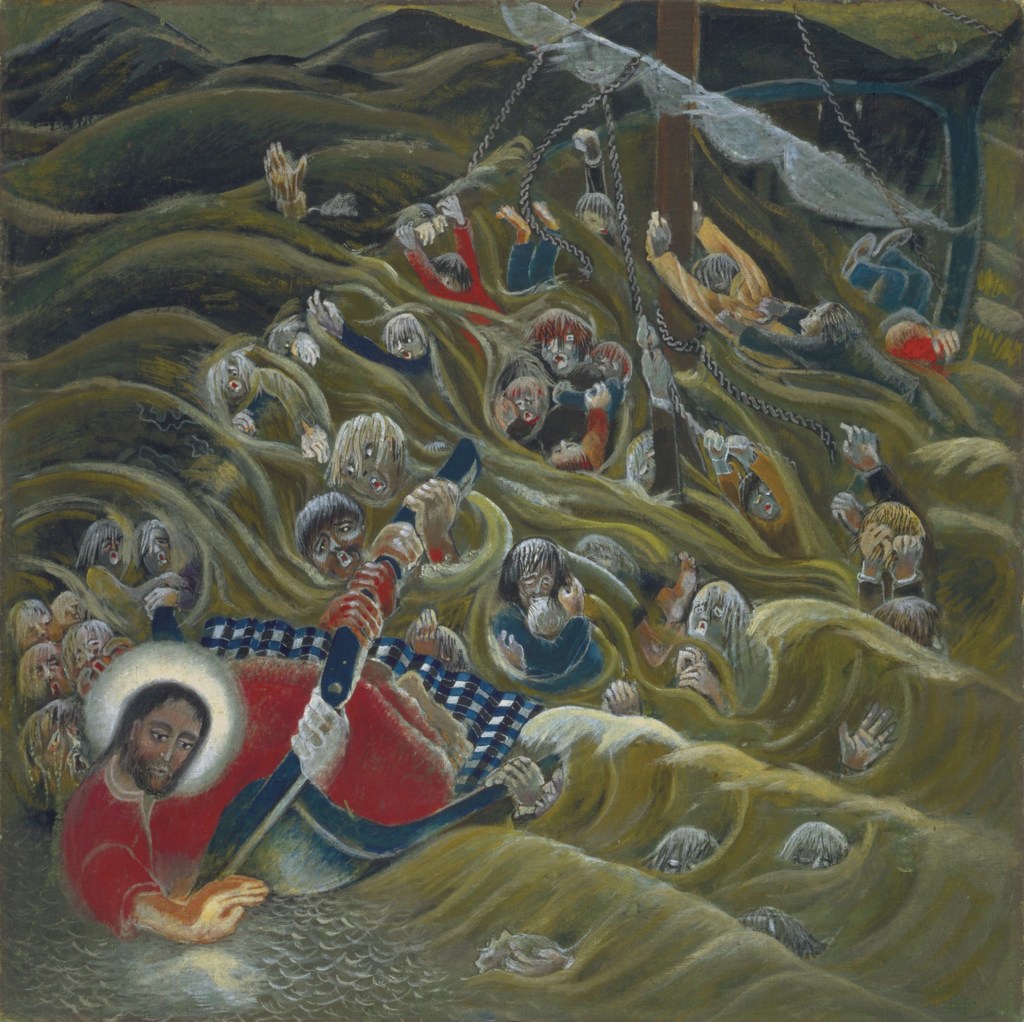
The fierce storms that are affecting both the United Kingdom and parts of continental Europe this week provide an intriguing backdrop to this week’s lectionary Gospel, Luke 8.22-25 which recounts Jesus stilling the storm. The other lectionary passages selected for this week (Genesis 2.4b-9,15-25; Psalm 65; Revelation 4) also ‘comment’ implicitly on the relationships between humanity, divinity and creation. The painting of the stilling of the storm by Eularia Clarke, stunningly conveys the terror of the people in the boat with Jesus. The boat itself is almost being swamped. Clarke’s painting forms part of the Methodist Church in Britain’s collection of modern art which can be accessed here Browse the Collection (methodist.org.uk) and it is reproduced in accordance with the generous rules offered by the Methodist Church.

Clare Amos, Director of Lay Discipleship, Diocese in Europe

Clare.amos@europe.anglican.org

Eularia Clarke, Storm over the Lake from the Methodist Modern Art Collection © TMCP, The Methodist Church in Britain, used with permission. http://www.methodist.org.uk/artcollection

Most of the time I enjoy thunder storms and find them exhilarating. I can remember however a terrifying experience once when Alan (my husband) and I were with friends in the Syrian desert north-east of Damascus exploring the then deserted site of Mar Mousa al-Habashi. A storm blew up quickly (as it can do in those parts) while we were out in the open walking across flat rocky ground with no bolt holes for cover. Fierce shards of lightning began to strike the ground. As the highest objects in the vicinity (even if we crouched down) we were the obvious targets at which the lightning would direct itself. It was a fearful few minutes before we reached the safety of our car.

In such contexts it is easy to see how the mythology of the Canaanites developed, in which the god Baal Haddad (‘Haddad’ means ‘blacksmith’) was venerated and feared, and how thunder was understood as the clang of Baal’s blacksmith irons and lightning the sparks as he worked the metal. Indeed where we were that late afternoon in Syria was exactly part of the heart-land of the Canaanite world. In the Canaanite religious tradition Baal showed his power by his ability to control both such storms and the unruly waters, whether seas whipped up by the winds, or waters bucketed down from the clouds into wadis that could turn into torrents in minutes. Since the 1930s we know considerably more about the religion of the Canaanites, Israel’s precursor and continuing neighbour. Discoveries of texts at Ras Shamra (ancient Ugarit) – which is only about 150 miles from where I was that day in Syria – have provided us with a detailed description of the story of Baal’s conflict with the stormy waters, which ends, of course, in Baal’s eventual victory.

It is fascinating to see how vestiges of this mythology have survived, though been transformed, in the Old Testament. The big difference of course is that it is ‘God’ (the deity the Bible names as YHWH) rather than ‘Baal’ who is the victor over the winds and the waters. But also what in the Canaanite myths is a real and fearsome battle, that it is far from certain Baal will eventually win, becomes in the Old Testament a literal ‘no contest’ in which God’s victory is absolutely assured. One of my favourite examples of how this transformation has been worked out comes in Psalm 104.26, ‘There go the ships, and Leviathan that you formed to sport in it.’ In the Canaanite myths Leviathan (Lotan) is a mighty monster who really gives Baal a run for his money, and at one point seems to be the likely victor of their fight. In the Old Testament Leviathan has been domesticated into God’s giant bath-toy!

The creation narrative of Genesis 1 contains just hints of some of these ancient ideas. Once again there is no battle – but there is the vestige of an understanding that for creation to flourish the deep waters need to be controlled and boundaried.

To understand the sea miracles of the Gospels, one of which, Luke 8.22-25,  is offered as our lectionary Gospel for this week, we need to be aware of this ancient symbolic background. The sea was the great unknown, the great hostile uncontrollable (at least by mortals). Divinity demonstrated its power by its ability to control the waters – and of course in Old Testament history such a demonstration had been made by God at the time of the Exodus and the crossing of the Red Sea. It is telling that the verb used to describe how Jesus spoke to the wind and the waves is ‘rebuke’ – a word used elsewhere in the Gospel to describe Jesus’ speech to demonic spirits (and significantly on one occasion to Peter as well, Mark 8.33). It was entirely reasonable for the disciples with Jesus in the boat to express their bewilderment with the question, ‘Who then is this, that he commands even the winds and the water, and they obey him?’ (Luke 8.25), for the Old Testament had indeed taught them that it was God alone who could control the sea.  The implication about Jesus is clear – even though it is not spelled out explicitly by the Gospel writer. That is, on the whole, how the Synoptic Gospels offer us their ‘Christology’, their understanding of who Jesus was and what he did. Not by spelling it out directly (as the Gospel of John does) but by leaving it up to us to draw our own conclusions from what Jesus did and said.

I have explored the ‘nature miracles’ of the Gospels in this way over many years, but it is only much more recently that I have also come to see that these fascinating episodes can also be a resource for looking at the relationship between humanity and creation. The question ‘Who is this, that wind and sea obey him?’ can also constitute an implicit rebuke to human beings who think that the glories and the wildness of creation should be subservient to human needs and control.

So it is interesting that this Gospel story is paired in the lectionary this week with what I refer to as the ‘second creation story’ of the Book of Genesis, Genesis 2.4b-9,15-25. This is the account in which humanity is created ‘from the dust of the ground’ (Genesis 2.7) like a potter moulds shapes out of clay, even though God’s special care for this creature that has been formed then becomes apparent.  The association between human beings (adam), with the earth (adamah) is made clear by the vocabulary used to tell the story. The comment that before the human beings was fashioned ‘there was no one to till the ground’ (Genesis 2.5) carries with it the implication that that will be the primary task of this soon-to-be-made creature. But it is interesting that the word that the NSRV translates as ‘till’ could equally mean to ‘serve’ or even to ‘worship’ the ground. The choice of the word that we use in our translation says quite a lot about our understanding of the relationship between human beings and the earth.

At any rate there is a rather different ‘feel’ to this passage compared with the description offered by Genesis 1.26-28, in which human beings are created as ‘the image of God’ and with ‘dominion’ over other elements of creation. I believe that it is no accident that Genesis includes both accounts with their different ‘feel’ within its pages in close proximity. The glory and tragedy of human beings is that we are both ‘image of God’ and ‘dust of the earth’, and it is our vocation to work this reality out in fear and trembling, both in our relationship with God, and our relationship with the rest of creation. The wellbeing of our world may well depend upon this.

Plain Speaking

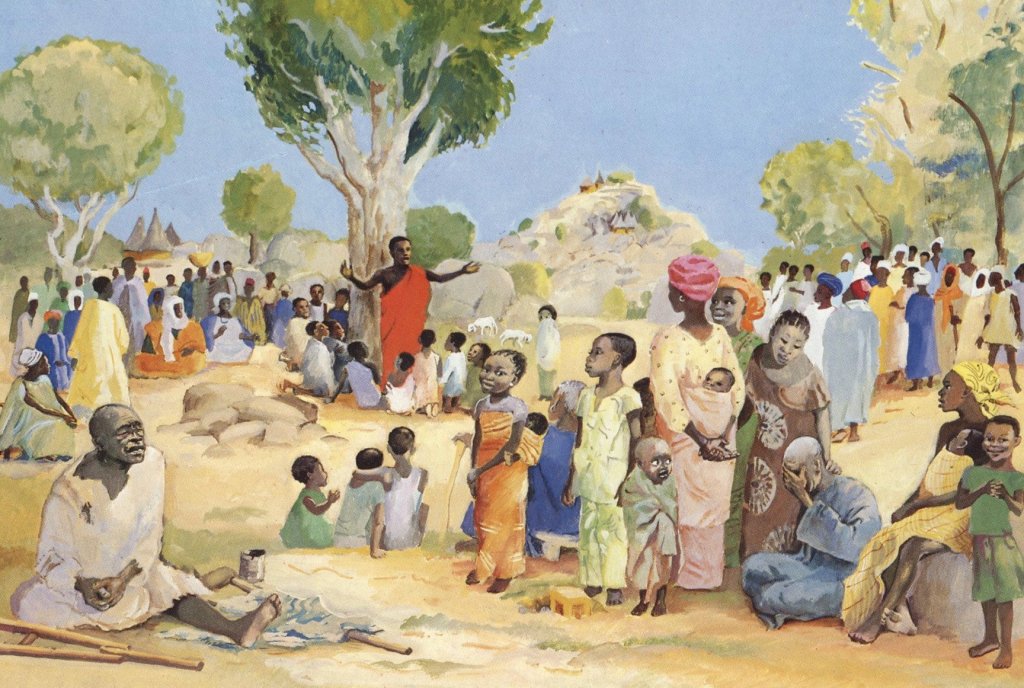
This week’s blog draws on the Gospel, ‘the Sermon on the Plain’, Luke 6.17-26, as well as the set Old Testament reading Jeremiah 17.5-10 and Psalm 1. Tellingly it is not easy to find a picture of Jesus preaching ‘on the plain’. The equivalent sermon offered in Matthew, ‘the Sermon on the Mount’ is far more frequently illustrated! However this picture – one of the Jesus Mafa series, portraying the Gospels in the context of village life in West Africa, comes fairly close! Formally it is described as illustrating Matthew’s Sermon on the Mount – but Jesus does seem to be on the same level as his listeners.

Clare Amos, Director of Lay Discipleship, clare.amos@europe.anglican.org

One way of looking at the ‘Sermon on the Plain’ which Luke offers us, which is both similar – and different – from Matthew’s ‘Sermon on the Mount’ is to see it as Mary’s Magnificat now being worded into life by her son Jesus.

The promised reversals of the Magnificat e.g. ‘He has brought down the powerful from their thrones, and has lifted up the lowly; he has filled the hungry with good things, and sent the rich away empty,’ (Luke 1.52-53) are echoed in the Beatitudes and Woes that Jesus now proclaims in this ‘level place’ – the older translations referred to ‘a plain’, which has given this talk its traditional name.

The fact that Jesus speaks on ‘a plain’ rather than on the ‘mountain’ – the location of Matthew’s rather better known Beatitudes – is surely significant. Location is important (as we know from various TV programmes which try to seduce us into wanting a new home, insisting on location… location… location!).

The Magnificat itself speaks explicitly of ‘bringing down’ the powerful, and ‘lifting up’ the lowly. Given that precursor it is no accident that the Gospel of Luke sets this sermon of Jesus Christ on the plain – level ground – rather than on a mountain-top. Luke is well aware of the importance of mountains. Just before this sermon Jesus has gone up a mountain to pray, and while there has chosen ‘the twelve’. Mountains – and their symbolic meaning – appear frequently in all the Gospels. By contrast the Greek word translated as ‘plain’ or ‘level place’ only appears here in the entirety of the New Testament. I suspect that Luke used it to reinforce the sense that Jesus did not choose to place himself ‘above’ others – but deliberately brought himself down to their ‘level’. This  insight is reinforced by the way that Jesus, before speaking to the disciples, ‘looked up’ (Luke 6.20) at them. Looking up is the right posture for Jesus to adopt to present his vision of the inversion of the normal rules of reality.

In the Book of Acts, when Paul is in Thessalonica, the hostile mob that is provoked by his preaching drags Paul’s supporters before the city authorities complaining that that they have offered hospitality to people like Paul who ‘have been turning the world upside down’ (Acts 17.6). Such an ‘upside down’ world is exactly the challenge that Jesus himself has offered to the disciples and to the crowd as he speaks to them on the plain.

Luke’s pairing of ‘blessings’ with ‘woes’ gives a different ‘feel’ to Jesus’ words, when compared with the Sermon on the Mount in the Gospel of Matthew.  This difference is perhaps reinforced by the choice of verses from Jeremiah 17.5-10 and Psalm 1 as complementary readings for this week.

Psalm 1 is not, I have to confess, my favourite psalm. Its ‘certainties’ about the respective fates of the righteous and the wicked rather stick in my gullet!  I am very willing to accept, what is often suggested, that it was added to the Book of Psalms at quite a late stage in the development of the book, in order to set in context, or even perhaps ‘tame’ the challenges thrown out by many of the other psalms in the book, especially the psalms of lament – which are all too willing to acknowledge that there is no automatic correlation between righteousness and prosperity.

It is interesting to see this argument also being carried on within the pages of the Book of Jeremiah. In Jeremiah 17.7 we have what seems to be almost a quote from Psalm 1. There is however a subtle difference. In Psalm 1 it is those whose ‘delight is in the law of the Lord’ who will be like ‘trees planted by water’. In Jeremiah 17 it is those ‘who trust in the Lord’. For Jeremiah that personal relationship with God would seem to be paramount.  But the fascination of the Book of Jeremiah is precisely that the prophet is elsewhere quite prepared to argue with any theology that simplistically links faith and success, based on his own personal experience. ‘Why does the way of the guilty prosper, why do all those who are treacherous thrive? You plant them, and they take root; they grow and bring forth fruit.’ (Jeremiah 12.1-2)

For me, one of the glories of the Old Testament, which is the part of the Bible in which I have the most professional expertise, is precisely this internal argument and debate that it conducts within its pages about the relationship between our faith in God, the righteousness of our behaviour and our ‘rewards’. It refuses to give us an easy answer, and that is a glory of this part of our Scripture. If God is, as Exodus 3.14-15 suggests, to be known as ‘the I am who I am’, then perhaps indeed we should not expect to be able to pin God down – though throughout history human beings have so often tried to do so.

To return to Luke’s blessings and woes. There are several ways in which we might read them, but perhaps one thought is to suggest that they are continuing that Old Testament debate about the relationship between righteousness and success, and in the process inviting significant questions as to what we mean by both.

Over the last two years, during the pandemic, many of us have found ourselves turning quite often to ‘wrestle’ with the ‘problem’ of evil and suffering, reward and punishment and what our biblical and Christian faith has to teach us in relation to this. It is hardly surprising, given the intensity of what we have been living through. In the Diocese in Europe a number of our chaplaincies have sought to help the people explore such questions. I am grateful to Revd Canon Medhat Sabry, chaplain in Madrid, for organising a theological ‘salon’ on this topic in which I was invited to participate. The number of people who tuned in for this Zoom event suggested that Canon Sabry had touched upon an important chord.

It is interesting to reflect, with Luke’s blessings and woes in mind, that one of the blessings that is offered will be to wipe away the tears from those who are weeping. I do think, and I am speaking to myself at least as much as anyone else, that sometimes our greatest need is to learn how to weep. Tears are not very British, and perhaps they are not a typical part of Anglican spirituality!  Indeed the need to carry on (as now) in difficult times, can mean that tears can seem a luxury we cannot allow ourselves. Yet St James of Saroug in the 6th century reflected in a way that resonates with Jesus’  ‘upside down’ words in Luke’s Gospel, ‘“You have no tears? Buy tears from the poor. You have no sadness? Call the poor man to moan with you. If your heart is hard and has neither sadness nor tears, with alms invite the needy to weep with you…provide yourself with the water of tears, and may the poor come to help you put out the fire in which you are perishing.”[i]  .

We are all invited to be on the same level! Perhaps this tells us just why Jesus preached this sermon on the plain.


[i] Quoted in Alan W. Jones, Soul Making: The Desert Way of Spirituality (San Francisco: Harper & Row, Publishers, 1985),.104.

Overflowing holiness

This week’s lectionary blog draws on all three of the suggested readings for the coming Sunday: Luke 5.1-11; 1 Corinthians 15.1-11 ; Isaiah 6.1-8 [9-13] but particularly focuses on the numinous call vision of Isaiah. It was partly prompted by the beauty of Salisbury Cathedral and its modern font, pictured above.

Clare Amos, Director of Lay Discipleship, Diocese in Europe

clare.amos@europe.anglican.org

I find it a visceral experience whenever I walk into Salisbury Cathedral and see its modern font, designed and created by William Pye and placed in the nave near to the main entrance door in 2008. It is quite literally a visceral experience – it gets me in the gut, it is so beautiful and so ‘right’. It is a combination of its cruciform shape, the continuing ‘overflowing’ of the water from each of its corners, yet an apparent wonderful stillness on the water’s surface which allows stained glass windows to be reflected in it. Appropriately, the worship at the Cathedral at certain seasons of the year – Epiphany and the post-Easter period – incorporates the font into the beginning or conclusion of the Sunday eucharistic liturgy.

It was Salisbury Cathedral and its font that came to mind as I was reflecting on the lectionary readings for this coming Sunday, the Gospel being Luke 5.1-11 (Luke’s account of the call of Peter and his friends), complemented by 1 Corinthians 15.1-11 (in which Paul lists the witnesses to the resurrection – including even himself) and Isaiah 6.1-8 [9-13] (the call vision of the prophet Isaiah).

It is fairly easy to see the common thread that must have been in the minds of the lectionary compilers as they grouped these readings together. In each case it is a call to God’s service – of Peter and his companions, of Paul, of Isaiah. Each recipient of the call also feels themselves deeply unworthy of it (‘Depart from me for I am a sinful man’/ ‘I am unfit to be called an apostle’/ ‘Woe is me… I am a man of unclean lips’). But it is important to notice another thread that they have in common – that in each case the call is preceded by a divine revelation, and the willingness to accept the call is a response to this revelation. In the case of the Gospel reading the ‘revelation’  is something very practical and concrete – a great shoal of fish which was presumably very welcome to men who earned their living in this way. In the case of Paul it is the privilege he has been given of seeing the resurrected Jesus, in spite of having been initially a persecutor of the early church. In the case of Isaiah it is his vision of God seated upon his throne, and the song of the seraphim that accompanies it.

The pattern in each case is that human response depends on divine initiative. And I don’t think it is wrong to describe such divine initiative as a divine ‘overflowing’. (Which was partly the link in my mind with the font at Salisbury Cathedral.) God is not static – and neither are God’s relationships with human beings, and indeed our world. There is a wonderful comment by John Piper that ‘mission is the overflow of God’s delight in being God’.  A year or so ago I explored the expression used for ‘overflowing’ in the New Testament. I was interested to discover that when we read in our English translations the word ‘abundant’ – as for example in John 10.10 ‘I have come that they may have abundant life’, the Greek original for ‘abundant’ comes from the same verbal stem as words translated elsewhere (especially in 2 Corinthians) as ‘overflowing’.  The implication is that God’s abundance is never static: it overflows and changes whatever it encounters.

As we reflect on this we are coming close to the paradox that is at the core of biblical – and Christian – faith. It is a paradox that we proclaim each Sunday when we say or sing the ‘Sanctus’ as a key part of our eucharistic prayer. Yet perhaps our very familiarity has dulled the breath-taking nature of the paradox, so that we are lulled rather than challenged to our ‘gut’.  For the words, which come of course from the call vision of Isaiah 6, ‘Holy, holy, holy is the Lord of hosts, the whole earth is full of his glory’ contain what is in some ways an unresolvable contradiction. The sentence begins by proclaiming the holiness of God, with the three-fold repetition of the word ‘holy’ suggesting a superlative – the absolute, extraordinary holiness of God. In the world of the Bible, and the culture of the Temple, the core understanding of ‘holiness’ was the idea of separation, linked to divine transcendence or otherness. It is no accident that the Hebrew word for ‘holy’ qdsh contains within it the sound of something being ‘cut’ – something being separated. Holiness was dangerous, if ‘ordinary’ ‘unclean’ human beings got too close to the ‘holy’ – unless they had previously taken elaborate precautions – they put themselves in mortal danger. Hence Isaiah’s cry ‘Woe is me…’.  

And yet that Sanctus, that proclamation of God’s ultimate otherness, goes on to affirm, ‘The whole earth is full of his glory’. ‘Glory’ in the biblical idiom, is a way of describing the visible presence of God.  In one sense this statement is totally illogical. For divine holiness and created earthliness do not belong together – they are poles apart. To speak of God’s visible presence throughout the whole earth ‘transgressed’ the normal bounds of both humanity and divinity. Indeed it could put what was earthly in dire danger. Unless… the ‘earthly’ is willing to allow itself to be changed and ‘made holy’, so that it can become a receptacle in which the divine can truly dwell.  

Yet do we really realise that when we sing the Sanctus week by week in the comfort and familiarity of our Anglican worship we are asking to be transformed in this way and pledging ourselves to share in the transformation of the world in which we dwell? To allow God’s grace to continue to overflow into us, as the water of that baptismal font overflows in the numinous beauty of Salisbury Cathedral? And if we did realise it, how many of us would be willing to continue to sing the song?