Trinity 17: Giving thanks

Clare Amos, the Director of Lay Discipleship, uses the lectionary Old Testament reading (2 Kings 5.1-3,7-15c) and the Gospel (Luke 17.11-19) to explore the importance of thankfulness. The picture below, which shows Hambledon Hill, close to where she lives when in Dorset, always evokes in Clare a sense of thankfulness.

It’s a great short punchline in today’s Gospel reading! ‘And he was a Samaritan.’ (Luke 17.16) For me, part of the inspiration of Scripture is when it says less rather than more – and leaves us to fill in the gaps for ourselves. So Luke’s Gospel doesn’t give us all the details of Jewish and Samaritan interrelationships – or the lack of them. Rather the Gospel lets us work out for ourselves the apparent contradiction that a Samaritan, the very person who might have been expected to be hostile to Jesus as a Jew, is the one person in this group of ten who both thanks Jesus and praises God for his healing.

Thanksgiving and gratitude are motifs which link together the Gospel and the Old Testament ‘connected’ reading (2 Kings 5.1-3,7-15c) which tells the tale of Namaan the Syrian.

Years ago, in my early days of studying theology, I came across the comment, ‘Gratitude is the primary ethical emotion.’ At this point in time I really cannot remember where it came from or who said it, but it is a remark that that has remained with me as a key interpretative principle for life – and thought – ever since. It must have been around the same time that I first came across the spiritual classic by J Neville Ward, The Use of Praying, which explores the various dimensions of the life of prayer. There are lots of spiritual nuggets in that book, but the primary take-away that I have always treasured is Neville Ward’s insistence that Christian prayer needs to begin with thanking – rather than say confession or intercession, which is often thought of as the starting-point for prayer. He suggests that confession and then intercession do indeed spring out of thankfulness – but that it is thankfulness which comes first. Here are a few of his gems:

  • ‘Thankfulness is happiness spontaneously reaching out beyond itself, wanting to make contact with its cause.’
  • ‘All prayer is some form or extension of thanksgiving or offering.’
  • ‘It is far more important that young Christians should be taught that Christianity is a religion dominated by thankfulness than that “he died to make us good”.’
  • ‘Thankfulness and appreciation of life unlock the door to the prison of the self.’

And of course Neville Ward also points out that one of the names for the primary and distinctive act of Christian worship is ‘Eucharist’ – a word which simply means thanksgiving. This comes home to me especially when I am on holiday in Greece and the regular word for ‘thank you’ in common speech is efcharisto, which derives from the same Greek root. Whenever I am in that country I go round saying efcharisto more frequently than I would usually say ‘thank you’, simply because I like being reminded of the connection!
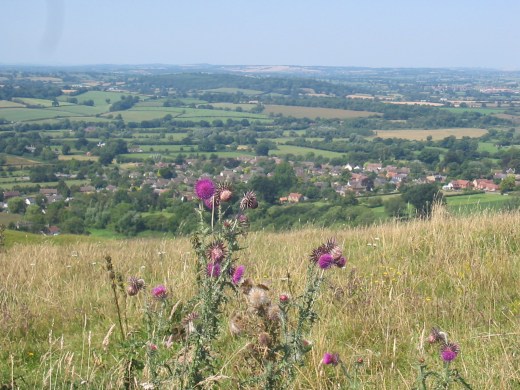
hambledon hill

The tale of Namaan the Syrian and his healing from leprosy is one of the great Old Testament stories that both young and old can appreciate. The fact that it is referred to in the New Testament, in the course of Jesus’ synagogue sermon in Nazareth (Luke 4.27), suggests that it was seen as an exemplar by later generations. It speaks both of the importance of thankfulness – Namaan’s response after his healing is profound – and also of a sense of wonder, on the part of those who drew together the biblical traditions, as well as on the part of Namaan himself – that God’s generosity can be shown in this way to a person who was outside the covenant community. Indeed somehow the two: his alien status and his sense of thankfulness belong together (as indeed is also the case with the Samaritan of Luke 17). What might this mean for those of us who feel very much that we ‘belong’ – whether it is to the household of faith or to particular political and national entities? Do we somehow need the gift of being helped to see our reality through the fresh and different eyes of others to enable us to appreciate life in a spirit of thankfulness? Is part of our current political problem a ‘weariness’ about Europe so that we do not realise how fortunate we are to live in this continent?

I am a bit sorry that the lectionary editors chose to conclude the Old Testament reading with verse 15. Because one of my favourite titbits in the Old Testament comes a couple of verses further along. When Elisha refuses Namaan’s offer of a present to show gratitude for his healing, Namaan responds by asking for ‘two mule-loads of earth’ (2 Kings 5.17) to take back with him to Damascus. The reason for his request is that when he is back in Damascus he intends to worship the God of Elisha and Israel. However this sat uneasily with the theology of the time in which particular gods – including the God of Israel – were each identified with a particular nation and a particular territory. So Namaan asks for a little bit of the territory of Israel to create as it were an ‘embassy’ of the God of Israel in Damascus. It is deliciously quaint, yet it also marks a breakthrough which will eventually lead to a profound awareness of the incomparability of the God we worship as Lord of time and space. And it is Namaan’s spirit of thankfulness which begins to open the door to this insight.

Perhaps not surprisingly, the lectionary readings selected by Common Worship for Harvest also encourage us to cultivate a spirit of thankfulness. That is especially true of the Old Testament passage, Deuteronomy 26.1-11. Many of our chaplaincies will be celebrating harvest festival around this time: in Holy Trinity Geneva we did so last Sunday. The key message of the excellent sermon was that we should remember our history, and remember the stranger. Both of which seem to me to be a vital part of what thankfulness should mean.
Trinity 16: Suffering for the Gospel

Dr Clare Amos, Director of Lay Discipleship in the Diocese and administrator of this blog, focuses on this week’s lectionary epistle to look briefly at a topic which is both sensitive and of contemporary relevance.

A first look at this week’s lectionary biblical readings could not easily spot the connection between them! Indeed such links can sometimes appear forced. The texts are not easy at all – the Gospel reading from Luke (Luke 17.5-10) reminds us sharply of the evil institution of slavery which was certainly a feature of the Graeco-Roman Gentile world of Jesus’ time, though less so among the Jewish community. I have to say that I proactively want the words seemingly spoken by Jesus in this passage to be sentiments that Luke the gospel writer has placed in Jesus’ mouth rather than the actual words of the historical Jesus himself! It is interesting that they are introduced with the comment, ‘The Lord replied’, rather than ‘Jesus replied’ – a slightly unusual phrasing that made me feel that my instinct that these words are quite distant from the mindset of the earthly Jesus may well be correct.

What seems to link the three readings is the motif of ‘faith’: its power (Luke 17.5-6), its life-giving quality (Habakkuk 2.4), and its link, according to Paul’s Second Letter to Timothy (2 Timothy 1.1-14), both to what one can learn from parents and grandparents, and to ‘sound teaching.’

Paul’s comments though also open up an issue that is still very live for us, or at least for many Christians, today – the potential link between suffering and our faith. ‘Join with me in suffering for the gospel, relying on the power of God.’ (2 Timothy 1.8) A report has recently been produced by the Bishop of Truro, commissioned by Jeremy Hunt when he was Foreign Secretary, https://christianpersecutionreview.org.uk/storage/2019/07/final-report-and-recommendations.pdf which explores the issue of the persecution of Christians in several parts of our contemporary world and makes key recommendations. Though welcoming the report ‘as the start of a wider conversation and a deeper dialogue’ another piece of work commissioned by the Anglican mission agency USPG has highlighted has offered the challenge that it is important not to look at the situations through the eyes of British Christians alone.

https://uspglive.org.uk/wpress/2019/07/a-response-to-the-bishop-of-truros-review-of-fco-support-for-persecuted-christians/

It is interesting of course that both the author of the initial report and USPG itself have close connections with our diocese in Europe. The Bishop of Truro is Philip Mounstephen – formerly chaplain in St Michael’s Paris – and USPG is a current partner of the Diocese in Europe in work such as the refugee ministry in the Pas de Calais. A reminder, if such were needed, that the issue of freedom of religion and belief is equally relevant this side of La Manche as well.

It is certainly a topic with which I myself have felt engaged for many years, intellectually, spiritually and emotionally. My years in fairly early adulthood spent living in Lebanon during its period of civil war in which religion was undoubtedly a factor, has influenced me ever since. My Lebanese experience in fact has made me only too aware that Christians can be the perpetrators of religiously inspired violence as well as the victims of it. That of course is relevant to us in Europe today. It is probably true that the worst example of violence in Europe since the Second World War instigated by people who at least partially linked their actions to their religion was the massacre of Bosnian Muslims by Christians in Srebrenica in 1995. I don’t think that in western Europe we yet fully realise the impact that atrocity has had on global Christian-Muslim relations.

I would however question whether the work done by USPG (or indeed the original Truro report) has fully taken into account the particular features of Christian spirituality that can make Christians especially susceptible to becoming the victims of violence. Our theology of the vulnerability of God expressed through the Cross, and the honouring of those who are ‘weak’, can act like a direct incentive to ‘bullies’ to show their apparent power by acts of discrimination and persecution.

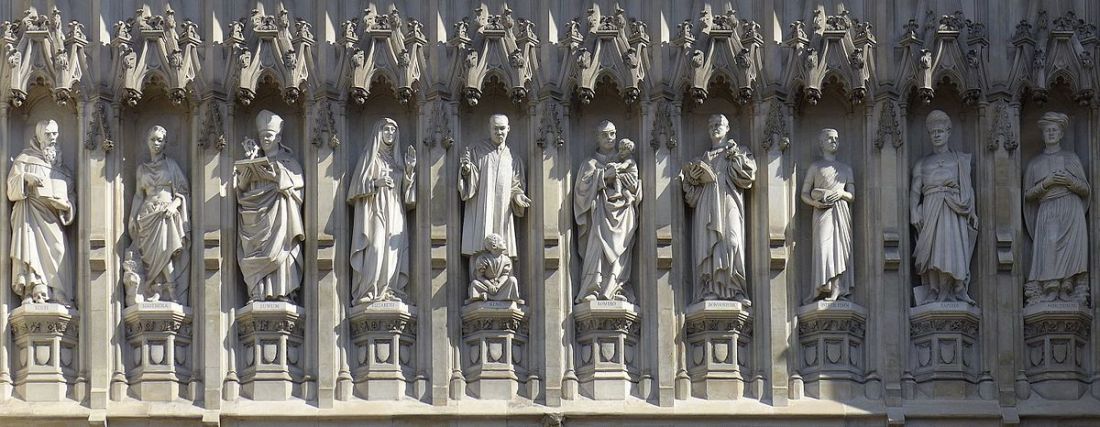
Westminster_Abbey_-_20th-century_Martyrs

The statues of 20th century martyrs outside Westminster Abbey

I could write much more on this topic – and indeed am working on a book exploring issues of religion and violence from a theological perspective – but I leave you for now with this comment, made by a Christian from the Middle East, which seems to resonate with Paul’s words in 2 Timothy: ‘Martyrdom is not seeking death for the sake of Christ; martyrdom is seeking life. But if asked to carry the cross to death, we need to be obedient.’

The Feast of St Michael and All Angels: Michaelmas and us …

Canon Alan Amos OBE, now retired from his ministry in theological education, hospital chaplaincy and parochial life, holds PTO in the diocese and has taken on several roles as a locum priest. He lives part of the year in Saint Julien in Genevois and worships at Holy Trinity Geneva. Alan draws here on the biblical readings for Michaelmas, Genesis 28.10-17 and John 1.47-end.

Fifty years ago, I was made deacon at a Michaelmas ordination, and I treasure particularly the collect for the day, with its reference to angels and human beings being joined in a common endeavour of ministry :

Everlasting God, you have ordained and constituted the ministries of angels and mortals in a wonderful order: grant that as your holy angels always serve you in heaven, so, at your command, they may help and defend us on earth; through Jesus Christ your Son our Lord, who is alive and reigns with you, in the unity of the Holy Spirit, one God, now and for ever.

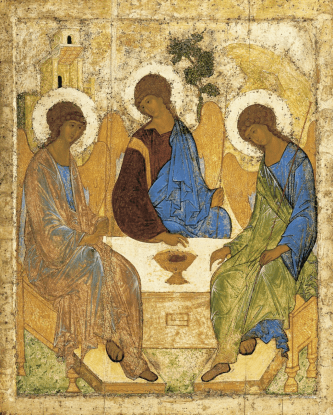
I particularly like the sense of ‘overlap’ between angels and human beings; it reminds me of Rublev’s wonderful Trinity icon, which picks up on the three strangers visiting Abraham, who then get transformed into angels, sprouting iconic wings, and thence into representing the communion of the Holy Trinity.

This story, and this icon, begins from the hospitality of Abraham, linking into the divine hospitality which welcomes us into communion.

That prompts me to ask, ‘are there ways in which our worship is angelic?’ By which I certainly do not mean self-consciously precious! Rather, does worship really provide ‘a transport of delight’, a ladder of sorts between earth and heaven ? Certainly the Sursum Corda welcomes us into the fellowship of angels and archangels worshipping the Lord of all holiness.

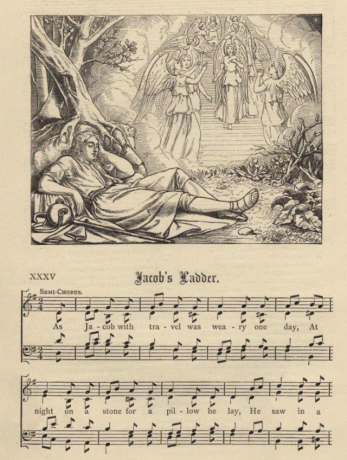
As a choir member at Holy Trinity in Geneva, I find myself often uplifted by the music which we prepare and sing, and thankful for the wonderful tradition of Anglican choral music which draws, of course, on the musical riches of the universal church.jacobs-ladder-sheet-music1

But then back to earth. And to some other words of worship, from the Book of Common Prayer : ‘and here we offer and present unto thee, O Lord, ourselves , our souls and bodies, to be a reasonable, holy, and lively sacrifice unto thee; humbly beseeching thee, that all we, who are partakers of this Holy Communion, may be fulfilled with thy grace and heavenly benediction.’ And we pray that this our offering may be accepted ‘not weighing our merits, but pardoning our offences.’ The beauty of the language of this prayer is used to emphasise that we worship as a corporate body ‘all we who are partakers’ – and that we are not to be deterred from worship by our lack of worthiness. The invitation to worship is insistent, even compelling; we are not to be left outside the web of worship suspended between earth and heaven, but to find our own place in it.

Angels are messengers, and so if we really are to be part of this divinely constituted order which includes us humans with them, we have to be bearers of the message, not in word only, but in apostolic action.

There are many examples in our diocese of how this action is carried forward, often with ecumenical partners. I just leave you with a couple which I am learning about and which seem very necessary in our times, first there is action to engage with and support refugees, where the Chaplaincy in Athens and more recently in Calais have played a leading role. I am also aware how on a smaller scale, the priest and people of La Cote, our sister church in Switzerland, have been deeply committed to this work.

Then there is Stephen Ministry, see: https://www.stephenministries.org/stephenministry/default.cfm/917?mnbsm=1

Named after Stephen the first martyr and proto-deacon, this is a ministry of caring and accompaniment for those who are going through major crises in life. Several of our English-speaking churches in Geneva, who participate in our Geneva ecumenical Cursillo, have members who have received training in this ministry. I wonder if you have come across Stephen ministry, or your church community shares in it?

Sometimes, in my ministry as a hospital chaplain, a patient would say ‘Chaplain, could you be an angel…’ and I never knew quite what request would follow. Retrieving one patient’s dentures was the least of my angelic tasks!


Trinity 14: Pray for kings…

Keith Burrell, Reader at Trinity Church, Lyon reflects on this week’s lectionary Epistle, I Timothy 2.1-7, which seems only too relevant to current concrns.


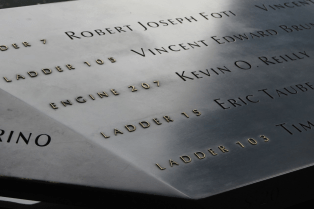
ground zero 1ground zero 2

The memorial at Ground Zero

‘Never’ I’m tempted to say, ‘Never has Paul’s instruction (‘pray for kings and all those in authority‘, 1 Timothy 2.2)  been more relevant and important.’ A glance at the news and we see refugees spending days on board NGO rescue ships in the Mediterranean because governments cannot decide where the ships might be allowed to dock; we hear bitter arguments in the UK and further afield over BREXIT; some leaders exchange insults and few seem to engage in reasonable discussions to find real solutions. The former Scottish MP Tam Dalyell pointed out that political discussion in the 1980’s became increasing conflictual. Since then the situation seems only to have got worse.  It reminds me of the line in Pete Seeger’s song which runs: ‘When will they ever learn?’

On the other hand, 18 years ago on 9/11 when the first plane struck one of the Twin Towers, ordinary people immediately set to work together to bring help to the victims. A recent visit to the Ground Zero memorial made that abundantly clear: there, along with the names of the other victims, are those of the First Responders listed by team: the men and women who gave their lives to help others. White roses mark the birthday of each victim on the appropriate day and are a reminder that behind each of these names is a person, an individual person, precious in God’s sight. But I also see in those white roses a sign of hope.

A sign of hope which will only be realised if we take Paul’s instruction seriously and pray regularly and earnestly for the leaders of the world’s governments. There are so many desperate situations all over the world, many but not all due to war, with so many innocent people caught up in them through no fault of their own. But so easily our prayers for them can fade like the television news headlines, replaced by other concerns.

Let us come before the Lord whole-heartedly, in humility and faith. As Archbishop Justin Welby put it, let us ‘batter the gates of heaven in prayer’ regularly and perseveringly… Let us batter the gates of heaven in prayer for kings and all those in authority, that all people may live peaceful and quiet lives in godliness and holiness.

Trinity 11: Entertaining Angels Unaware

Dr Clare Amos, who among her other roles coordinates the Diocesan Ministry Scheme, writes on two of this week’s lectionary readings. She particularly focuses in Hebrews 13.1-8, 15-16, though also draws attention to the Gospel reading, Luke 14.1, 7-14.

It is one of those pithy biblical sayings which has crept into wide use certainly among English speakers : ‘Entertaining angels unawares’ is a remark that is used by many more than avid readers of the Bible. Indeed, if asked, many regular readers of the Bible would be hard-pressed to immediately locate its origin in these verses from the Letter to the Hebrews chapter 13. It has to be said that the modern NRSV translation, which speaks of entertaining angels ‘without knowing it’ doesn’t have quite the same ring! It is of course referring to the story of Abraham’s hospitality to the three mysterious angels of Genesis 18, a visit which led to him and Sarah receiving in return far far more than they had expected.

It is a mixed bag of instructions and commands that are gathered together in these first 8 verses of this chapter of Hebrews. They are then summarized and undergirded by the striking statement, ‘Jesus Christ is the same yesterday and today and for ever’ (Hebrews 13.8). It seems to suggest that giving hospitality isn’t just a sort of incidental niceness to strangers – but takes us to the very heart of the eternal nature of God. Hospitality is also a theme of this week’s lectionary Gospel reading (Luke 14.1, 7-14), and will also be so next week. The Gospel of Luke in particular makes clear how the receiving and the giving of hospitality are fundamental aspects of the earthly ministry of Jesus.

As I write this reflection, I am currently in Rome with the 2019-20 cohort of interns who will be spending time in several chaplaincies in our diocese between now and the end of June 2020 as part of the Church of England Ministry Experience Scheme (MES). They will be learning, working, worshipping and exploring what may be their future vocations in the life of the church. We are having our induction meeting here in Rome – and as with many events in the life of our diocese it would not be possible without generous hospitality offered to us, in this case partly by All Saints, the Anglican church in Rome which is a chaplaincy of our diocese. Later today we will be visiting the Episcopal church in the city, St Paul’s within the Walls, to hear about the ministry to refugees which has been developed by that church. Such hospitality to refugees is a regular part of the work of many chaplaincies in our diocese.

Over the last couple of years the learning and reflection of the MES interns has been focused around a particular ‘theme’ which they have shared something about in a presentation to Diocesan Synod towards the conclusion of their time with us. Last year the theme was ‘pilgrimage’, this year it will be ‘hospitality’. It is an appropriate theme, both in terms of learning about the importance of hospitality in the life and work of many of our chaplaincies, and the hospitality that each of them will receive in the coming months which makes this MES programme possible. In her introductory talk yesterday one of our pastoral mentors reminded us that the writer Henri Nouwen had spoken of ‘listening’ as a deep form of spiritual hospitality: I am sure that our interns will both experience such ‘spiritual hospitality’ on the part of others, and I hope will learn more about practicing it themselves.

Deliberately, one of the motifs which undergird the Diocesan Rule of Life and accompanying prayer which were introduced at this year’s Synod in June, is hospitality. Both Rule and Prayer draw from the story of Jesus’ encounter with the two disciples on the Road to Emmaus in emphasizing its importance. The hospitable invitation, ‘’Stay with us, because it is almost evening and the day is now nearly over’ (Luke 24.29) has consequences beyond their imagining and their hopes. In some ways that Emmaus encounter feels like a New Testament parallel to the Old Testament story of the angelic visit to Abraham in Genesis 18 to which Hebrews 13.2 refers, and it is interesting that a there is a depiction of the Emmaus story by the Indian Christian artist Jyoti Sahi which  clearly echoes the famous depiction of Abraham’s three visitors offered in the beautiful icon of Andrei Rublev. (Jyoti Sahi’s picture can be found as number 8 in the sequence of his art at https://globalworship.tumblr.com/post/142159343095/emmaus-art-india)

roublev trinity

The Icon of the Hospitality of Abraham, Andrei Rublev, 15th century.

Rublev’s icon is also a reminder that as Hebrews 13.8 suggests, such hospitality is not just a one off haphazard event, but that we are receiving, experiencing and perhaps even participating in something that is profoundly part of the nature of God. The short verses below, written many years ago now by my husband Alan Amos, dare to suggest in acts of hospitality we are being invited to ‘mirror’ the divine life revealed in our world.

Three in one, in closest harmony

Circled by love, in tender symmetry

Offering up the Lamb who is to be

Life for the world


Angels are they, yet hold in meaning more

Than angels visiting at Sarah’s door:

God’s life itself, ready for us to pour

Grace on this world.


Help us then this circle now to join,

Our lives in newborn harmony entwine

In action mirroring the life divine

Revealed in our world.

Trinity 10: Restoring a broader vision

Canon Alexander Gordon, chaplain of Holy Trinity Church Geneva, reflects on this week’s lectionary readings: Isaiah 58.9b-14; Hebrews 12.18-29; Luke 13.10-17.

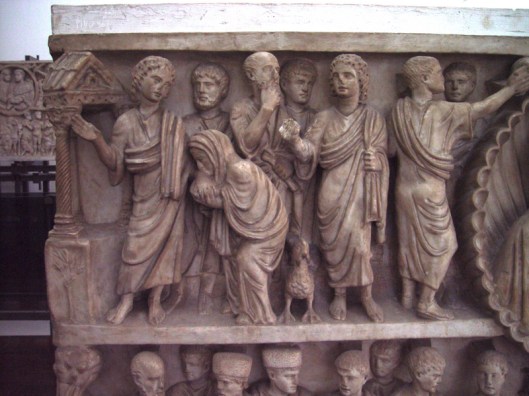
The Sequence for Pentecost Sunday, written by a former reforming Archbishop of Canterbury, Stephen Langton, in the thirteenth century has the petition in one English translation ‘What is rigid, gently bend, what is frozen, warmly tend, straighten what goes erringly’. Thinking of the plight of the woman in today’s Gospel for the tenth Sunday after Trinity those words came to my mind. It is difficult to imagine the depths of affliction which she must have endured. Aside from the premature aging that this curvature of the spine would bring, there was the sheer inability to delight in her surroundings, or even to see where she was going. No doubt her life would have been punctuated with expressions of apology for bumping into other people who either did not see her or want to see her. All of this contributing to her personal diminishment and spiritual deprivation.

bent woman medium

 This scene, part of the fourth century Sarcohphagus of the Two Brothers in Rome, may depict a beardless Christ healing the bent woman.  [ Christ healing the crippled woman who was bent over, from ‘Art in the Christian Tradition’, a project of the Vanderbilt Divinity Library, Nashville, TN. http://diglib.library.vanderbilt.edu/act-imagelink.pl?RC=51253, retrieved August 21, 2019. Original source: Collection of J. Patout Burns and Robin M. Jensen.] 

So the liberation which the Lord brings to this afflicted woman is enormous. But of course there is even more going on here than we see at first sight. Her affliction is a symbol for a profound spiritual illness – one concerned with a lack of vision.

The first reading set for this Sunday from Isaiah follows on from some defining of who is truly to be regarded as part of God’s people, and foremost in this is the requirement to keep the Sabbath. That said, there is an opening up of membership of the religious community to a wider group than before – and this section includes the famous verse quoted by Jesus ‘my house shall be called a house of prayer for all the peoples’ (Isaiah 56.7). But the prophet has also been concerned to attack idolatry, which is of course the refusal to see the reality of things – a failure of vision – and he repeats the need for true justice and right behaviour. In our passage, Isaiah describes what might be a true and just keeping of the Sabbath – ‘If you remove the yoke from among you, the pointing of the finger, the speaking of evil, if you offer your food to the hungry and satisfy the needs of the afflicted, then your light shall rise in the darkness’.

This is the background to Jesus’ confrontation with the leader of the Synagogue. What constitutes a just and right keeping of the Sabbath? Surely, Jesus argues, the removal of the yoke of affliction from this daughter of Abraham who has suffered eighteen years? But Jesus is also aware of the Mishnah’s commentary on Sabbath regulations which affect the use of animals – they may be untied (even the kind of knot to be used is specified) and taken to water on the Sabbath. Which may be why the leader of the Synagogue keeps addressing the crowd, whom he wants to stir up, rather than Jesus himself, whom he recognises as too much of a force to be reckoned with.

The woman in this Gospel story has much to teach us. Her condition left her unable to see properly – just the ground in front of her. Something that she needs to be liberated from.

In Western society today, we are in a similar kind of danger – the danger of limited vision. Populist politicians discourage us from looking further ahead or deeper into the situations which we face. So climate change becomes fake news. Migrants are a problem to be eliminated. International diplomacy becomes a shouting match conducted by Twitter feed. The European Union becomes a costly bureaucratic nightmare to be dissolved away. The Common Good becomes an extravagant fantasy.

All of this is about a limited field of vision. We need the faith and courage to look further ahead and deeper into the complex realities which our world faces, and to pose the difficult questions which we are not always welcomed.

The cure of our idolatrous short-sight brings us back to worship. In the reading from the letter to the Hebrews, we are reminded of the holiness of God – a holiness which must be respected in reverence and awe in our worship. Our God, the writer tells us, is a ‘consuming fire’. Not a spiritual hot water bottle! As we open our eyes to this God in worship, our vision of the here-and-now is changed and enlarged along with our hearts to embrace in, through and with Christ the work of unbinding. A work of that love which is the fire at the centre of all that is, and which enables all of our being and our doing. We are told that the first thing that the healed woman did was to praise God. Such praise, the first task of Sabbath rest, changes literally everything. It restores delight – in surroundings, in other people, in the absolute love of the God of fire. And with the restoration of delight comes a longer view and deeper vision.

Trinity 9: ‘It is time for the Lord to act’

Revd Roxana Tenea Teleman, assistant curate at Holy Trinity, Nice, with St Hugh, Vence (France), reflects on this Sunday’s Gospel reading, Luke 12.49-56, drawing also on the Epistle for this week, Hebrews 11.29-12.2.

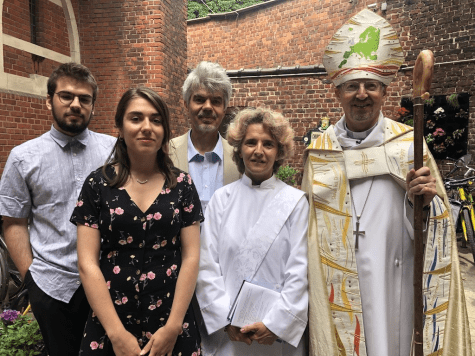
roxana and family ordination

Roxana and her family after her ordination to the diaconate by Bishop Robert Innes on 30 June 2019

My first ‘encounter’ with the Anglican Church, a turning point in my life, happened in Bucharest, just a few months after the fall of Communism in Romania (and in Eastern Europe) – a time of confusion, unrest, deep worries, even angst for some. Emotions ran high, society seemed ablaze, families were worryingly divided. We had been unprepared, the change had taken us by surprise, we had failed to interpret our time.

We could, perhaps, blame the decades of imposed ‘peace’, ‘unity’, uniformity, and one-track thinking that gave us a false sense of security, and lulled our (political) conscience into slumber, anaesthetised our capacity to discern, and nearly extinguished our fire of dreaming of freedom.

Thirty years later, divisiveness seems to have become a leitmotiv in Romania, in the whole of Europe, actually: social unrest, unprecedented political divisions, with feisty debates, with traditionally major parties being dealt strong blows, and unexpected election results, an unwillingness to negotiate or just to listen. We were still unprepared for these, and we are still puzzled. We were well equipped, though, with tools and research teams meant to probe beneath the surface of events, to recognise what is really going on, and what is likely to happen.

‘Why do you not know how to interpret the present time (καιρός, kairos)?’, Jesus Christ asks the crowds. Why do we fail, again and again, to read the signs of the times?

It is, perhaps, because we are so preoccupied with chronos, the continuous linear measurable time, which encapsulates our earthly lives, that we do not recognise the time (kairos) of our Visitation from God (Luke 19.44), when he is acting in our life, in the world?

Or, let us face it, we might be afraid to acknowledge the divine kairos: we are warned that God’s intervention in our human time is disruptive, that it can bring about division and lay bare our soul, with its abyss of fears, inconsistencies and contradictions, before our own eyes and “to the eyes of the one to whom we must render an account” (Hebrews 4.13).

More division? What an unsettling thought! We would so much prefer to avoid conflict and division at all costs, at least, in our families and our churches – these are, surely, the most painful instances of disharmony. Parents and church leaders have the experience and the wisdom that allows them to identify what might disrupt the good (and smooth) conduct of family or church life and peace, don’t they? Should they not build in a firewall to prevent division seeping in? Yet, this fear of disturbances, and of challenges, fear that the shallow peace of suppressed conflicts, questions and choices, of complacency might be disrupted, the ‘fear of fear’, might become the ‘fear of belonging to Another, […] to God’ (T. S. Eliot, Four Quartets), who is intent on leading us through mountains and valleys, when we would rather choose a flat landscape.

Christ, the ‘perfecter of our faith’ (Hebrews 12.2), wants to kindle a fire of purification and refinement, the fire of God’s active presence in the world, that can effect changes by igniting our resistance, the fire of judgement that consumes all unrighteousness, idolatry and injustice.

The Church has been entrusted with Christ’s message of release and transformation, which is bound to be divisive – why do we try to ‘tame’ it? There is no mildness or promise of instant gratification and happiness in it (as ‘Good News’, which very often is used for ‘Gospel’ nowadays, may sound), but the announcement of powerful, life-changing events, of the ‘consuming fire”’ (Hebrews 12.29) of God’s Visitation.

In some Eastern Churches, before the Divine Liturgy begins, it is the deacon’s task to remind the priest that ‘It is time (kairos) for the Lord to act’ (Psalm 119.126). The liturgy, even if, etymologically, it means ‘the action of the people’, is, indeed, the place where God makes irruption into our churches, into our life, with the fire of his Word, that is ‘living and acting, sharper than any two-edged sword, piercing until it divides soul from spirit, joints from marrow’ (Hebrews 4.12), with the gift of His peace ‘which passes all understanding’ (Philippians 4.7) and with the radical inclusiveness of the invitation to his table. With this renewed awareness of and opening to God’s presence with us, we could ‘run with perseverance the race that is set before us’ (Hebrews 12.1).


Trinity 8: Glad to be Unhappy

Revd Richard Bromley, Mission Director of ICS (Intercontinental Church Society), explores this week’s lectionary epistle, Hebrews 11.1-3, 8-16.

To get the best from this lectionary reflection you might want to follow this link, to Watersky by Jeff Johnson and Phil Keaggy and allow it to play as you read. 

On a visit to Amsterdam, my daughter and I went to the Van Gogh museum to see a new exhibition.  Of course, the centre piece was his ‘Starry Night’, painted in the asylum in St Remy in 1889.  Van Gogh wrote at that time that he often felt the night to be ‘more richly coloured than the day’.  Unable to go outside at night he painted the Starry Night from memory.  We had to buy a print that now takes pride of place on the wall of my lounge.

1280px-Van_Gogh_-_Starry_Night_-_Google_Art_Project

Vincent Van Gogh: The Starry Night

The writer of Hebrews, having written of Christ and his work has moved to our response and now, reaching his peak in chapter 11, pronounces: ‘Now faith is confidence in what we hope for and assurance about what we do not see’.  He goes on to develop what this faith looks and feels like.

By faith we have confidence in his invisible hand at work (11.3), all is not chaos, however the news reads, family life feels or the latest development on Brexit looks.

By faith we obey the call to go, even though we realise later we did not really know where we were going or what it would be like when we got there.  If we had known, we may not have left.  But this is what it means to be a pilgrim (11.4).

By faith we make our homes in other lands, realising this world is not our home.  We find ourselves integrating into and forming community, making friends, working, playing and serving.  We seek the good for our host countries, they become ‘our home’ because God has brought us here (11.9).

The Daily Telegraph’s Helen Brown commenting on Van Gogh’s ‘Starry Night’ explains how the painting ‘maintains an electric tension between ecstasy and melancholy’.  It is wonderful, but at the same time is dreadful.  Don McLean wrote of the painting ‘It makes you glad to be unhappy,’

This time of year, in chaplaincy life there is a sense of the ecstasy and melancholy.  It is the summer holidays, we go places, see family and have time to pick up a book or paint a picture.  It is also the time some of our friends have packed their bags and returned home or to their next assignment, being less confident where home really is.  We are aware of people returning for family, for work, or for financial reasons.  We know people moving on as the journey leads them somewhere else.  We know people delighted to leave, others with a torn heart.

In Cyprus, where we lived for a time, we marked this time of year with our church young people.  On the last evening they were all to be together we took them to the beach in Larnaca, we played games and laughed in the evening sun.  As the sun went down and the stars came out, we sat in a line with our feet in the sea, lapping at our toes.  I read them today’s lectionary reading from Hebrews 11, emphasising v 12 and 13, ‘And so from this one man, and he as good as dead, came descendants as numerous as the stars in the sky and as countless as the sand on the seashore.  All these people were still living by faith when they died. They did not receive the things promised; they only saw them and welcomed them from a distance, admitting that they were foreigners and strangers on earth.

God had brought us together and then scattered us.  It is a painful experience, especially for the Chaplain, who ‘starts again’ every year in a way not normal in an English parish.  But these stars are sent out, we as chaplains and chaplaincies rarely get to see the impact we have had.  The faith which we have created and the space to grow and develop in, the changes that are wrought in people’s lives in their time with us.

Occasionally a well-known person (Archbishop Justin) appears who was nurtured in one of our chaplaincies, but there are, like the stars in the sky, people who have been impacted, developed, grown in faith in chaplaincies who we will never really know about it until we get to that better country spoken of in verse 16, where God greets us in the place he has prepared for us.


Trinity 7 : The Would-be Rich Fool


Hector Davie draws on all three lectionary readings (Ecclesiastes 1.2, 12-14; 2.18-23; Colossians 3.1-11;  Luke 12.13-21) for this week’s blog.

Every year the newspapers here report the results of the various quality-of-life polls, and the Swiss scan them with enthusiasm. Have we been beaten by the Norwegians? Whatever are the Irish and the Icelanders doing there in the top ten? If we are not up near the top of the chart, the pollsters must surely be measuring the wrong things.

There is a strongly-held belief that material wealth is the main basis for a high standard of living, and the differences in wealth between countries, even within Europe, give rise to the idea that some nations are more developed than others. This is not a Christian view. We are not here for the money. It is easier, says Jesus, for a camel to pass through the eye of a needle than for the rich to enter heaven. Even if Chesterton’s comment is true, that ‘modern manufacture has been really occupied in trying to produce an abnormally large needle (and) biologists have been chiefly anxious to discover a very small camel’, serving Mammon doesn’t mix with serving God.511px-Dortmund,_Bonifatius-Kirche,_Eingang_West

Sculpture of the camel going through the eye of a needle in St Boniface Church, Dortmund.(Mathias Bigge [CC BY-SA 3.0 (http://creativecommons.org/licenses/by-sa/3.0/)%5D)

Indeed the Gospel may well be far more radical than we are willing to accept. Perhaps we should take our cue from the lilies of the field, cancel our insurance policies, cash in our pension funds and give the proceeds to the poor? Or is this just an example of Semitic thought, of seeing things in terms of black and white? Is the real message perhaps the same as that of the Lord’s Prayer – ‘Seek first God’s kingdom and God’s righteousness, and all these things shall be yours as well.’?

The Reformers held equally radical views about wealth, but tempered them with their own thoughts about work. With the right ethic, as Max Weber famously pointed out, work can easily generate wealth and it is interesting that the three cities most associated with Swiss wealth are Zurich, Basle and Geneva – the cities of Zwingli, Erasmus and Calvin.

Our Gospel reading today, however, is not about work or wages. The voice from the crowd has not been working. The money in question comes from an inheritance. The brother refuses to share it. Surely that can’t be right. As with any domestic dispute, it was the done thing to go and ask the rabbi, and it was expected that the rabbi would decide the claim.

But Jesus, as often, does not give a direct answer. Instead, he tells a parable about a rich man and his crops – his life savings. The rich man’s response to wealth is simple: build a bigger barn and sit back, eat, drink and have fun. We’ve heard the story before (not least from Ecclesiastes!) Ecclesiastes does not condemn the merry-making – it is merely rather pointless, like most worldly things. The prophet who condemns it is Isaiah, and in quite a different context.

In Isaiah 22, Jerusalem is under siege, perhaps by Sennacherib, but after Judah is defeated the siege is lifted. The prophet calls for sackcloth and ashes, But the inhabitants use the opportunity to fortify the city wall, and then give themselves over to joy and festivity, eating and drinking. How mixed-up can their priorities be! They rejoice at their good fortune; but they neglect the God who guides their destiny.

This is the nub of Jesus’ reply. Why does the disgruntled figure from the crowd want the share of the inheritance? If you or I had Jesus in person in our midst – and we do – what would we do? Listen to his teaching? Seek his healing touch? Or pester him to take sides in a family dispute? The New Testament is full of advice on how to deal with disputes, but the underlying message is that disputes have no place in the powerful love of the redeemed community

So, as today’s epistle bids us, let us set our minds on things that are above, not on the earth. Not in the expectation that God will bless us materially, as God blessed Solomon in 1 Kings 3.13, or that we can lead a toil-free lily-like existence, for God does not work that way. Yet even if we repeatedly forget God, there is one reading today, from Hosea 11, that reminds us of anther truth – no matter how far we stray, now matter how far we neglect the things that are above, God never ceases loving us.

Many years ago, Hector Davie took advantage of the Church of England’s willingness ‘to pay to train a layman.’ He is a member of the congregation of St Ursula’s Church in Berne and tries to contribute regularly to communication within the parish and beyond.

Trinity 6: Prayer in a Europe of many languages

This week’s lectionary reflection is written by Dr Clare Amos, Diocesan Director of Lay Discipleship and administrator of this blog.

One of the ‘traditions’ at the World Council of Churches, where I worked for seven years, is that whenever the Lord’s Prayer is said, whether in the offices in Geneva or in a meeting in another part of the world, people are asked to say the prayer in their own language. It is a tradition that I have grown to appreciate very much. It requires sensitivity on the part of the leader of worship – once having started off the prayer they need to drop their voices. It also often requires sensitivity on the part of the congregation, because it many contexts it would be very easy for English speakers to dominate, and to drown out the rest of the worshippers. But done well – as it generally is in World Council of Churches circles – it is a powerful and moving affirmation of the quest for unity in diversity, the spirit which undergirds the ecumenical movement.

I believe that this practice also happens at a number of the chaplaincies in our Diocese in Europe, in which, even if English is the ‘common tongue’ of worship, there are many members of our congregations whose mother language is different. It does potentially say something important about the relationship of our churches and chaplaincies as both ‘guests and hosts’ in the contexts in which we minister. When we took the group of our diocesan 2018-2019 ministry experience scheme interns to the Holy Land last November one site that they all seemed especially to enjoy visiting was the Church of the Pater Noster, the church on the Mount of Olives where the Lord’s Prayer is displayed in well over a hundred different languages. One of our group who himself came originally from Cornwall was very impressed to discover a plaque with the Prayer written in Cornish!

pater-noster-2

Some of the versions of the Lord’s Prayer on display at the Church of the Pater Noster in Jerusalem.

The Lord’s Prayer – in the shorter version that it is found in the Gospel of Luke (Luke 11.2-4) is the core of the lectionary Gospel for this coming Sunday. The Gospel then continues (verses 5-13) to tease out the meaning of prayer from this initial starting point, and it is significant that it ends – as it has also effectively begun – with a reference to God as our heavenly Father.

For one thing that is fundamental about the Lord’s Prayer is its starting point. It does not begin with confession of our sins, or indeed with prayers of intercession and need for ourselves or others. Rather it starts with the affirmation that God is our Father – and offers praise to God’s name. So it is a prayer grounded in thanksgiving for and assurance of our existing relationship with God, rather than a prayer that seeks to create such a relationship. That is a vital principle for Christian prayer. The classic book that has most influenced my own understanding of prayer – J Neville Ward, The Use of Praying, makes the point eloquently that prayer needs to begin with thanksgiving and praise – and the other dimensions of prayer flow out of that. That is also the modern Anglican understanding of the Eucharist (a word which itself means ‘thanksgiving’). The ‘Gloria’ is now set as the first element of the service (not the last – which is where Cranmer placed it). We are all – in our unity and our diversity – beloved children of God and that needs to be the primary principle undergirding our relationship with God – and with each other.

It is often and truly said that the Gospel of Luke gives a particular importance to prayer and its essential role in the life and ministry of Jesus. So the point – here – when Jesus teaches his disciples to emulate him in prayer seems to be of particular importance. It is noteworthy that it comes immediately after two important passages (which have provided the lectionary Gospel readings for the previous two weeks). The first of these is the parable of the Good Samaritan (Luke 10.29-37) and the second is Jesus’ supper at Bethany with Martha and Mary when Jesus’ commended Mary for her listening to him (Luke 10.38-42). It is possible to see these two passages as expressing the dual focus of Jesus’ ministry – both the need for practical compassion and action for others, and the need for quiet listening to the word of God. Can we suggest that placing the teaching of the Lord’s Prayer at this point is therefore intended to reinforce the wisdom that prayer and action belong together – and action, whether on behalf of ourselves or others needs to be rooted in prayer and our family relationship to God?

It is also interesting to explore both how the different petitions of the Lord’s Prayer seem to be exemplified in the later teaching of Jesus in this Gospel (especially chapters 15-17), and then are hinted at during the passion of Jesus as portrayed by Luke. Remembering TS Eliot’s line about ‘where prayer has been valid’, we can say that in the Gospel of Luke lives out and validates his own prayer through his life and his sacrificial death.